


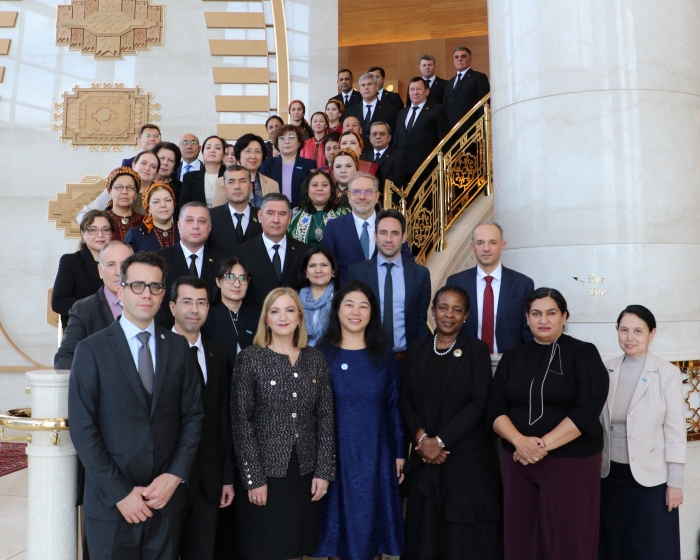
Ashgabat, 18 November 2026 – A High-Level Policy Dialogue on Universal Health Coverage, titled “Primary Health Care, Health Workforce and Health Financing: A Shared View of Where We Stand,” took place on 16–17 November in Ashgabat.
The roundtable was organized by the Ministry of Health and Medical Industry of Turkmenistan, WHO, UNICEF, UNFPA, UNDP and the Office of the UN Resident Coordinator, bringing together representatives of ministries, the State Committee on Statistics, the Mejlis Committee on Social Policy, medical education institutions and UN agencies for a closed, informal working discussion on joint efforts to advance quality, accessible and affordable health services. The dialogue aimed to build a shared understanding of the country’s progress in primary health care, the health workforce and health financing, drawing on available evidence and national experience.
The Policy Dialogue was the sixth dialogue convened under the United Nations Sustainable Development Cooperation Framework for Turkmenistan (2026–2030). It built on the findings of the 2025 health system assessment and followed the International Conference on Universal Health Coverage and the Sustainable Development Goals in the CIS, held in October 2026, where the Awaza Declaration was adopted.
The discussions were moderated by Dr. Natasha Azzopardi Muscat, Director of Health System Department in the WHO Europe. In her opening remarks, she highlighted the opportunity to use the findings of the 2025 assessment to identify practical next steps for Turkmenistan, drawing on the experience of other countries in the WHO European Region. Dr. Guillaume Dedet, WHO Representative in Turkmenistan, emphasized the importance of continued cooperation between national institutions and UN partners to advance this work. He also noted that Turkmenistan’s forthcoming chairmanship of the Group of Landlocked Developing Countries in 2027 provides an opportunity to exchange experiences and learn from countries pursuing innovative approaches to universal health coverage.
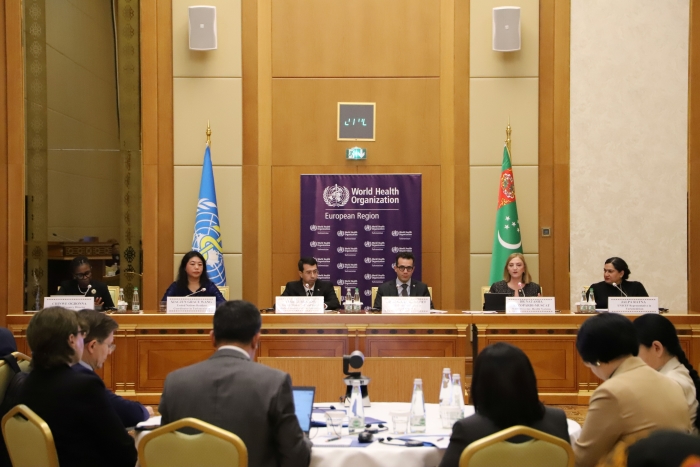
In their opening remarks, Deputy Minister of Health and Medical Industry of Turkmenistan Mr. Sapar Gurbanov and UN Resident Coordinator in Turkmenistan Ms. Xiaojun Grace Wang emphasized the importance of a multisectoral, people-centred health system that brings together strong primary health care, a qualified health workforce and sustainable health financing.
From UNICEF perspective, Ms. Jalpa Ratna, UNICEF Representative in Turkmenistan, noted:
“Ultimately, the success of our national programmes, reforms and investments will be measured by the confidence families have in the services available to them, and by the difference these make in the lives of their children.”
Ms. Chinwe Ogbonna, UNFPA Representative in Kazakhstan and Country Director for Kyrgyzstan and Turkmenistan, emphasized the importance of integrating sexual and reproductive health services into all aspects of the Universal Health Coverage framework, supported by disaggregated demographic data and evidence to inform people-centred policies, services and financing.
“Sexual and Reproductive Health services needed by the population are essential parts of healthcare services delivered across the health system. This is firmly grounded in the Programme of Action of the International Conference on Population and Development and SDG 3 and 5. UNFPA will continue to support the generation of disaggregated demographic data and evidence for inclusive, agile policy advice that ensures tailored, high-impact, people-centred services are integrated into the Universal Health Coverage benefit package, differentiated delivery mechanisms and strengthened financing arrangements that offer financial risk protection,” said Ms. Ogbonna.
Implementation of the Awaza Declaration on Universal Health Coverage and the Sustainable Development Goals in the CIS region, adopted on 7 October, was a recurring theme throughout the dialogue, providing a framework for discussions on the current status of Universal Health Coverage in Turkmenistan and the milestones to be achieved through continued collaboration.
“Our ultimate goal is to ensure that everyone can receive quality health care when they need it, wherever they live, without financial hardship,” said Ms. Wang. She invited participants to view the health system through the eyes of those who rely on it every day: a mother in a remote community who needs regular access to medicines, an older person managing a chronic illness, or a health worker striving to provide quality care close to home.
During the meeting, participants reviewed Turkmenistan’s progress towards achieving national SDG 3 targets. Mr. Uladzimir Valetka, Economist at the UN Resident Coordinator’s Office, noted that continued improvements in SDG statistics, high coverage of skilled care at birth and immunization, and reductions in child mortality and tuberculosis incidence demonstrate meaningful progress. He emphasized that strengthening primary health care, supported by sustainable financing and financial protection mechanisms, is essential to ensuring timely, quality care close to home without placing excessive pressure on household budgets. Particular attention, he noted, should be given to low-income families, remote communities, children and adolescents, and people requiring ongoing treatment, with resources aligned to their needs and barriers to access addressed. He proposed focusing future discussions on how stronger, sustainably financed primary health care systems can improve quality and reduce geographical and social disparities in access.
Over two days and eight sessions, national partners, WHO and UNICEF presented evidence from Turkmenistan and shared experiences from across the WHO European Region. Participants reviewed progress towards the health-related Sustainable Development Goals and implementation of the National Primary Health Care Roadmap. They discussed digital health, the size and age profile of the health workforce, and the training of family doctors and nurses. Sessions also covered care for children and families, including the Integrated Management of Childhood Illness strategy and the WHO Pocket Book of Primary Health Care for Children and Adolescents, as well as health financing, with a focus on out-of-pocket payments and health expenditure tracking.
Each session centred on three guiding questions: What does the available evidence show? What does it mean for people seeking primary health care, particularly children and families? And what do we still need to know? The discussions that followed helped identify priorities for follow-up and areas where further analysis is needed.
The dialogue concluded with renewed commitments to advancing the National Primary Health Care Roadmap, conducting further studies, including on labour market prospects for medical personnel, and exploring sustainable health financing options to accelerate progress towards the Sustainable Development Goals, with a focus on the most vulnerable populations. As a next step, WHO will consolidate the experts’ findings and share a summary with the Ministry of Health and Medical Industry, reflecting the priorities identified during the dialogue. WHO and its UN partners will continue working closely with the Ministry and other relevant national institutions to implement the roadmap, strengthen the health workforce, enhance the use of digital tools and data for decision-making, and identify practical financing solutions to support high-quality primary health care services for all.
The roundtable aligns with Turkmenistan’s commitments under the United Nations Sustainable Development Cooperation Framework (2026–2030) and contributes to the achievement of SDG 3 on ensuring healthy lives and promoting well-being for all at all ages. The United Nations reaffirmed its commitment to supporting Turkmenistan in the policy decisions ahead through continued technical assistance, partnership and evidence-based dialogue. ///nCa, 19 November 2026 (in cooperation with UN Turkmenistan)