


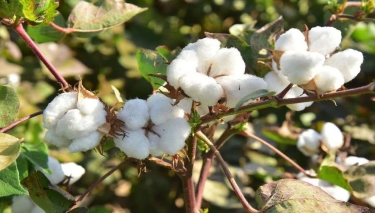
Turkmenistan is continuing to renew its cotton varieties. Scientists at the Cotton Research Institute of the Ministry of Agriculture have presented new medium-staple and extra-long-staple varieties. Some of them have completed several years of trials and been passed to the State Variety Testing Network. The new breeding lines stand out for yield, ginning outturn (fiber content) and fiber quality, and are adapted to the soil and climate conditions of the country’s different regions.
Between 2022 and 2025, four new extra-long-staple cotton varieties developed by the institute took part in competitive variety trials. Two of them, Li-7505 and Li-14046, were submitted to the State Variety Testing Network for further study and eventual registration as breeding achievements. Both varieties showed a fiber outturn of around 30%, as well as good technological characteristics, including fiber length, strength and breaking load.
Another promising result came from medium-staple cotton breeding. The Li-7079 variety successfully completed three years of competitive trials and has also been passed to the State Variety Testing Network. Its fiber outturn was 35.3%, 1.1 percentage points above the standard. Its yield advantage reached 0.9 centners per hectare, and its pre-frost harvest of raw cotton was 2.2 centners per hectare higher.
The next stage is multiplication on seed-growing farms, followed by use by cotton-growing enterprises.
Breeding work is also under way at the institute’s provincial branches, which makes it possible to develop varieties suited to the country’s different soil and climate conditions.
The Dashoguz branch of the institute has developed two new varieties, Daşoguz-11 and Daşoguz-12. Their seeds and the necessary documentation have already been submitted to the relevant Ministry of Agriculture body for variety testing. According to preliminary data, the new lines have improved yield, fiber outturn and fiber quality, and are intended for conditions in the north of the country.
At the Ahal branch, breeders have presented two new medium-staple varieties, Ahal-8 and Ahal-9.
The main aim of the breeding work is not only to raise yields but also to replace varieties regularly, retiring aging ones in favor of new varieties with better agronomic and technological traits. Scientists’ priorities include cotton that tolerates temperature swings, difficult soils and moderately saline irrigation water, and that is adapted to local growing conditions.
Turkmenistan grows mainly two botanical species of cotton: medium-staple Gossypium hirsutum and extra-long-staple Gossypium barbadense. The first matures earlier and gives a high fiber outturn. The second matures later but yields fiber with excellent technological properties. Well-known zoned varieties include Ýolöten-7, Daşoguz-120, Daşoguz-114, Ýolöten-39 and Aş-140. ///nCa, 17 November 2026 (based on material from the newspaper “Neutral Turkmenistan”)