


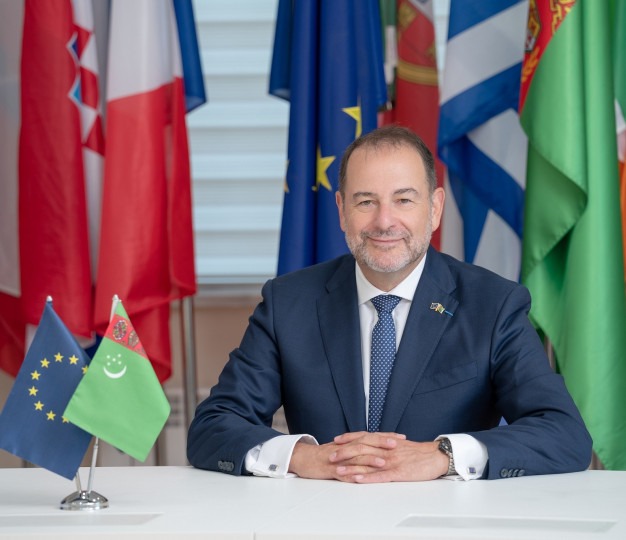
Ambassador Luc Pierre Devigne is a senior European diplomat with three decades of experience in international trade, bilateral negotiations, and Eurasian affairs. He took over as the head of the Delegation of the European Union to Turkmenistan on 1st September 2026.
With a master’s degree in economic law (LL.M), he joined the EC in 1996 and has served in various management positions in the EU structure. These include, 1) in DG Trade of the European Commission : Head of Unit responsible for intellectual property and public procurement, and bilateral trade relations across Eastern Europe and Eurasia (including Chief Negotiator for major trade agreements such as DCFTAs with European Neighbourhood and EPCAs with Central Asia), and 2) in the EEAS (European External Action Service – the EU diplomatic service) Deputy Managing Director for Russia, Eastern Partnership, Central Asia, Regional Cooperation and OSCE at the EEAS headquarters in Brussels.
Prior to entering European public service, he worked in corporate finance and M&A investment banking, leading international negotiations across the United States, Brazil, China, and Japan.
Here is the text of his interview with nCa:
nCa: Ambassador, you recently presented your credentials to the President. How do you see Turkmenistan’s place in the EU’s Global Gateway strategy?
LD: Thank you. Turkmenistan is an essential partner for Global Gateway, not a peripheral one. The EU’s engagement with Turkmenistan is carried out within the framework of the 2019 EU Strategy for Central Asia – and of our flagship Global Gateway initiative.
Global Gateway is not just about building infrastructure – it’s about building sustainable, trusted connections in transport, energy, digital, and people-to-people. We very much look forward to the Global Gateway Summit in Brussels (in June 2027).
At the 2025 1st EU-Central Asia Summit in Samarkand, President von der Leyen announced €12 billion in Global Gateway financing for the region.
Turkmenistan is a key part of this package. We hope the investment conditions will soon evolve to align with the expectations of the institutional investors to make the optimum use of this facility.
Thanks to its location between the Caspian and the East and its energy resources, Turkmenistan is a natural bridge for us.
nCa: EU-TM trade turnover is almost €1.3 billion – the EU is Turkmenistan’s 4th largest trading partner. The legal base for the mutual cooperation will likely depend on the ratification of the PCA from 1998. Does that limit EU-Turkmenistan cooperation prospects on the Global Gateway and beyond?
LD: You are right, relations with Turkmenistan are since 2010 governed by an interim Agreement on Trade and Trade-related Matters. By contrast, as you know, since 2016, the EU and its Member States successfully negotiated Enhanced Partnership and Cooperation Agreements (EPCAs) with Kazakhstan, Kyrgyzstan, Uzbekistan and Tajikistan.
However, this situation does not stop us from cooperating with Turkmenistan. Despite its status as an “upper middle income” country, which normally prevents us from allocating bilateral support, we did include an envelope for our bilateral cooperation, and we work on numerous practical projects. For example, in the area of trade and economic integration, we very much support the accession of Turkmenistan to the WTO, which would send a positive signal to international trade and investors, and help developing our bilateral relations. In March 2026, we also organised the first EU-Turkmenistan Business Forum, and we hope to continue this practice. But clearly, an EPCA would provide investors with more predictable and transparent rules. It is a priority I will work on – to translate our shared interests into strengthened political and economic cooperation.
nCa: What is Turkmenistan’s specific role in the Trans-Caspian Transport Corridor – the Middle Corridor?
LD: This is a flagship for us. The EU has identified the Trans-Caspian Transport Corridor as a key route for developing transport links between Europe and Central Asia. The corridor connects Central Asia with the South Caucasus and Europe through the Caspian Sea, with Turkmenbashi International Sea Port as a key hub.
I highlighted this at the TIF 2026 on 1st October. Trade on the corridor has already quadrupled since 2022. Now we need to make it cheaper and to achieve that, to make it faster and (more) digital. Railway modernisation, a field of EU expertise, is a major contributing factor. This year, the European Commission published a study identifying key infrastructure investment needs along the route (in the field of transportation, trade, energy and digital connections). Now, we need to move forward on this basis. We hope that a Framework Agreement between the European Investment Bank and Turkmenistan will soon be concluded; this will boost our joint investment agenda.
nCa: Beyond transport, where do you see Global Gateway investment in other infrastructure sectors such as energy?
LD: I see two tracks here. First, we have our energy cooperation (we have a Memorandum of Understanding with Turkmenistan since 2008). We now focus on methane emissions reductions, efficiency, and diversification of transit routes. Second, we want to develop the energy of the future: green energy. Clearly, Turkmenistan’s potential in renewable energy (solar, wind, hydrogen) offers several opportunities for future EU investments. We already implement (with Germany) our project “EU for a Green Turkmenistan“, focusing on climate policy, renewable energy, energy efficiency, and methane emissions’ reduction.
nCa: Turkmenistan has the 4th largest gas reserves in the world. Is there still a discussion about bringing Turkmen gas to Europe via the Caspian?
LD: Yes, the conversation is always there. We note that the political circumstances around the Trans-Caspian are evolving, and we remain ready to examine any sound project meeting our standards and capable of attracting private investment.
nCa: How is Turkmenistan involved in the other Global Gateway pillars – digital and education?
LD: We are supporting digitalisation of customs and trade facilitation – crucial factors for the Trans-Caspian Corridor to work. Through its Trans-Caspian Transport Programme, the EU, which has 70 years experience in facilitating cross-border trade, supports the approximation and digitalisation of cross-border procedures.
As for education: the EU is Turkmenistan’s partner for Erasmus+, Horizon Europe, youth exchanges, and vocational training. The recent high level regional (with the five Central Asia partners) DARYA meeting hosted by Turkmenistan connected the topics of professional training and Trans-Caspian connectivity. Global Gateway is ultimately about people. If we improve connectivity, but don’t invest in people – we will miss the point.
nCa: What are the main obstacles you see for EU investors in Turkmenistan?
LD: I am always honest with our Turkmen partners: predictability, clarity, and connectivity are key. This means that EU investors need clear rules for trade, currency convertibility, and reliable logistics (including Internet connections which are fast and easy to access). That is why we support trade facilitation and harmonising standards with international (WTO) and EU practices. I believe that Turkmenistan is genuinely interested in intensifying our cooperation in this regard.
nCa: A final question: What would success look like for you at the end of your mandate?
LD: Three concrete areas come to my mind:
- An improved legal framework (including WTO membership and an Enhanced Partnership and Cooperation Agreement) so that EU-Turkmenistan relations benefit from the modern, comprehensive legal basis which they deserve.
- An improved Trans-Caspian Transport Corridor, so that the trains cross Turkmenistan twice faster and use fully digitalised infrastructure, with EU support.
- Major investments in renewable energy with EU technologies and methane emissions reduced in line with the Global Methane Pledge undersigned by Turkmenistan.
The potential for closer EU–Turkmenistan cooperation is considerable.
My team and I look forward to working with our Turkmen partners in mutual respect to strengthen our relationship and turn shared ambitions into concrete achievements. /// nCa, 10 November 2026