


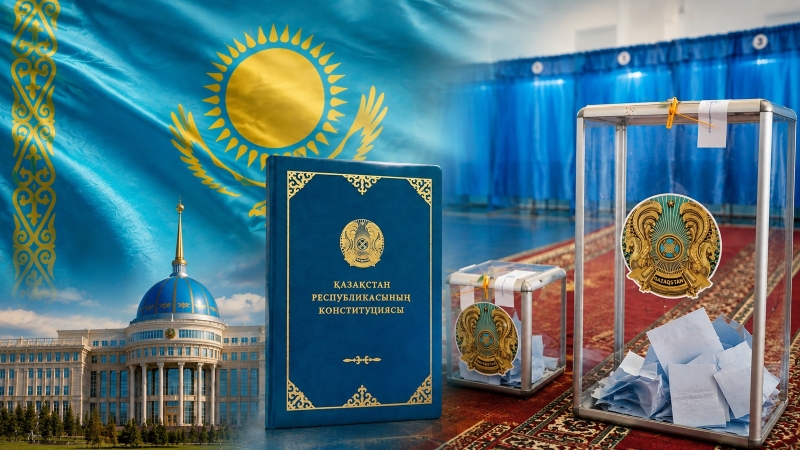
1. Kurultai as a new stage of constitutional modernization of Kazakhstan
The upcoming Kurultai elections should be viewed as a key stage in Kazakhstan’s political and legal transformation. Their significance extends beyond a typical parliamentary campaign: they mark the practical launch of a new constitutional model, which will update the system of representative power, clarify the logic of parliamentary accountability, and establish a new legislative mandate.
The political significance of the upcoming elections is heightened by the fact that they are expected to involve registered political parties representing various social and programmatic agendas.
Potential campaign participants include the AMANAT party, the Ak Zhol Democratic Party of Kazakhstan, the People’s Party of Kazakhstan, the Auyl People’s Democratic Patriotic Party, the National Social Democratic Party, the Respublica party, and the Baitak Green Party of Kazakhstan.
Of particular note is the emergence of the Adilet party, whose participation in the electoral process will be contingent on completing the procedures established by law.
The final list of election participants will be determined after the official nomination and registration of party lists, but it is already clear that the Kurultai elections will serve not only as an institutional but also as a party-political test for the updated system.
For an international audience, the Kazakh process is important primarily for its procedural consistency. The new Constitution was adopted through a national referendum, after which the state began legislatively formalizing the new institutions and preparing for elections to a renewed representative body. This logic demonstrates that reform is not limited to political statements, but rather proceeds through constitutional procedures, legal mechanisms, and institutional continuity.
2. Constitutional mandate and legal continuity
The adoption of the new Constitution was not the end, but the beginning of a new stage in state development. Its significance is revealed precisely through its subsequent implementation: the creation of a new parliamentary structure, the adoption of relevant legislation, the establishment of rules for political representation, and the holding of elections to the Kurultai.
This is the fundamental meaning of the reform. Kazakhstan demonstrates that political modernization can be achieved through the rule of law rather than institutional disruption. The process begins with a constitutional mandate, moves to legal codification, and concludes with the practical implementation of new norms.
For external partners, this is an important signal: the state is striving to update the political system within the framework of legal continuity, not through ad hoc or extra-procedural decisions.
This approach is particularly significant in today’s international environment, where a state’s resilience is assessed not only by economic indicators but also by its ability to implement complex political changes without undermining institutional stability. In this sense, Kazakhstan’s reform demonstrates an attempt to combine renewal with predictability, and political change with a legally established order.
3. Institutional meaning of the upcoming elections
The Kurultai elections are a practical continuation of the constitutional reform. Their purpose is not only to renew the composition of the legislative body but also to launch a new model of parliamentary accountability. Through these elections, the provisions of the new Constitution are transferred from legal text to actual state practice.
The Kurultai must become the highest representative body exercising legislative power. Its formation signifies a transition to a new parliamentary architecture, where representative power becomes more compact, institutionally defined, and politically understandable.
For an international audience, it is important to emphasize that this is not simply a change in the name of parliament, but the creation of a new mechanism through which public mandates, party programs, and the state agenda will be translated into legislative decisions.
This is why the upcoming elections are significant not only for Kazakhstan’s domestic politics. They are also a test of the country’s ability to transform constitutional reform into a functioning institution.
The key question is not whether reform has been announced, but how effectively the new constitutional framework will deliver more accountable, consistent and predictable governance.
4. Political representation and party participation
The upcoming campaign will be significant not only for the state but also for the party system. Political parties’ participation in forming the Kurultai increases their accountability to society. Political forces must present not just lists of candidates, but substantive programs, professional teams, and a clear vision for the country’s development.
In this sense, elections become a test of the maturity of party representation. Parties are expected to compete not only through slogans but also through the quality of their platforms, the competence of their candidates, their management skills, and their willingness to take responsibility for future legislative decisions. This shifts political competition to a more institutional level.
This aspect is particularly important for international observers. A strong party system is formed not only through participation in elections, but also through the ability of parties to translate public demands into legislative initiatives. If the Kurultai becomes a platform for such work, the reform will achieve not only formal but also substantive results.
5. Formation of a new legislative mandate
Voters will determine the composition of the new representative body, which will operate under the amended Constitution.
This means that the future Kurultai will receive not only electoral legitimacy but also a special political function: becoming the first parliamentary institution of the new constitutional cycle.
The significance of the elections lies not only in the distribution of parliamentary seats. They must demonstrate how the new constitutional model will work in practice: how the legislative process, parliamentary oversight, interaction between the branches of government, and the accountability of political forces to society will be structured.
The new legislative mandate is also important from the standpoint of the quality of public administration. The parliamentary system must ensure not only the adoption of laws but also public debate on government decisions, oversight of budget execution, participation in personnel procedures, and institutional balance between various elements of government. In this sense, the Kurultai becomes one of the key mechanisms for implementing the new Constitution.
6. Kazakhstan model of legal modernization
It’s important to look at Kazakhstan not as a state conducting a one-off political campaign, but as a country pursuing modernization through legal processes. This is the main international meaning of the reform.
A rule of law is manifested not only in the presence of a Constitution, but also in how the state implements its provisions: through public procedures, legislative frameworks, electoral mechanisms, and institutional continuity.
This clarification is especially important for external audiences. International partners evaluate political systems not only by declarations but also by the sequence of actions.
In Kazakhstan’s case, this sequence is precisely evident: a referendum, the adoption of a new constitutional framework, the legislative formalization of the Kurultai, and the preparation of elections. This allows the country to speak of reform as a structured legal process.
For investors, international organizations, the diplomatic community, and think tanks, institutional predictability has intrinsic value. A state that implements reforms within the framework of the Constitution and the law creates a more stable environment for political dialogue, economic planning, and international cooperation.
7. Expected institutional effects
The positive impact of the reform should be assessed not only through the formal change in the parliamentary structure. More important are the institutional results: increased clarity of the political system, greater party accountability, renewed representation, expanded parliamentary oversight, and the creation of a more direct link between the electoral mandate and the legislative branch.
The transition to a new parliamentary model could make the legislative process more transparent and manageable. At the same time, it raises the bar for the quality of parties, deputies, and parliamentary work in general.
While the previous system was perceived as more complex in terms of the distribution of responsibility, the new structure should make political accountability more visible to society.
Furthermore, the Kurultai elections create an opportunity to renew the political class, expand professional representation, and integrate new public, regional, and expert groups into legislative work. This is especially important for the state, which seeks to strengthen trust in institutions and demonstrate that constitutional reform has practical, rather than symbolic, significance.
In the long term, the success of the reform will depend on the extent to which the new representative body can become not only a formal institution but also a platform for legislative modernization, parliamentary oversight, and substantive political competition. This is where the main test of the new constitutional model will take place.
Conclusion
The upcoming Kurultai elections will be the first major test for Kazakhstan’s updated political and legal system. They will demonstrate how consistently the country can implement adopted reforms, translate public mandates into functioning institutions, and establish a political system based on legal continuity.
The international significance of this process lies in the fact that Kazakhstan is demonstrating a model of modernization through the Constitution, law, and institutional accountability.
The new Constitution was adopted not for the sake of a symbolic update of political language, but as a foundation for reformatting representative power and improving the quality of public administration.
This is why the Kurultai elections should be viewed as more than just an internal political event. They are an indicator of how the state is transforming constitutional reform into practice and legal mandates into sustainable institutions.
For Kazakhstan, this is an opportunity to confirm that the new Constitution is not a mere declaration, but a working tool for institutional development. ///nCa, 4 August 2026