


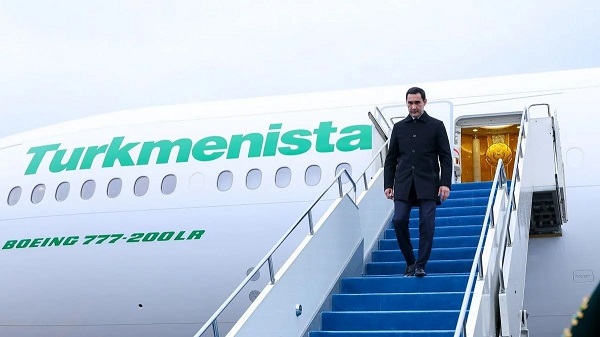
President Serdar Berdimuhamedov arrived in Astana on April 21 for a working visit that places environmental diplomacy and regional cooperation at the forefront of Central Asia’s agenda.
He is in Kazakhstan to take part in two key events: the Regional Environmental Summit and a meeting of the Council of Heads of State of the International Fund for Saving the Aral Sea—a body that has become central to coordinating efforts to address one of the region’s most pressing ecological crises.
At the airport, Berdimuhamedov was received by Kazakhstan’s Prime Minister Olzhas Bektenov, underscoring the importance Astana attaches to the visit. Kazakh media reports indicate that the summit has brought together leaders and senior officials from across Central Asia, along with representatives of international organizations, to focus on joint responses to climate change, water scarcity, and land degradation.
The Regional Environmental Summit is expected to serve as a platform for aligning national policies with broader regional strategies. Discussions are likely to center on the rehabilitation of the Aral Sea basin, sustainable water management, and the expansion of green energy and climate-resilient infrastructure.
Kazakhstan has positioned the gathering as an opportunity to deepen cooperation not only within Central Asia but also with global institutions engaged in environmental protection.
A major highlight of Berdimuhamedov’s visit will be his participation in the IFAS summit, where heads of state are set to review ongoing projects and outline future priorities. According to Kazakh sources, the meeting will assess progress in improving environmental conditions in the Aral Sea region, including efforts to combat desertification, improve water efficiency, and support affected communities.
The leaders are also expected to discuss strengthening the institutional capacity of IFAS and mobilizing additional international funding.
Turkmenistan has played an active role in shaping the regional environmental agenda, particularly during its chairmanship of IFAS. Berdimuhamedov has consistently advocated for a more structured and internationally supported approach to the Aral Sea crisis, including the development of a comprehensive Central Asian water strategy. His proposals—such as establishing a UN Regional Centre for Climate Change Technologies in Ashgabat and advancing a dedicated UN programme for the Aral Sea region—are expected to feature in his remarks.
Kazakh media coverage suggests that bilateral meetings on the sidelines of the summit are also on Berdimuhamedov’s schedule. These engagements are likely to focus on strengthening Turkmen-Kazakh cooperation in trade, energy, and transport, alongside environmental collaboration.
The visit reflects a broader trend of intensifying regional coordination in Central Asia, where environmental challenges increasingly intersect with economic development and security concerns. By bringing together political leadership and international partners, the Astana meetings aim to generate practical outcomes and reinforce a shared commitment to sustainable development.
Berdimuhamedov’s participation signals Turkmenistan’s continued emphasis on environmental diplomacy as a key pillar of its foreign policy, as well as its intention to remain an active contributor to collective solutions for the region’s ecological challenges. /// nCa, 22 April 2026