


nCa Report
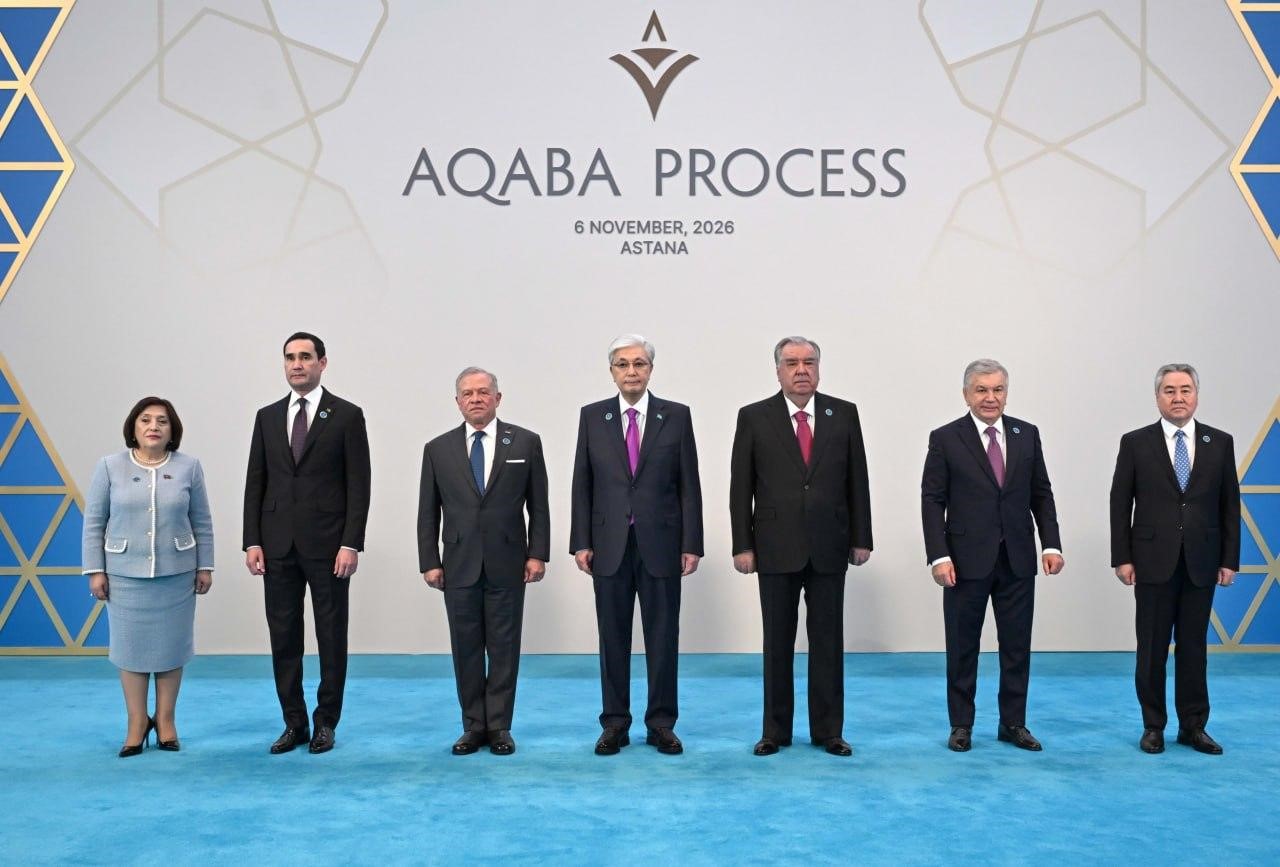
On 6 November 2026, the Aqaba Process held its first-ever meeting in Central Asia: a summit in Astana on “Security in the Field of Artificial Intelligence”, co-chaired by Kazakhstan’s President Kassym-Jomart Tokayev and Jordan’s King Abdullah II.
Key takeaways
- A first for the region. Kazakh and Jordanian officials, and independent regional media, all describe the Astana round as the first Aqaba Process gathering hosted in Central Asia.
- Five heads of state in the room. Tokayev, King Abdullah II, Tajikistan’s Emomali Rahmon, Turkmenistan’s Serdar Berdimuhamedov and Uzbekistan’s Shavkat Mirziyoyev attended. Azerbaijan sent Parliament Speaker Sahiba Gafarova and Kyrgyzstan sent Foreign Minister Jeenbek Kulubaev.
- Focus on terrorism and extremism. The agenda was the misuse of AI by terrorist and extremist actors: propaganda, recruitment, deepfakes and financing, plus how states can use AI defensively.
- One concrete offer on the record. Mirziyoyev offered to host a Central Asian office of the UN Office of Counter-Terrorism (UNOCT) in Uzbekistan and proposed a Tashkent-based programme, “Enlightenment Against Ignorance in the Digital Age”.
- No binding outcome documented. The Aqaba Process does not adopt binding decisions, and no joint declaration or communique had been published by the media sites accessed for this report.
- Bilateral layer. On 5 November Tokayev and King Abdullah held official talks and exchanged state orders: the King received Kazakhstan’s new Order of Al-Farabi as its first recipient, and Tokayev received Jordan’s Order of al-Hussain ibn Ali.
[Please note: Very little information is available on the actual proceedings of the Aqaba Process meeting held in Kazakhstan on 6 November 2026. This is in line with the nature and mandate of the Process. This report incorporates the earlier known positions of the participating countries and also the bilateral meeting between President Tokayev and King Abdullah II on 5 November 2026 in Astana. Ed.]
The Aqaba Process: a flexible forum that has moved from battlefields to algorithms
King Abdullah II launched the Aqaba Process in 2015 to coordinate international action against terrorism and violent extremism; it is named after the Red Sea city where its first meetings were held. Unlike treaty bodies, it has no permanent membership and adopts no binding decisions, according to The Times of Central Asia.
Kazakhstan’s presidency describes the format as bringing together heads of state, leaders of intelligence, defence and international bodies to build a shared threat picture and agree practical responses. Jordan’s Royal Court says rounds have also been hosted abroad, in Albania, the Netherlands, Nigeria, Rwanda, the United States, the United Nations, Singapore, Spain, Norway and Brazil (Jordan Times), and more recently in the UK, Indonesia, Italy and Bulgaria (Anadolu via ANews).
The agenda has steadily moved toward technology. Recent rounds, newest first:
| Date | Venue | Theme | Source |
| 6 Nov 2026 | Astana, Kazakhstan | Security in the field of AI; first round in Central Asia | Akorda |
| Jun 2026 | New York | Extremist recruitment through online games | Times of Central Asia |
| 17 Feb 2026 | Sandhurst, UK | Drone threats and how to regulate their use | Petra |
| 14-15 Oct 2025 | Rome, Italy | Round attended by Kazakh representatives (theme not confirmed in sources opened) | Kazakh MFA |
| 2019 | United States | Terrorist use of the internet and social media; tech companies brought into the talks | Times of Central Asia |
Looking ahead, King Abdullah welcomed Australia’s willingness, during an earlier visit to Australia, to host a 2027 Aqaba Process meeting on countering online extremism and the misuse of emerging technologies (Anadolu via ANews).
The road to Astana: an official visit, two state orders and a round of arrivals
King Abdullah II left Jordan on Thursday 5 November for a two-day visit to Kazakhstan, the Royal Court said, to co-chair the Aqaba Process meeting with Tokayev and hold bilateral talks (Anadolu via ANews). Kazakhstan’s presidential spokesman Aibek Smadiyarov said the bilateral agenda covered trade, investment, economic cooperation and cultural ties (Qazinform).
At the Akorda talks on 5 November, both leaders pledged to keep implementing the agreements from the 2025 exchange of high-level visits. Tokayev called economic engagement the main driver of the relationship and pointed to academic, scientific and tourism links. The King listed trade, investment, tourism, technology and defence as priority areas and reaffirmed Jordan’s interest in security cooperation with Kazakhstan on terrorism and extremism (The Astana Times).
The leaders exchanged state honours. Tokayev presented the King with the new Order of Al-Farabi, making him its first recipient, and called the moment historic. The King in turn conferred Jordan’s highest state honour, the Order of al-Hussain ibn Ali, on Tokayev (The Astana Times; Akorda).
Tokayev told the King that hosting the first Aqaba Process meeting in Central Asia was a great honour and that the AI-security theme was timely. He said it would let the region present its own perspective (The Astana Times).
Other leaders’ travel
- Mirziyoyev arrived on 5 November on a working visit, at the joint invitation of Tokayev and the King, and was met at the airport by Prime Minister Olzhas Bektenov (UzDaily). Tokayev saw him off personally on 6 November (Azattyq Ruhy).
- Rahmon and Berdimuhamedov also flew in for the summit (Qazinform). Tokayev had invited Berdimuhamedov to the “AI security forum” in Astana as early as 26 August (Interfax-Kazakhstan).
The summit: five presidents, a king and two senior envoys
The official attendance list published by Akorda is the most reliable record. It names seven principal participants, “and other officials”:
| Country | Participant | Level |
| Kazakhstan | Kassym-Jomart Tokayev | President (host, co-chair) |
| Jordan | King Abdullah II ibn Al Hussein | Monarch (founder of the Aqaba Process, co-chair) |
| Tajikistan | Emomali Rahmon | President |
| Turkmenistan | Serdar Berdimuhamedov | President |
| Uzbekistan | Shavkat Mirziyoyev | President |
| Azerbaijan | Sahiba Gafarova | Speaker of the National Assembly (Milli Majlis) |
| Kyrgyzstan | Jeenbek (Zheenbek) Kulubaev | Foreign Minister |
Representatives of international organisations also attended, according to The Times of Central Asia, and Uzbekistan’s presidency mentioned “other international guests” (Trend). Azerbaijan’s parliament said Gafarova presented her country’s achievements in digital technologies at the meeting (Report.az).
How the event was labelled. Kazakhstan’s presidency calls it an “Aqaba Process Summit”. Uzbekistan’s presidency describes a “meeting of Central Asian heads of state” held within the Aqaba Process, with Jordan’s King and envoys from Azerbaijan and Kyrgyzstan. Neither description implies a treaty-level event.
What is not documented. None of the sources accessed lists intelligence directors, defence ministers or cybersecurity advisers as attendees of the Astana session. The Akorda description of the format says the forum brings such officials together in general, but does not say who came to Astana. Kazakh outlets also give no indication that the session was closed or confidential; Akorda released photographs and a readout.
What leaders said and proposed
The only full summit statement available so far comes from Uzbekistan, whose presidency published a readout. Kazakhstan’s and Jordan’s official summit readouts list participants but carry no speech text, so what Tokayev and King Abdullah said inside the session is not yet fully on the record. Their positions below come from the 5 November talks and the Royal Court’s pre-summit statement.
- Tokayev (Kazakhstan). He framed the summit as a chance for Central Asia to present its own view on AI security and give new impetus to joint efforts to maintain peace and security, and praised the King for launching the Aqaba Process more than ten years ago (Baq.kz via Akorda).
- King Abdullah II (Jordan). The Royal Court set the agenda as ensuring security in the field of AI, preventing its use for terrorist or extremist purposes, and strengthening regional and international cooperation against emerging technological threats (EconoTimes). He thanked Kazakhstan for co-organising the round (The Astana Times).
- Mirziyoyev (Uzbekistan). He said AI brings major opportunities and new security risks, and argued that quality education is a core foundation of security. He offered to host a Central Asian office of UNOCT in Uzbekistan to help countries set up channels for reporting terrorist content, detect terrorist financing and train specialists, including in using AI for these tasks (UzDaily; Eurasianet via Yerepouni).
- He also proposed an international programme at Tashkent’s Center for Islamic Civilization, “Enlightenment Against Ignorance in the Digital Age”, to build multilingual resources, train religious leaders in digital communication and support young researchers (Times of Central Asia).
- Uzbekistan voiced support for the UN Global Dialogue on AI Governance, and Mirziyoyev closed by saying AI’s future depends on the purposes it serves, so the aim should be to turn it into a tool for peace and human development rather than a source of threats (UzDaily; Yuz.uz).
- Gafarova (Azerbaijan). She presented Azerbaijan’s achievements in digital technologies and innovation (Report.az).
- Turkmenistan’s Position (Serdar Berdimuhamedov): Official state media and regional reporting confirm that President Serdar Berdimuhamedov participated personally in the Astana Aqaba Process summit alongside President Tokayev, King Abdullah II, President Rahmon, and President Mirziyoyev. Speaking at the Summit, President Serdar Berdimuhamedov said that Turkmenistan proceeded from the premise that long-term security in the world can and should be ensured, first and foremost, through the intensification of preventive diplomacy, the practical application of the principles of neutrality, and the restoration of a culture of peace, trust, and political dialogue. He also reaffirmed Turkmenistan’s firm and unwavering commitment to cooperation in ensuring lasting security and stability in Central Asia and throughout the world, and its readiness to make a constructive contribution to the implementation of the goals and objectives of the Aqaba Process.
- Kyrgyzstan and Tajikistan Delegations: Kyrgyz Foreign Minister Jeenbek Kulubaev officially attended and represented Kyrgyzstan at the Astana summit, focusing on regional coordination against the misuse of emerging technologies for terrorist and extremist propaganda. No separate standalone address text was released by Bishkek beyond participation readouts. Similarly, President Emomali Rahmon participated on behalf of Tajikistan, reinforcing Dushanbe’s ongoing regional advocacy for digital safety and its proposed Regional AI Center.
The threat picture
The summit’s core worry is that generative AI lowers the cost of extremist messaging. Models can produce text, images and video in minutes, translate into many languages and imitate real voices, which helps propagandists reach audiences across linguistic borders. Fabricated recordings of politicians, religious leaders or security officials add a further risk, and automated conversations can tailor recruitment pitches to individuals, making them harder to spot (Times of Central Asia).
Regional context: each capital arrived with its own AI and security agenda
Several participants had already put AI, cyber or counter-terrorism initiatives on the international table before Astana, which helps explain the proposals made there. Since the detailed reportage of the Aqaba Process meeting is sparse, we are jotting down here the earlier known positions:
| Country | Related initiative | Source |
| Kazakhstan | 2026 declared the Year of AI and Digital Development; a Ministry of AI and Digital Development and an AI Development Council created; Data Center Valley named a priority | Trend |
| Kazakhstan | Interior Ministry proposed a UNODC regional cybercrime centre in Astana on 4 Nov; delegates from 27 other countries attended the conference | Times of Central Asia |
| Kazakhstan | Joined the Budapest Convention on Cybercrime on 14 Oct 2026 (in force for it from 1 Feb 2027); signed the UN Convention against Cybercrime in Oct 2025, not yet in force | Times of Central Asia |
| Kazakhstan | Proposed a network of AI centres for Turkic states (May 2026); Turkic security officials discussed a cybersecurity council and that network in Sept 2026 | Interfax-Kazakhstan; Astana Times |
| Uzbekistan | Offered a Central Asian UNOCT office; proposed the Tashkent “Enlightenment Against Ignorance” programme; backs the UN Global Dialogue on AI Governance | UzDaily |
| Tajikistan | UN General Assembly unanimously adopted its resolution on AI and sustainable development in Central Asia (25 Jul 2025); it also promotes a Regional AI Center in Dushanbe | Tajik MFA; Asia-Plus |
| Turkmenistan | Proposed a UN-backed International Code for the Peaceful Use of AI in diplomacy, as part of its priorities for the 81st UN General Assembly | Trend |
| Jordan | Aqaba Digital Hub reported Jordan’s first dedicated AI compute platform operational (Sept 2026) | Petra |
The common thread is that Central Asian states want a role in shaping AI rules rather than receiving them, and are using UN-linked proposals, hosted institutions and regional hubs to do so.
Outcomes: proposals on the record, commitments not yet confirmed
As of 8 November, the documented results are proposals and political signals, not adopted measures. That fits the format: the Aqaba Process is a non-binding forum, and no joint declaration or communique from Astana has been published by Akorda, the Jordanian Royal Court or the media outlets reviewed.
Analysis and what to watch
The Astana round shows Central Asian capitals wiling to host the institutions that will govern AI-era security. Kazakhstan floated a UNODC cybercrime centre in Astana a day before the summit, Uzbekistan offered a UNOCT office in the same forum, Tajikistan keeps promoting an AI centre in Dushanbe, and Turkmenistan is pushing a UN code on peaceful AI use. Each proposal needs a UN or partner decision before it becomes real.
The format also matters. A non-binding, low-publicity forum lets Jordan, Kazakhstan and their partners talk candidly about intelligence-sensitive threats, but it leaves little public trace, which is why outcomes remain thin on the record. Kazakh expert Didar Tebaev told 24KZ that the process has outgrown its regional origins and now spans the Middle East, East Africa and Central Asia (24KZ).
What to watch
- Whether the UN responds to Uzbekistan’s UNOCT offer, and whether Kazakhstan’s UNODC cybercrime centre gathers backing.
- Any consolidated summary from Jordan’s Royal Court or Kazakhstan’s Foreign Ministry, and publication of the Tajik and Turkmen statements.
- The next round: Australia’s 2027 meeting on online extremism and emerging technologies.
- Kazakhstan’s Budapest Convention membership taking effect on 1 February 2027, and progress toward entry into force of the UN cybercrime convention.
- Whether Central Asian security services announce joint AI-related training or information-sharing arrangements, which would turn the summit’s themes into practice. /// nCa, 9 November 2026