


Tariq Saeedi
There is a paradox at the heart of Central Asian geopolitics that rarely gets the attention it deserves. For nearly two centuries, the region was treated as an object of history rather than a subject of it — shaped by Russian imperial cartography, then Soviet planning, then the post-Cold War security frameworks of Washington and Beijing.
Outside powers came, drew their lines, built their pipelines, and left their definitions. Central Asia absorbed all of it, adapted to all of it, and remained, in the eyes of most analysts, a passive geography.
That is changing. — It is changing because of something far more prosaic and, paradoxically, far more durable: the global system is fracturing in ways that make regional coordination the rational response. The pressures unifying Central Asia today are not romantic. They are structural. And that distinction makes all the difference.
When Fragmentation Becomes an Integrating Force
The old architecture of globalization rested on a set of assumptions that are quietly being abandoned: that trade flows would remain politically neutral, that maritime routes would stay open and uncontested, that supply chains could stretch indefinitely without political disruption.
Sanctions regimes, great-power competition, and the exposed fragility of just-in-time logistics have collectively shattered that assumption. The overland interior of the Eurasian landmass — long treated as the backwater of global commerce — has suddenly become its most strategically interesting alternative.
Central Asia sits at the center of this revaluation.
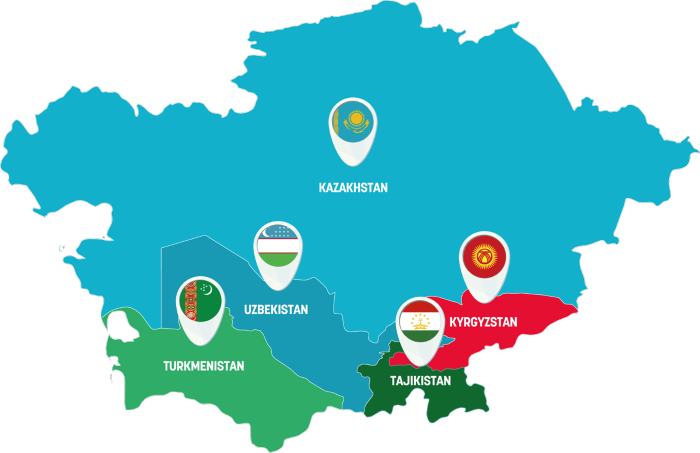
The region connects East Asia to the Caucasus, South Asia to Europe, the Middle East to the Russian periphery. But connectivity of this kind is not a prize that any single state can claim. Kazakhstan’s corridors need Uzbekistan’s networks. Uzbekistan’s trade ambitions need Turkmenistan’s transit cooperation. Kyrgyzstan and Tajikistan need the regional energy and transport architecture that only collective planning can produce. No single Central Asian country, acting alone, can become the Eurasian transit hub that global fragmentation now makes possible. Together, they could become something the world increasingly needs.
The irony is exquisite: it is the fracturing of globalization that is teaching Central Asia the value of regional coherence.
The Art of Balancing — and Its Hidden Demands
Central Asian diplomacy has, over the past two decades, become genuinely sophisticated. Each of the five states has cultivated simultaneous relationships with Russia, China, Turkey, the European Union, the Gulf states, India, and the United States — a multi-vector posture that was once derided as unprincipled but is now widely recognized as strategically rational. In a world of rival powers, small and medium states have every reason to avoid exclusive alignment.
But there is a hidden cost to this strategy that is rarely discussed. Individually, each Central Asian state is a modest actor — large enough to be taken seriously, too small to be taken on its own terms. Collectively, they are something different: a significant transit region, a substantial energy zone, a genuine diplomatic balancing platform. The world has quietly begun recognizing this.
The proliferation of multilateral formats — C5+1, China-Central Asia, EU-Central Asia, GCC-Central Asia — reflects not just external interest, but an emerging external habit of treating the region as a single interlocutor.
Here lies the interesting pressure. — When the outside world groups you together, you begin to think of yourself together. The summits convened in Astana and Samarkand, the consultative meetings of Central Asian leaders, the cross-border infrastructure projects — these are not merely diplomatic theater. They are, slowly, building a regional political consciousness that no amount of Soviet-era integration projects ever managed to produce. External framing is becoming internal reality.
The Environment as a Unifier
Of all the forces pushing Central Asia toward coordination, the most underappreciated is the one that operates without any diplomatic agenda at all: climate change.
Water was, for decades, the most reliable source of regional division. The upstream-downstream tensions over the Syr Darya and Amu Darya rivers — between Kyrgyzstan and Tajikistan, who control the headwaters, and Kazakhstan and Uzbekistan, who depend on the flows — generated genuine bitterness and occasional crisis. But climate stress is rewriting the calculus. Glaciers are retreating. Drought cycles are deepening. The Aral Sea basin remains a monument to the consequences of uncoordinated water management.
No country can solve these problems unilaterally, because the ecological systems involved recognize no borders.
What was once a source of conflict is increasingly becoming a shared problem — and shared problems, when severe enough, have a way of producing shared institutions. Climate adaptation may ultimately prove to be the most powerful integration driver Central Asia has, precisely because it is not optional. Survival, one might say, is becoming regionalized.
Infrastructure Before Politics
There is a lesson from European history that is relevant here, though it is rarely applied to Central Asia: deep political integration rarely precedes infrastructure. It follows it. The Coal and Steel Community was not a romantic project; it was a functional one. The habits of coordination that pipelines and railways and electrical grids produce are more durable than the political rhetoric that accompanies them.
Central Asia is building these habits, whether it knows it or not. Cross-border energy grids, shared rail corridors, coordinated logistics hubs — these are already creating the kind of day-to-day interdependence that makes political regionalism feel less like ideology and more like common sense.
The same logic applies to the energy transition: the region’s simultaneous relevance to hydrocarbons, uranium, rare earths, and green hydrogen potential means that energy infrastructure will only deepen, not diminish, over the coming decades. Pipelines and grids create routines. Routines create constituencies for cooperation. Constituencies create political will.
The Digital Question
One dimension of this transformation deserves more attention than it typically receives. Digital systems have their own logic of scale, and that logic is uncomfortable for small, fragmented markets. Central Asia faces a version of a problem that many mid-sized regions confront: individually, the five states lack the scale to build sovereign digital infrastructure, develop competitive AI systems, or create the data ecosystems necessary for modern governance and economy. Together, they represent a meaningful digital space — a multilingual, multi-ethnic region with its own cultural, linguistic, and governance needs that will not be adequately served by systems trained in Washington or Shenzhen.
The opportunity is real, and it is time-sensitive. Unlike Europe, which must now disentangle itself from decades of regulatory and technological path-dependencies, Central Asia has not yet locked itself into rigid digital architectures. The region could, with sufficient coordination, build shared standards for data governance, develop regional cloud infrastructure, create coordinated cybersecurity frameworks, and invest in AI systems that actually reflect Turkic and Persianate linguistic and cultural realities.
This is not idealism — it is a recognition that digital sovereignty, in the twenty-first century, requires a minimum viable scale that no single Central Asian state can reach alone.
The Question of Institutionalization
None of this will happen automatically. The structural pressures toward regional coherence are real, but structural pressures do not build institutions by themselves. They create incentives; it takes deliberate political choices to act on them.
The Central Asian states face a genuine strategic fork. One path is the continuation of the current arrangement: five countries pursuing their national interests with variable coordination, periodically consulting each other but never quite crossing the threshold into durable common institutions. The other path is something more intentional — not a supranational union on the European model (which is neither likely nor, perhaps, desirable), but a genuine architecture of coordination: sectoral councils, permanent working mechanisms, shared infrastructure planning, and, critically, a regional capacity to think about itself.
That last point is easy to underestimate. Much of the serious analytical work on Central Asian geopolitics has, until recently, been produced at institutions far from the region itself. The think tanks, research centers, and policy forums that define how a region is understood — and therefore how it is engaged — take time and sustained investment to build. Central Asia’s are growing, but the potential is considerable. A region with the capacity to generate its own analysis, publish in its own languages, and train its own policy thinkers is in a fundamentally stronger position than one that imports those frameworks wholesale. The investment required is institutional, patient, and unglamorous. It is also, in the long run, among the most consequential a region can make.
What Central Asia Could Become
The long-term strategic vision — and it is worth stating it plainly — is of a Central Asia that functions as something genuinely new in geopolitical history: a region of medium-sized states that has achieved coordinated stability without any single hegemon imposing it. Not a federation, not an empire, not a satellite of a larger power, but a flexible, infrastructurally integrated, diplomatically coordinated regional system that adds systemic value to the broader Eurasian order.
The value such a Central Asia would offer the world is considerable. A functioning overland corridor through the region reduces the chokepoint dependencies that make maritime geopolitics so dangerous.
A diplomatically coherent Central Asia can maintain communication channels across rival great-power blocs — a function that is increasingly scarce and increasingly valuable.
A resource-stable Central Asia can play a stabilizing role in the energy transitions of the coming decades.
And a Central Asia that manages its own affairs — rather than being managed by others — offers the world something rarer still: a working model of non-hegemonic regional order. /// nCa, 19 May 2026