


nCa Report
Between April 26 and 30, Prime Minister Andrej Babiš led one of the most commercially ambitious Czech foreign missions in years — a four-day swing through Azerbaijan, Kazakhstan, and Uzbekistan with Deputy Prime Minister Karel Havlíček and a delegation of representatives from over 50 companies spanning energy, transport, mechanical engineering, and the defense industry.
The trip wasn’t dressed up in grand geopolitical language. Babiš was blunt about the purpose: Czech exports go roughly 80% to EU countries, and the country needs to open new markets. “The new markets are here,” he said.
Azerbaijan: More Than a Courtesy Call
The visit opened in Azerbaijan, and it was anything but routine. President Aliyev held expanded talks with Babiš in Gabala on April 27 — a setting that signals genuine personal investment from the Azerbaijani side.
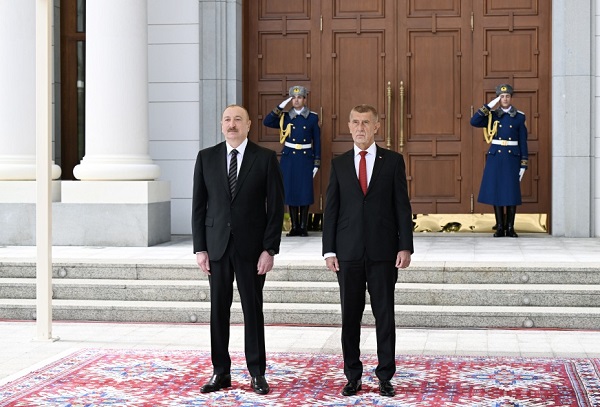
The energy dimension was front and centre. Azerbaijan is already the Czech Republic’s first supplier of crude oil, covering 42% of consumption. Babiš came to Baku asking for natural gas too, bringing state energy company ČEZ with him to explore long-term supply arrangements.
Deputy PM Havlíček underscored the existing depth of the relationship: “We are their second most important partner in Europe after Italy,” he noted, while signalling Czech interest in expanding into gas supplies as part of broader energy diversification efforts.
On the industrial side, the Czech defense delegation was notably specific: the Czechoslovak Group, Colt (assault rifles), Aero Vodochody (proposing the L-39NG aircraft), and state-owned Explosia all participated. Czech companies were also negotiating to supply metro carriages to Azerbaijan — a detail that points to real industrial traction, not just goodwill.
Czech-Azerbaijani trade has been falling sharply — down 29% in 2025, and by a striking 60.8% in the first two months of 2026. The visit was partly about arresting that slide, not just building on existing momentum.
Kazakhstan: The Long Game
Kazakhstan was the middle stop, and in structural terms it may be the most important relationship of the three. Babiš held talks with President Tokayev focused on oil, industrial cooperation, and logistics — with Prague explicitly expressing interest in Kazakh oil deliveries.
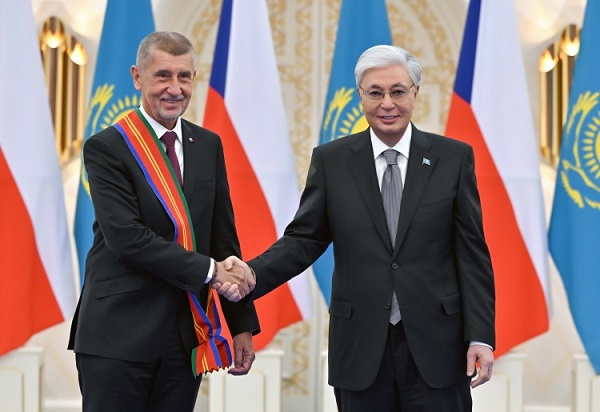
Kazakhstan is Central Asia’s largest economy, a significant uranium producer, and sits astride the overland trade routes connecting Europe and Asia. For Czech companies with expertise in engineering, energy systems, and transport, the potential runway here is long. That said, concrete signed agreements from this leg were less visible in public reporting than from Uzbekistan — suggesting the Astana leg was more about laying foundations than cutting ribbons.
Uzbekistan: Where the Deals Got Done
Tashkent was where the mission turned most tangibly commercial. Babiš met President Mirziyoyev at the Kuksaroy residence, with talks covering both narrow and expanded formats. It was noted that bilateral trade has nearly doubled in recent years, and a target of $1 billion in trade turnover was set as a priority.
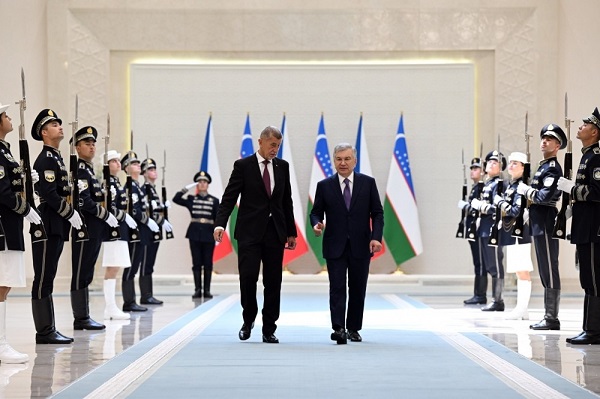
The institutional architecture put in place was notable: a Business Council will be established to systematically manage the economic relationship, and the next Intergovernmental Commission meeting is scheduled in Tashkent in August. There are already 37 enterprises with Czech capital operating in Uzbekistan.
The headline project was Škoda’s railway deal. The initiative involves the supply and assembly of Škoda electric trains in Uzbekistan with gradual localization of production components. A Škoda Academy is set to open at the Tashkent State Transport University to train local specialists. This is precisely the kind of industrial ecosystem-building — not just a one-off export — that creates durable commercial presence.
Discussions also touched on the restoration of direct flights between the two countries, which would matter for both business travel and tourism.
What Was This Trip Really About?
Strip away the diplomatic language, and five things were on Babiš’s agenda.
Energy security was the most urgent driver. Babiš referenced the situation around the Strait of Hormuz as a reason why diversifying energy sources matters now — a reminder that these conversations don’t happen in a vacuum. Securing oil and gas ties with Azerbaijan and Kazakhstan, and exploring longer-term nuclear cooperation potential (Kazakhstan is a major uranium producer), fits a Czech energy strategy that is both practical and defensive.
Export markets were the second engine. Czech industry — engineering, rail, defense, pharmaceuticals — needs growth beyond a European market that is, in Babiš’s own words, being “destroyed” by the Green Deal. Whether or not one agrees with that framing, the commercial logic of looking east is real.
Industrial partnerships, not just export sales, were the third goal. The Škoda Academy model in Tashkent, and the localization of production components, suggest Prague is thinking about embedding Czech companies into these economies — not just shipping goods to them.
Connectivity was the fourth strand. The Trans-Caspian Middle Corridor linking Central Asia to Europe via Azerbaijan is gaining relevance as supply chains restructure globally. Czech interest in rail and freight links fits into this picture naturally.
Visibility was the fifth, and perhaps most underrated, element. Central Asia and the South Caucasus remain relatively underexplored markets for Czech companies despite their size and strategic importance. Simply being present — with a prime minister, a deputy PM, and 50 companies — changes that.
An Honest Assessment
The Czech Republic is not Germany or France. Success in this region, as Havlíček argued, cannot be measured in small percentage increases in exports — the goal is large-scale contracts, not incremental growth. Whether this trip delivers those will only be clear in the months ahead.
What it did achieve, concretely, was this: a Škoda railway project launched in Uzbekistan with a training academy attached; a $1 billion trade target set with Tashkent; a Business Council created; energy discussions opened with Baku and Astana; and defense industry introductions made across all three capitals.
What it didn’t achieve — at least not yet — was any large-scale energy supply agreement. The infrastructure to move Azerbaijani gas or Kazakh oil directly to the Czech Republic in significantly larger volumes doesn’t change overnight. The real value of these energy conversations is optionality: keeping doors open, building personal relationships with decision-makers, and positioning Czech companies for when circumstances shift.
The C6+ dimension — the implicit recognition that Azerbaijan and Central Asia now form an integrated strategic space — is a real analytical insight, and the visit does reflect it. But it’s probably more accurate to say that Babiš was thinking about energy and commerce than about regional architectures per se.
This was a pragmatic mission by a pragmatic politician. The results are modest but real, and the foundations laid are more durable than a single set of handshakes. /// nCa, 1 May 2026