


nCa Report
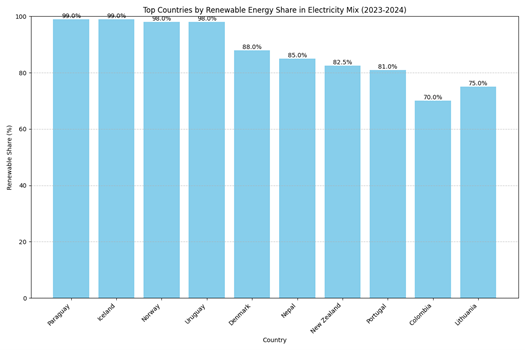
There are four countries in the world that are generating electricity from renewables to meet their domestic consumption. There are another nine countries that are covering more than 70% of their electricity requirement from renewables.
The list is growing. — There are at least 90 countries that are meeting more than 35% of their electricity demand from renewables.
Our benchmark here is 25%.
The USA is the newcomer to the honor-roll of renewables. In 2024, renewables (including hydro, wind, solar, biomass, and geothermal) made up about 22% of US electricity generation, up from around 20% in previous years. Forecasts suggest that it will hit the 25% mark in 2026.
Now, to put this in perspective, let’s look at which countries have already blown past that 25% threshold in their electricity generation from renewables. Here is a list based on the latest data (mostly from 2023-2025), drawing from reports by organizations like the IEA, Ember, IRENA, and others.
It is not a complete list —there are around 90 nations now exceeding 35% renewables in electricity—but this covers a solid, diverse sample across continents. Many of these leaders rely on hydropower as a backbone, but wind and solar are increasingly stealing the show in places with aggressive buildouts.
| Country | Approximate Renewable Share in Electricity Mix | Key Sources Contributing | Notes/Year |
| Paraguay | 99% | Hydro (nearly all) | 2023; Almost entirely hydropower-dependent. |
| Iceland | 99% | Geothermal (~70%), hydro (~30%) | 2023; Leverages volcanic geography for geothermal. |
| Norway | 98% | Hydro (~92%), wind/solar (~6%) | 2024; Exports surplus hydro power. |
| Uruguay | 98% | Hydro (~50%), wind (~35%), solar (~3%), biomass | 2024; Rapid wind/solar buildup since 2010s. |
| Denmark | 88% | Wind (~55-58%), solar/biomass (~30%) | 2024; Leader in wind integration and community-owned projects. |
| Nepal | 85%+ | Hydro (dominant) | 2023; Seasonal hydro reliance, with growing solar. |
| New Zealand | 80-85% | Hydro (~55-60%), geothermal (~20%), wind/solar | 2024; Geothermal from volcanic activity. |
| Portugal | 75-87% | Hydro (~25%), wind/solar (~45-50%), biomass | 2024; Coal-free since 2021, targeting 93% by 2030. |
| Colombia | 70%+ | Hydro (dominant), growing wind/solar | 2024; Hydro-heavy, vulnerable to droughts. |
| Lithuania | 70-80% | Wind/solar/biomass/hydro | 2024; Rapid renewable adoption in Baltics. |
| Luxembourg | 70%+ | Wind/solar/hydro/biomass | 2024; Small grid, high imports. |
| Chile | 69% | Hydro (~30%), solar/wind (~35%), geothermal/biomass | 2024; +29 pp since 2010 due to solar/wind boom. |
| Brazil | 65-89% | Hydro (~60%), wind/solar/biomass (~25-29%) | 2024; Large hydro base, with wind/solar growth. |
| Canada | 65-70% | Hydro (~60%), wind/solar (~8%), biomass | 2024; Varies by province; Quebec nearly 100% hydro. |
| Sweden | 65%+ | Hydro (~40%), wind/solar (~20%), biomass | 2023; High low-carbon overall including nuclear. |
| Netherlands | 50-60% | Wind (~30%), solar (~20%), biomass | 2024; Offshore wind expansion key. |
| Germany | 50-55% | Wind (~28%), solar (~12%), biomass/hydro | 2024; Energiewende policy driving transition. |
| Spain | 54% | Wind/solar (~43%), hydro (~11%) | 2024; Targeting 81% by 2030; coal down to 1%. |
| Italy | 41% | Hydro/solar/wind/biomass/geothermal | 2025; Growing solar, geothermal in Tuscany. |
| Australia | 35% | Solar/wind (~30%), hydro (~5%) | 2024; +27 pp since 2010; rooftop solar leader. |
| China | 32-33% | Hydro (~15%), wind (~10%), solar (~8%) | 2024; World’s largest renewable capacity, targeting 33% by 2025. |
| Poland | 30-35% | Wind/solar (~25-30%), biomass/hydro | 2025; Solar boom to 25 GW capacity. |
| India | 20-25% | Hydro (~10%), solar/wind (~12-15%) | 2024; Rapid growth but coal still dominant. |
Zooming out to regions, Europe as a continent hit 51% renewables in its electricity mix in 2024, up three percentage points from the year before.
Latin America averages over 60%, thanks mostly to abundant hydro resources. It’s fascinating how geography plays a role—countries like Iceland and New Zealand tap into geothermal from their volcanic landscapes, while Denmark and Portugal have bet big on wind and solar through smart policies.
On a global scale, renewables are really starting to flex their muscles in electricity generation.
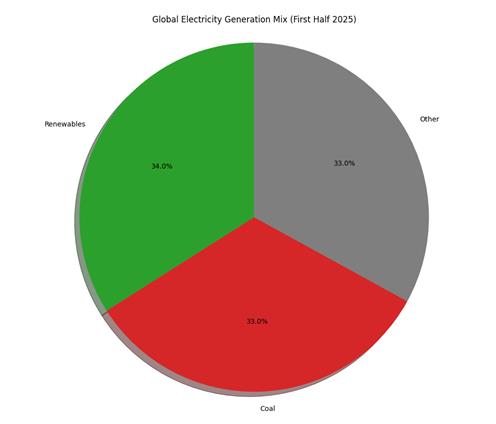
In the first half of 2025, they accounted for 34% of worldwide electricity, edging out coal at 33% for the first time ever—that’s up from 33% in 2024 and 30% in 2023.
What’s even more telling is the investment trend: 92-93% of all new electricity capacity added in 2024-2025 came from renewables, with solar and wind leading the charge. This isn’t just a blip; it’s a structural shift.
The US hitting 25% soon mirrors what’s already happened in dozens of countries where renewables dominate (over 50% in many cases) or are the outright majority.
Looking ahead, projections paint an optimistic picture for renewables’ dominance in electricity.
By 2030, they’re expected to reach 46% of global electricity generation, with solar and wind alone hitting 30%—surpassing hydropower and leaving coal in the dust by as early as 2025. In the bigger energy picture (beyond just electricity), renewables might climb to 26% by 2050, while fossils drop to 67%.
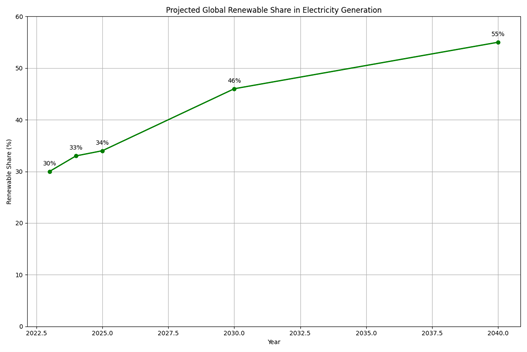
True global dominance—say, over 50% in electricity—could arrive around 2035-2040 if we keep up the current growth rates (15-16% annual capacity additions), but it’ll hinge on things like better grid infrastructure, energy storage solutions, and supportive policies.
All in all, this data shows renewables aren’t just emerging; they’re rapidly becoming the go-to for electricity worldwide, with the US joining a growing club of nations making the switch. If trends hold, we’re on track for a cleaner grid sooner than many might think. /// nCa, 27 February 2026