


Alexey Kustov, Chief Research Fellow Institute for Strategic and Regional Studies under the President of the Republic of Uzbekistan
Discussions regarding Uzbekistan’s participation in the Commonwealth of Independent States (CIS) often shift into the realm of political and economic assessments.
From an economic perspective, however, the picture is significantly more concrete. For Uzbekistan, the CIS is, first and foremost, a set of practical mechanisms. These include a free trade regime, the mutual recognition of documents and standards, the visa-free movement of citizens, and transit and transportation agreements. All of this has a daily impact on the operations of enterprises and the incomes of ordinary people.
This interpretation aligns perfectly with the official position. Speaking at the CIS summit in Dushanbe in October 2025, President Shavkat Mirziyoyev called the member states of the association “Our natural partners”. Here, the CIS is not juxtaposed against other vectors but rather serves as one of the pillars of the country’s economic diplomacy.
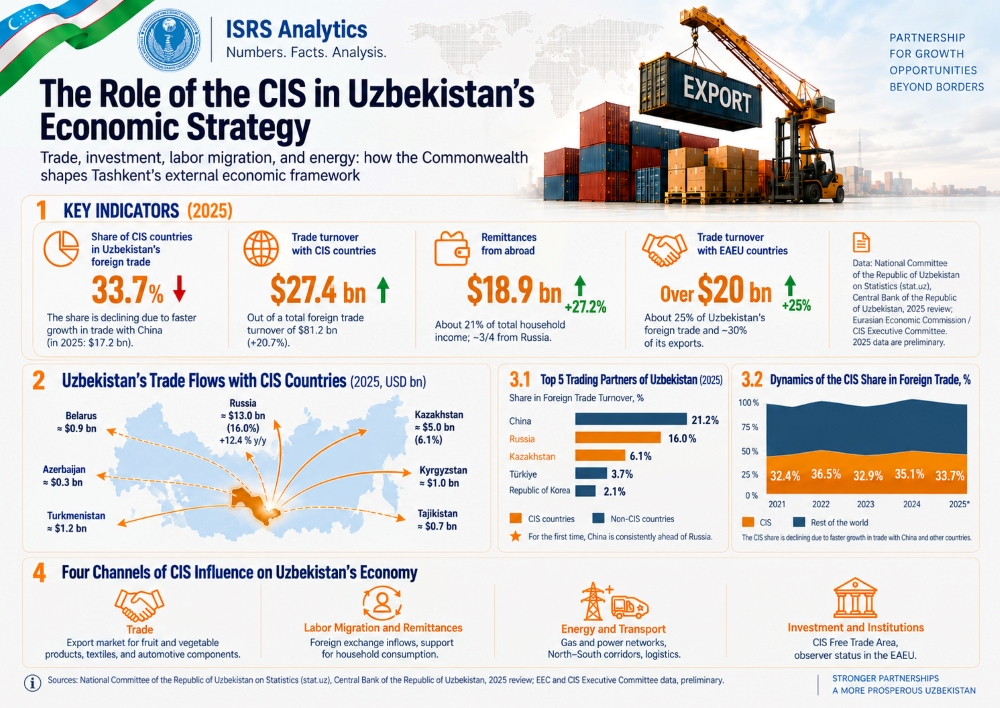
In 2025, Uzbekistan’s GDP grew by 7.7%, and exports reached $33.8 billion, representing a 24% increase. At the same time, the Commonwealth states account for about a third of its foreign trade – a share that has remained relatively stable for several years, despite the rapid expansion of ties with other regions.
In October 2024, trade turnover within the Commonwealth saw a 16 percent growth, reaching an 11 percent increase by year-end. By 2025, it had hit $27.4 billion, growing by more than 20 percent.
Behind this stability lies not the inertia of past ties, but rational calculation. CIS markets are familiar to Uzbek businesses: they offer comparable standards, the absence of a language barrier, well-established logistics, and duty-free access. The Commonwealth’s population of roughly 250 million people generates steady demand for fruits and vegetables, textiles, automobiles, electrical engineering, chemical products, and services. For companies entering foreign markets for the first time, this is the least risky direction.
This is precisely why the Commonwealth serves as a kind of “launchpad”. An enterprise that has successfully mastered exports to neighboring countries can then more confidently enter more complex markets. The main partners here remain Russia and Kazakhstan, as well as Kyrgyzstan, Tajikistan, Turkmenistan, and Belarus. Meanwhile, the top five trading partners also include China, Turkey, and the Republic of Korea, confirming the multi-vector nature of Uzbekistan’s foreign economic policy.
Importantly, the Republic has long ceased to be a passive participant in the association. Since 2017, it has restored its active presence in CIS structures, joined more than twenty sectoral bodies, and signed 24 multilateral documents.
The culmination of this course was Uzbekistan’s first chairmanship of the CIS in 2020. The objective set during that period – a “phased transition to a qualitatively new level of cooperation” – has defined the logic of all subsequent work.
The President of Uzbekistan has put forward over a hundred initiatives at Commonwealth summits, most of which address specific barriers. Tashkent persistently advocates for a free trade zone functioning “without exemptions and restrictions”, the expansion of “green” corridors, the development of e-commerce, and access to public procurement.
In 2025, the President emphasized that “it is important to expand mutual markets in our countries”, proposing the creation of a rapid response mechanism to market fluctuations under the CIS Economic Council and accelerating the removal of technical barriers.
This is directly linked to the national goal of raising exports to $67 billion by 2030. Uniform requirements, digital document exchange, the mutual recognition of certificates, and accelerated border crossings can turn geographical proximity into a sustainable advantage for domestic goods. This is especially true for small enterprises, for which administrative procedures often cost more than the duties themselves.
Physical market connectivity is equally important. Uzbekistan is landlocked and separated from ocean ports by the territories of at least two states, so logistics costs directly affect export competitiveness. Since most traditional routes pass through Commonwealth countries, simplifying transit and unifying customs procedures is not merely a protocol matter but a highly practical one, measured in delivery times and production costs.
This theme has been a constant in Tashkent’s proposals since 2020. In 2025, the President put forward the idea of information and logistics centers integrated with all modes of transport, called for attracting private capital into infrastructure, and proposed hosting a CIS Conference on Public-Private Partnerships in the transport sector in Uzbekistan.
The returns from these steps go well beyond transit revenues. Connecting the North-South and East-West corridors and gaining access to the ports of the Baltic, Black, and Caspian Seas means diversifying routes and transforming the Republic’s territory into a vital link between Eurasian markets.
Reliable logistics naturally attract warehouses, dry ports, and export-oriented manufacturing along highways, which in turn fosters regional development.
Energy deserves special mention. The Commonwealth states are connected by shared gas and electricity grids. For an economy with rapidly growing consumption, this means energy supply reliability and existing infrastructure that would have required massive investments to build from scratch. The Republic is implementing programs in both traditional and alternative generation with its partners, including the construction of a nuclear power plant, and in 2025 advocated for a Program for the Innovative Development of the CIS Energy Sector. A similar logic applies to food security – a shared market smooths out seasonal supply fluctuations.
The creation of value-added products signifies a change in the fundamental nature of economic ties. Several of Tashkent’s proposals are dedicated to this goal: the Comprehensive Program of Industrial Cooperation, the idea of placing joint production at the center of the Commonwealth’s agenda, measures to stimulate mutual investments, and the CIS Innovative Industry Forum at the Innoprom platform. The Head of Uzbekistan spoke of “many examples of successful industrial cooperation”, and the main task now is to replicate them.
Several promising areas can be identified here. The first is the agro-industrial complex: the deep processing of fruits and vegetables, storage centers, and cooperation in seed farming and veterinary medicine. Uzbekistan has a significant raw material base, while its partners possess processing and packaging technologies that increase the final value of the product.
The second area is mechanical engineering, electrical engineering, and building materials. The Republic is interested not so much in finished goods as in joint ventures with a high degree of localization. This format ensures technology transfer, the training of engineers, and job creation – an effect unattainable through simple supply chains. Obvious niches include components for transport and agricultural machinery, pharmaceuticals, chemicals, and advanced materials.
The third area involves digital solutions and payment infrastructure, which significantly reduce the costs of cross-border trade. Following the artificial intelligence forum in Samarkand in August 2025, Uzbekistan initiated an Action Plan to deepen cooperation in digitalization and the creation of a CIS Venture Platform.
This agenda has robust financial backing. According to the CIS Executive Committee, citing UNCTAD, foreign direct investment inflows into Commonwealth countries amounted to $23.2 billion in 2023, while outbound investments reached almost $32.5 billion. To channel these resources into manufacturing, Uzbekistan proposed a roadmap for supporting special economic and industrial zones, as well as measures to accompany cooperation projects. The interregional level is particularly promising, as real business needs are identified much faster there.
It is also crucial that such projects go beyond the bilateral dimension. Uzbekistan is located in the very heart of Central Asia and has well-established ties with all its neighbors. A joint venture on its territory gains direct access to a fast-growing regional market with a population of around 85 million people – a highly compelling argument in favor of localizing production.
Such cooperation becomes a natural driver for the goals of the “Uzbekistan – 2030” Strategy: accelerated industrialization, export growth, and increased incomes for the population. The Commonwealth remains one of the practical instruments for achieving these goals – not the only one, but an active and well-tuned one. As the Uzbek economy becomes more complex, so does its agenda with the CIS – transitioning from simple market access to the formation of joint production chains.
It is precisely in this transition that the main prospect lies. Dynamic growth, an expanding domestic market, and an active investment policy create a solid foundation for a new quality of interaction. As President of Uzbekistan Shavkat Mirziyoyev emphasized, the decisions being made are intended to serve the “well-being and prosperity of our countries and peoples”, and it is by this ultimate criterion that the return on multilateral partnership is measured.