


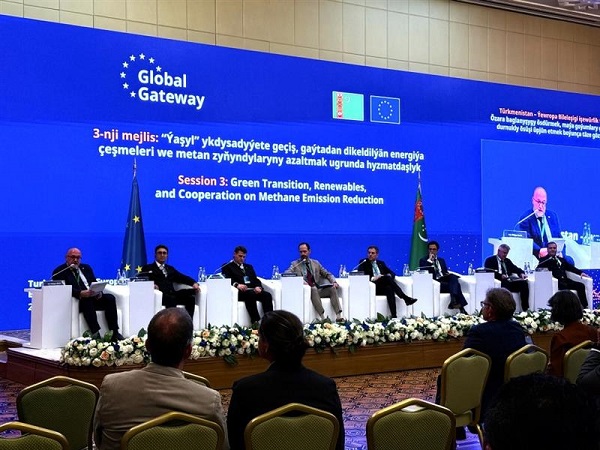
On 26 March 2026, Ashgabat hosted the Turkmenistan–European Union Business Forum, which served as a vital platform for discussing strategic partnership. One of the key topics of the forum was the third session, dedicated to “Governance aspects on green transition.” The session was moderated by Philippe Merlin, Ambassador Extraordinary and Plenipotentiary of the French Republic. The discussion brought together high-ranking officials from the Government of Turkmenistan, European diplomats, and executives from international energy companies to explore concrete pathways for cooperation in renewable energy (RE) and emission reductions.
Turkmenistan’s Strategy: From Modernization to RE Integration
Serdar Saparov, Deputy Minister of Energy of Turkmenistan, emphasized that the country’s long-term priorities focus on large-scale technological modernization and a gradual transition to low-carbon development. Renewable energy is viewed not merely as an alternative to traditional sources, but as the foundation for sustainable growth and long-term energy security.
A key document in this process is the National Strategy for the Development of Renewable Energy until 2030. It envisions the active integration of solar and wind generation into the national grid. A significant practical step in this direction was the signing of two Memorandums of Understanding with IRENA (International Renewable Energy Agency), allowing the country to leverage global best practices in developing standards and technical regulations.
To attract foreign investors, Turkmenistan has updated its regulatory and legal framework by adopting the Law “On Renewable Energy Sources.” Alongside legal support, Turkmenistan offers international partners specific economic incentives, including concessional lending, protection against unfair competition, and exemptions from customs duties.
“We strive to create a transparent and predictable environment for international cooperation, backed by clear legal guarantees and state assistance at every stage of ‘green’ project implementation: from design to connection to the national grids of Turkmenistan,” Saparov stated.
A concrete example is the 10 MW hybrid solar-wind power plant in Gyzylarbat (Balkan province), which is already prepared for connection to Turkmenistan’s national energy systems.
Saparov also announced plans for the construction of solar power plants in the Balkan and Ahal provinces, inviting foreign companies to participate. Parallel to this, a large 1,574 MW combined-cycle power plant is being built in the Balkan province, creating a base for energy diversification.
Methane Emission Reductions: COP28 Commitments and International Partnership
Myrat Archaev, Deputy Chairman of the State Concern “Turkmengas,” detailed the implementation of commitments made at COP28 in Dubai and the country’s joining of the Global Methane Pledge, which aims for a 30% reduction in methane emissions by 2030.
Under a memorandum signed on 14 March 2024, between GIZ (Deutsche Gesellschaft für Internationale Zusammenarbeit), the Ministry of Energy, and “Turkmengas,” specialized equipment for detecting methane and CO2 leaks along pipelines has been procured, with delivery expected in the near future.
In collaboration with UNEP, work is also underway with the International Methane Emissions Observatory (IMEO). Turkmenistan receives and promptly processes satellite imagery identifying both large-scale and minor emission events.
“In parallel, there is close cooperation with international organizations on personnel training, both within Turkmenistan and abroad. The equipment and knowledge provided by international partners would be ineffective without proper utilization and the presence of qualified specialists,” the speaker noted.
The European Perspective: Security, Freedom, and Prosperity
Thomas Mützelburg from the German Federal Foreign Office (Climate Diplomacy Department) outlined three core principles of the EU’s climate policy: Security, Freedom, and Prosperity.
Regarding Security, he noted the risks that global warming poses to water resources in Central Asia and the importance of regional cooperation, including through the Team Europe initiative and GIZ. Germany supports joint water management. Particular attention was paid to Turkmenistan, located at the far end of the Amu Darya River, whose waters will become ever scarcer, especially considering the upcoming operation of the Qosh Tepa Canal in Afghanistan.
Turning to the second aspect, Freedom, the speaker highlighted that despite reaching a record 55% share of renewable energy production in Germany last year, the country’s industry remains dependent on oil and gas imports for the foreseeable future. Energy freedom also means “freedom from blackmail,” which requires diversification of supplies. Turkmenistan is viewed as a primary partner in this direction.
Speaking of Prosperity, Mützelburg pointed out that fossil fuels are subject to price spikes (as seen with the Iran war), whereas “sun and wind remain free.”
Mützelburg welcomed Turkmenistan’s efforts to reduce methane emissions and noted that as of next year, all oil and gas imports to the EU must meet the Oil and Gas Methane Partnership (OGMP) monitoring standards. Furthermore, from 2030, a maximum methane intensity threshold will be applied to all fossil fuel products. This creates significant business opportunities for joint projects aimed at rapid mitigation.
Business Experience and Technology
Giorgio Castriota Scanderbeg, Managing Director of Eni Turkmenistan Limited, shared the company’s practical experience. Eni joined the OGMP 2.0 framework in 2020 and achieved “Gold Standard” reporting in both 2024 and 2025—the highest level of accuracy in methane emission reporting. The company is committed to achieving zero flaring from its upstream assets and near-zero methane emissions by 2030.
In Turkmenistan, Eni is currently at Level 4 of OGMP reporting. The company conducted a source-based campaign last year to identify all methane sources and performs annual Leak Detection and Repair (LDAR) campaigns. “Other projects are in line with our common strategy in order to reduce venting by our storage tanks and within Burun, our operated asset, by replacing some of the sealing systems, Scanderbeg told.
Yago Aranda Larrey, Chief Growth Officer at Sensia, presented advanced Optical Gas Imaging (OGI) solutions—specialized infrared cameras that visualize invisible gases and allow for the quantification of emissions, even in grams per hour. This technology complies with OGMP 2.0 requirements and the upcoming European methane regulations (2027). It helps automate monitoring, reduce costs, enhance safety, and ensure compliance with Monitoring, Reporting, and Verification (MRV) standards.
The Role of the Private Sector and Cultural Context
Andreas Jahn, Executive Director of the Federal Association of Small and Medium-sized Enterprises of Germany (BVMW), added a cultural dimension by quoting the poem “Four Candles” by the Turkmen classic Magtymguly Fragi, where the last candle—Hope—is capable of reigniting Peace, Faith, and Love.
He drew a parallel with the energy theme, suggesting that cooperation between Turkmenistan and the EU can ignite hope for sustainable development.
Jahn emphasized the importance of involving small and medium-sized enterprises (SMEs), establishing clear regulatory standards, and utilizing EU platforms for the transfer of technology and knowledge. While major players like Siemens, Bosch, and ThyssenKrupp already have established structures, SMEs require clear legal frameworks to ensure a rapid return on investment.
Outcomes and Cooperation Prospects
During the Q&A session, the speakers reaffirmed Turkmenistan’s openness to proposals from European companies regarding solar energy and satellite emission monitoring.
Archaev noted that interaction with monitoring service providers must be mutually beneficial to achieve the COP28 goals and the global methane agreement.
Philippe Merlin, Ambassador of France, summarized the discussion: “Today’s discussions clearly show that the green transition requires cooperation across governments, industry, technology providers and entrepreneurs. Turkmenistan has very significant and obvious opportunities to advance both renewable energy development and methane emission reductions in partnership with the European Union and other international stakeholders.”
He further added that this partnership would play a crucial role in turning Turkmenistan’s international commitments into “concrete projects and measurable outcomes,” opening new investment opportunities for European companies and supporting a sustainable energy future for the country.
The core message of the session was that Turkmenistan possesses vast potential in solar and wind energy, alongside significant challenges and opportunities in reducing methane emissions within the oil and gas sector. The European Union stands ready to offer advanced technologies, financing (including through GIZ, EBRD, and EIB), standards, and expertise. In turn, Turkmenistan offers an updated regulatory framework, economic incentives, ready-to-launch pilot projects, and the political will for a “green” transition.
The session demonstrated that mutually beneficial cooperation in renewables and climate technologies not only aligns with global sustainable development goals but also opens new horizons for trade and economic relations between Turkmenistan and the EU under the Global Gateway initiative. ///nCa, 31 March 2026