


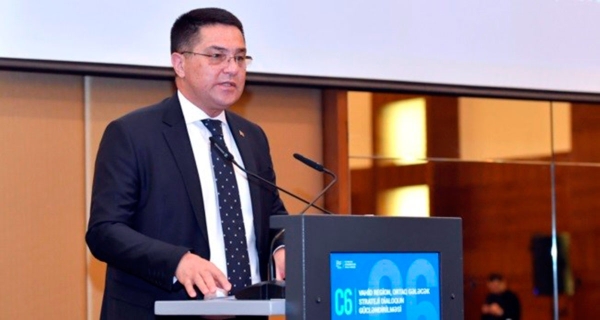
The Director of the Scientific Center for Strategic Studies at the Institute of International Relations of the Ministry of Foreign Affairs of Turkmenistan, Ambassador Shiri Shiriev, recently shared detailed insights in an interview with the portal “Turkmenistan – Golden Age” about the new C6 format (Central Asia + Azerbaijan). He described it as a significant stage in the evolution of regional cooperation and a strengthening of the countries’ positions on the international stage.
According to the expert, the origins of the C6 format trace back to 2018, when the mechanism of Consultative Meetings of the Heads of State of Central Asian countries was launched (initially in the C5 format). This tool enabled the regional states to regularly engage in open dialogue, build mutual trust, and coordinate key decisions. Over several years, this led to tangible results: the atmosphere of interstate relations improved significantly, transport connectivity increased, and intra-regional trade turnover doubled.
The C5+ format (involving external partners) evolved into a recognizable diplomatic brand, attracting the attention of major global players — China, Russia, the United States, the EU, India, Japan, the Republic of Korea, France, Italy, Germany, and the Gulf Cooperation Council.
“These meetings, which have no analogues in world practice, ultimately consolidated the region’s new international subjectivity,” the expert believes.
The culmination of the process was the November 2025 event — the Consultative Meeting of the Heads
of State of Central Asian countries, during which Azerbaijan officially joined the format as a full participant, transforming C5 into C6.
Shiri Shiriev notes: “A common geopolitical identity has already formed between Azerbaijan and the countries of Central Asia, and this is a natural process. […] The geopolitical developments of the last three decades in the region — in the spheres of economy, transport, trade, energy, and security — have made deeper cooperation a necessity.”
In the assessment of the Turkmen expert, Baku’s accession did not merely expand the format quantitatively but added qualitatively new depth. “Azerbaijan fits organically into this space: it strengthens geo-economic connectivity, especially in Caspian logistics and energy, expands opportunities for coordination on international issues, and opens new avenues for investment and technological exchange — from traditional sectors to digital solutions,” he says.
Regarding the goals of the C6 format, Shiriev emphasized that it “strengthens the sovereignty of the states by providing alternative routes to global markets through Azerbaijan.”
The expert stresses that C6 serves as a conceptual foundation for cooperation between the CA5 (the five Central Asian countries) and Azerbaijan, aimed at developing the Trans-Caspian Corridor (Middle Corridor), energy integration, and strengthening regional security.
The key directions of the strategic dialogue are economy and logistics, security, and resilience. Shiri Shiriev is convinced that C6 represents a clear strengthening of the region’s position on the international arena: now the six states can act with coordinated positions. ///nCa, 24 February 2026