


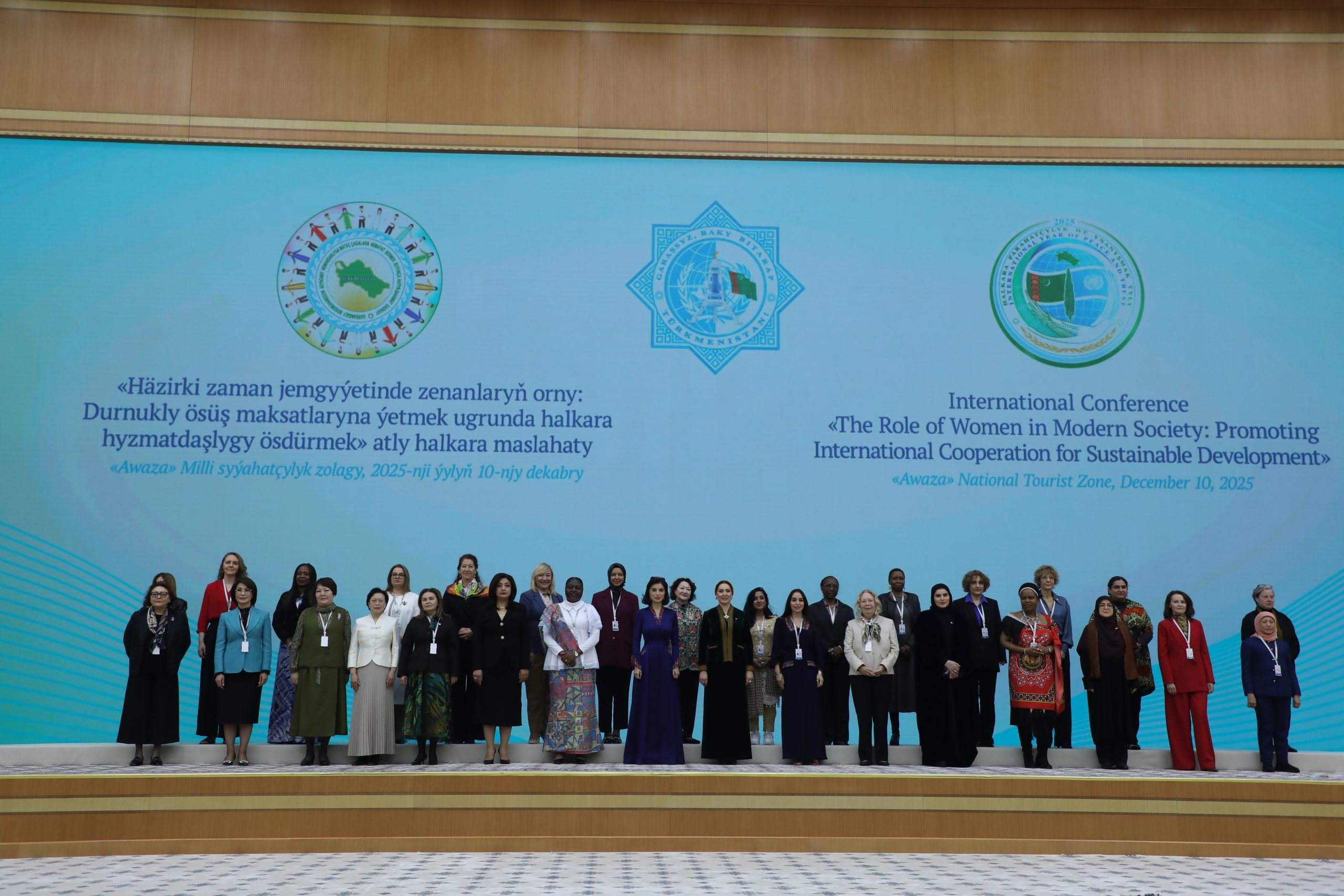
Turkmen state media have released the text of the Final Document of the International Conference “The Role of Women in Modern Society: Promoting International Cooperation for Sustainable Development,” which took place in the Awaza National Tourist Zone on December 10, 2025.
In the document, conference participants reaffirmed their commitment to the goals of gender equality and the empowerment of women within the framework of the 2030 Agenda for Sustainable Development.
The document recommends four key strategic directions for strengthening the role of women, which include:
- Participation of women in public administration and civil society institutions;
- Economic opportunities for women;
- Social activism in the fields of education, healthcare, and ecology;
- Strengthening international cooperation and partnership for gender equality.
Final document of the International Conference “The Role of Women in Modern Society: Promoting International Cooperation for Sustainable Development” (unofficial translation)
We, the participants of the International Conference “The Role of Women in Modern Society: Promoting International Cooperation for Sustainable Development”, gathered in the Awaza National Tourist Zone (Turkmenistan) on December 10, 2025, at the invitation of the Government of Turkmenistan in cooperation with the United Nations, on the eve of the International Day of Neutrality and the 30th anniversary of Turkmenistan’s permanent neutrality in the International Year of Peace and Trust (2025), guided by the spirit of strengthening multilateral dialogue, partnership and cooperation among states in the interests of sustainable development, gender equality and the empowerment of women,
Recognizing our commitment to the purposes and principles of the Charter of the United Nations, including respect for human rights, the equal rights of men and women and the promotion of universal security and progress,
Noting that the growing role of women in modern society represents one of the defining trends of global social development and includes both traditional family responsibilities and professional, public and managerial functions, and recognizing that the active participation of women in all spheres of the life of the state and society contributes to the strengthening of social progress, economic growth and humanitarian values,
Acting in the context of the International Year of Peace and Confidence (2025) and taking into account that in 2025 the world community will celebrate the 30th anniversary of the Fourth World Conference on Women and the adoption of the 1995 Beijing Declaration and Platform for Action, and will also enter the final stage of implementing the 2030 Agenda for Sustainable Development,
Recalling the Beijing Declaration and Platform for Action (1995), which became the agenda for the empowerment of women and the main global strategic document for achieving gender equality, and reaffirming the commitment to its goals and strategic directions,
Recalling the relevant United Nations resolutions and decisions aimed at the promotion and protection of women’s rights, including the General Assembly resolutions on the advancement of women and the achievement of gender equality, and taking into account the conclusions and recommendations of the United Nations Commission on the Status of Women,
Emphasizing the importance of the full and effective implementation of the 2030 Agenda for Sustainable Development and all 17 Sustainable Development Goals, in particular Goal 5 – Achieve gender equality and empower all women and girls, as well as the Women, Peace and Security Agenda and other global initiatives aimed at the full inclusion of women in the peacekeeping and humanitarian dimensions of development,
We are convinced that further strengthening of international cooperation in matters of enhancing the role of women in the life of states, ensuring their rights, opportunities and decent living conditions, as well as integrating a gender perspective into all areas of politics and development is crucial for achieving the Sustainable Development Goals and building a just, peaceful and inclusive society,
I. Participation of women in public administration and civil society institutions
1. We affirm that the full and equal participation of women in leadership, public administration and civil society institutions is a prerequisite for ensuring effective, accountable and inclusive governance;
2. We note that the presence of women at all levels of the decision-making process contributes to the enrichment of political discourse, increasing the focus of policies on the needs of the entire population and the promotion of sustainable and inclusive development;
3. We call upon all UN Member States to ensure the necessary conditions for the full and equal participation of women in political and public life, paying particular attention to the development of their leadership potential through training and mentoring programs, supporting the active civic position of young women leaders, as well as expanding opportunities for women to participate in the activities of political parties, trade unions and other public associations;
4. We note the special role of civil society, non-governmental women’s organizations and movements in promoting gender equality and protecting the rights and interests of women;
5. We encourage awareness-raising campaigns and educational programs aimed at raising public awareness of the significant contribution of women leaders, as well as actively engaging men in efforts to promote gender equality and support women leaders.
II. Economic Opportunities for Women
6. We note that the economic empowerment of women is a crucial element in achieving sustainable development, making a significant contribution to reducing poverty, improving the well-being of families and societies, and ensuring sustainable economic growth at the national and global levels;
7. We confirm that ensuring equal economic opportunities for women should be facilitated by strengthening national sustainable development strategies and programmes aimed at increasing women’s participation in the economy and creating a favourable environment for women’s entrepreneurship;
8. We note that the development of women’s entrepreneurship and support for women entrepreneurs play an important role in sustainable economic growth and improving the socio-economic situation of society;
9. We emphasize that the digital transformation of the economy must be accompanied by overcoming the gender digital gap, noting that increasing women’s participation in the digital economy and high-tech industries has not only an equity aspect, but also significant economic potential;
III. Women’s social activity in the fields of education, healthcare and ecology
10. We reaffirm that ensuring equal access of women and girls to quality education at all levels is a fundamental basis for expanding their opportunities in society, and note the significant progress achieved in this area over the past decades;
11. We note that the most important area of social activity is the involvement of women in the fields of science, culture, education and youth education, given that women constitute a significant portion of workers in education and health care, and their contribution is critically important for the development of human capital;
12. We emphasize the need to encourage professional women to act as mentors and role models for the younger generation, inspiring girls and young women to choose careers in science, medicine, ecology and other important social areas;
13. Recognize that the health of women and girls is essential for national health and sustainable development, emphasizing that positive progress has been made at the global level in recent years;
14. We emphasize the need to further strengthen health systems, taking into account gender aspects – from expanding coverage of maternal and child health services to ensuring widespread access to modern family planning services;
15. Note that women play a key role in maintaining the health of families and communities as mothers, caregivers, health workers and volunteers, and that their care ensures the well-being of future generations;
16. We emphasize that women are active participants in efforts to protect the environment and combat climate change, and welcome the increase in their contribution to the development and implementation of environmental policies;
17. We call on the international community and national governments to more actively involve women in decision-making processes on environmental issues, climate change, water and energy resource management;
18. We note that educated and healthy women who have realized their potential make a more significant contribution to economic development, family well-being, and strengthening peace and stability;
19. We call upon Member States, educational and scientific institutions, the private sector and civil society to establish partnerships to support social initiatives led by women, including in the fields of education, health, culture and the environment;
IV. Strengthening international cooperation and partnership for gender equality
20. We reaffirm that achieving gender equality and women’s empowerment requires active international cooperation, exchange of experience and joint action by all States, UN organizations, regional organizations, civil society and the private sector;
21. We welcome the efforts undertaken at the global and regional levels to coordinate policies on gender equality and emphasize the value of multilateral dialogue on these issues;
22. We particularly note the importance of holding international and regional conferences and forums dedicated to the role of women and gender issues as effective platforms for exchanging best practices, monitoring progress achieved and developing coordinated approaches;
23. We recommend continuing the practice of convening such forums, including on the sidelines of the UN, in order to maintain the constant attention of the international community to issues of expanding women’s rights and ensure the further advancement of this agenda;
24. We call for the creation and strengthening of new dialogue platforms and networks aimed at promoting cooperation on gender issues;
25. We call for expanded interaction between governments, international organizations and civil society to implement joint initiatives such as global networks of women leaders, regional forums of business women, youth women’s summits and others;
26. We support the idea of establishing permanent thematic groups of friends on gender equality issues at the UN and at regional platforms, which will promote the attraction of resources and political support for relevant programs;
27. We are confident that new platforms for direct exchange of experiences between women leaders, parliamentarians, entrepreneurs, scientists and cultural figures will become an important resource for mutual learning and strengthening the global movement for women’s rights;
28. We note the complementarity of the Women, Peace and Security and Youth, Peace and Security agendas and emphasize the importance of including young women in peacebuilding initiatives;
29. We call upon the United Nations and its specialized agencies, as well as international financial institutions, to continue and increase their support for national efforts to achieve gender equality;
30. We express our deep gratitude to the Government of Turkmenistan, the Gurbanguly Berdimuhamedov Charitable Foundation for Assistance to Children in Need of Guardianship, the UN system structures and all the organizers and partners for holding this International Conference dedicated to the role of women in modern society, and for their consistent contribution to the promotion of ideas of gender equality, mutual understanding and sustainable development;
31. We declare our readiness for further cooperation within the UN, regional organizations, multilateral and bilateral initiatives for the practical implementation of the ideas and recommendations developed during the Conference, and also agreed to continue to make joint efforts with the aim of achieving real progress in the empowerment of women, promoting their participation in all spheres of life and ensuring equality on a global scale;
32. We call upon Member States, UN agencies and relevant partners to continue to strengthen the spirit of dialogue, cooperation and equality, thereby ensuring that women’s empowerment becomes a lasting asset of the international community and a key priority for international cooperation.
Awaza, Turkmenistan, December 10, 2025. ///nCa, 17 December 2025