


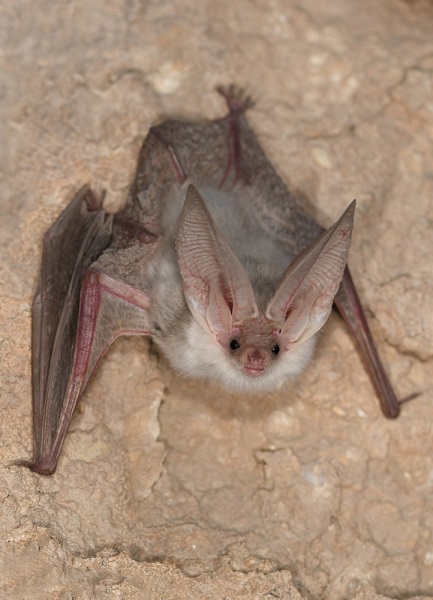
An international team of scientists from Germany, Uzbekistan and Turkmenistan, led by the Museum für Naturkunde Berlin, has rediscovered the Turkestan long-eared bat (Plecotus turkmenicus) in the Karakum Desert of Turkmenistan, a species not recorded alive for the past half-century.

In October 2025, a targeted international expedition focused on locating this bat. Researchers visited historical sites and other suitable locations in the Karakum Desert. A juvenile female was first found in a cliff crevice. An adult male was then discovered in a loess cave 87 km away, in the border area with Uzbekistan. Thus, for the first time since 1970, the continued existence of the species has been confirmed.
For the first time ever, photographs, video footage and audio recordings were obtained of living individuals of this mysterious desert dweller, previously known only from a few museum specimens in Russian museum collections. Genetic samples were also collected to study the evolutionary history of Central Asian bats.
During systematic surveys of Turkmenistan’s bat fauna for the update of the national Red Data Book, the Turkestan long-eared bat received the highest priority due to the almost complete lack of knowledge about it. Being endemic to the Karakum Desert and adjacent border regions of Turkmenistan, Kazakhstan and Uzbekistan, there were serious fears that the species was extremely rare or possibly extinct.
The species is likely under severe threat, primarily from climate change. Ongoing desertification in Central Asia, driven by rising temperatures, is reducing the already sparse vegetation cover, thereby shrinking both food resources and habitat for the bat.
The discovery in the border zone also suggests the previously unknown presence of Turkestan long-eared bat in Uzbekistan.
The Government of Turkmenistan is now incorporating the rediscovery into its plans to establish a major protected area of more than 50,000 hectares. This will benefit not only the endemic bat but the entire biodiversity of Central Asia’s cold winter deserts, including large mammals such as the Asiatic wild ass (kulan) and goitered gazelle (jeyran).
Close cooperation between the Museum für Naturkunde Berlin, the Ministry of Environmental Protection of Turkmenistan, the Administration of Protected Areas of Turkmenistan, and the Academy of Sciences of Uzbekistan on the study of Central Asian bat fauna will continue. ///nCa, 8 December 2025 (photo credit – Christian Dietz)