


A Foundation Built on Ancient Values, Guided by Modern Vision

Tariq Saeedi
When the world gathers in Ashgabat on December 12, 2025, for the international conference marking the 30th anniversary of Turkmenistan’s permanent neutrality, the discussions will encompass far more than diplomatic protocols and geopolitical strategy.
At the heart of this mega-event lies a profound truth: neutrality, as refined and developed by Gurbanguly Berdimuhamedov—Arkadag, the National Leader of Turkmenistan—has evolved into something unprecedented in international relations. It has become a living, breathing doctrine of compassion that reaches across borders to touch the lives of the most vulnerable among us: children in need.
This evolution did not happen by accident. It is the result of Arkadag’s systematic, diligent work over decades to develop what can only be called the humanitarian dimension of neutrality—a concept that transforms a legal status into a moral imperative, a bridge between nations into a lifeline for those who suffer.
The Genesis of Compassion: March 2021
In March 2021, a remarkable institution was born in Turkmenistan. The Charitable Foundation for Assistance to Children in Need of Care, named after Gurbanguly Berdimuhamedov, emerged from a vision that saw beyond borders, beyond politics, to the simple human truth that every child deserves care, health, and hope. This was not merely the establishment of another charitable organization. It was the practical manifestation of Arkadag’s understanding that true neutrality must have a human face, a helping hand, a compassionate heart.
The foundation’s creation was deeply rooted in the ancient humanistic traditions of the Turkmen people—traditions of hospitality, generosity, and care for those in need. Yet Arkadag’s genius lay in channeling these timeless values through modern institutional frameworks, creating a mechanism through which Turkmenistan’s neutral status could become an active force for good in the world.

Four Years of Transformative Action
Since its inception, the foundation has become far more than a national institution. It has evolved into an international symbol of how a neutral country can actively contribute to global humanitarian efforts while maintaining its principled stance of non-interference and peaceful cooperation.
Healing Within Borders
At home, the foundation has touched countless young lives. The flagship achievement stands proudly in the new city of Arkadag: the Children’s Health and Rehabilitation Center named after Gurbanguly Berdimuhamedov. This state-of-the-art facility, the first of its kind in the region, represents a quantum leap in pediatric care. Equipped with cutting-edge medical technology, it provides comprehensive treatment and rehabilitation services to children who need specialized care.
The foundation has systematically strengthened the healthcare infrastructure across all five velayats of Turkmenistan. Modern ambulances, equipped with the latest emergency medical equipment, have been donated to children’s departments in regional hospitals.
Sophisticated dialysis machines from German manufacturer B.Braun have been placed in maternal and child health centers across the country, extending the reach of life-saving kidney treatment to children in every corner of the nation.
Beyond medical equipment, the foundation supports surgical interventions, rehabilitation programs, and long-term medical care for children in orphanages, specialized schools, and boarding institutions. Each intervention is more than a medical procedure—it is a promise that no child will be left behind, that every young life matters.
Reaching Across Borders
But perhaps the most profound expression of the humanitarian dimension of neutrality lies in the foundation’s international activities. Here, Arkadag’s vision reveals its full scope.
Turkmenistan’s neutral status is not passive neutrality—it is what has been termed “positive neutrality,” an active engagement with the world’s suffering that respects sovereignty while answering the universal call of human compassion.
The foundation’s humanitarian assistance has reached children in Turkey following the devastating earthquakes, in Ukraine amid ongoing challenges, in Palestine during times of crisis, in Afghanistan where reconstruction continues, in Tajikistan where schools need support, and in Russia’s Primorsky Krai when help was needed.
This is not random charity. It is systematic humanitarian diplomacy, guided by the principle that a neutral nation has a special responsibility to serve as a beacon of hope and help wherever children suffer.
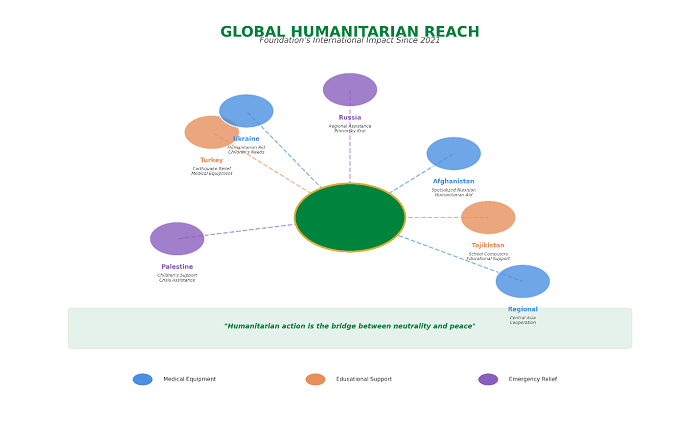
The scope is impressive: medical equipment, clothing, food, educational supplies, and specialized nutrition have all been dispatched to countries in need. In Tajikistan’s Khatlon region, computers were provided to schools built by Turkmen construction workers. In Afghanistan, specialized children’s nutrition produced in Turkmenistan’s medical cluster was sent to support the youngest and most vulnerable.
The Architectural Vision: Neutrality’s Humanitarian Dimension
What Arkadag has accomplished goes beyond charitable work. He has architected a new understanding of what neutrality can mean in the 21st century.
Traditional neutrality often suggested distance, non-involvement, a careful stepping back from the world’s troubles. Arkadag’s concept of positive neutrality, with its humanitarian dimension, proposes something radically different: deep involvement in alleviating human suffering, active participation in global humanitarian efforts, but always through the lens of respect for sovereignty, non-interference in internal affairs, and the promotion of peace.
This humanitarian dimension operates on several interconnected levels:
The Preventive Level: By addressing humanitarian needs, particularly among children, the foundation contributes to conflict prevention. Healthy, educated, supported children are the foundation of stable societies. This aligns perfectly with Turkmenistan’s emphasis on preventive diplomacy.
The Bridge-Building Level: Humanitarian assistance creates bonds of friendship and trust between peoples. When Turkish families see Turkmen aid arriving after an earthquake, when Afghan children receive nutrition from Turkmenistan, when Palestinian youngsters receive support in difficult times—these acts build bridges that no amount of formal diplomacy could construct.
The Values Level: The foundation demonstrates in practical terms that Turkmenistan’s neutrality is grounded in profound humanistic values. It shows that neutrality is not indifference but rather a commitment to universal human dignity that transcends political divisions.
The Institutional Level: Through partnerships with UNICEF, cooperation with the UN’s Sustainable Development Goals framework, participation in international conferences, and collaboration with humanitarian organizations across Asia, Europe, and the Middle East, the foundation has created an institutional architecture that embeds humanitarian action within Turkmenistan’s neutral foreign policy.

Recognition and Growth
The international community has noticed. At the 57th session of the UN Commission on Population and Development, significant attention was devoted to the humanitarian activities of the foundation.
UNICEF’s representative in Turkmenistan has called the foundation’s work “an excellent example of realizing the tradition of helping those who need support.” The UN Resident Coordinator in Turkmenistan presented a certificate recognizing the foundation’s valuable contribution to helping children in need and implementing the core principle of the 2030 Agenda: “leaving no one behind.”

In March 2025, on the foundation’s fourth anniversary, an international conference in Arkadag city brought together representatives from Uzbekistan, Turkey, Iran, Russia, Kazakhstan, China, Tajikistan, Belarus, Kyrgyzstan, India, Georgia, Armenia, Pakistan, and Austria, along with international organizations and companies. The theme—”Year of Peace and Trust: Developing International Activities in the Interests of Children”—captured perfectly how the foundation’s work connects to Turkmenistan’s broader neutrality policy.
That same month, the foundation signed an expanded partnership agreement with UNICEF, marking a new stage in cooperation on healthcare development, education, child protection, and social integration. The Ministry of Health and Medical Industry of Turkmenistan also formalized its collaboration with the foundation, creating systematic mechanisms for supporting children’s health initiatives.
The December 12 Context: Where Neutrality Meets Humanity
As we approach December 12, 2025, the significance of this date resonates on multiple levels. Thirty years ago, on December 12, 1995, the UN General Assembly unanimously adopted Resolution 50/80, recognizing Turkmenistan’s permanent neutrality. All 185 member states at that time supported this historic decision. The resolution was reaffirmed in 2015, and most recently, on the 79th session of the UN General Assembly, a third resolution was adopted, welcoming Turkmenistan’s decision to host an international forum in December 2025.
This forum will be held at the highest level—heads of state and leaders of international organizations will gather in Ashgabat. They will discuss peace, security, sustainable development, and the role of neutrality in the modern world. But underlying every discussion will be the recognition that neutrality, as Turkmenistan practices it, is inseparable from humanitarian action.
The year 2025 has been declared by the UN General Assembly, at Turkmenistan’s initiative, as the “International Year of Peace and Trust.” This designation is particularly symbolic: it coincides not only with the 30th anniversary of Turkmenistan’s neutrality but also with the 80th anniversary of the United Nations itself. UN Secretary-General António Guterres has emphasized that UN structural divisions will actively participate in the international events organized by Turkmenistan, with the December 12 forum serving as the culmination.
Arkadag’s Systematic Development of the Concept
To understand how we arrived at this point requires looking back at Arkadag’s methodical approach to developing the concept of neutrality. From the foundation laid by the first President, who first secured international recognition of neutrality, Arkadag built layer upon layer of sophistication.
He established the Regional Center for Preventive Diplomacy for Central Asia in Ashgabat in 2007, creating an institutional mechanism for neutrality to serve peace in the region. He championed the adoption of numerous UN resolutions that expanded the understanding of neutrality’s role: the declaration of December 12 as International Day of Neutrality (2017), resolutions on the role of neutrality in maintaining peace and security, the designation of Central Asia as a zone of peace, trust, and cooperation, and the International Year of Dialogue as a Guarantee of Peace (2023).
But perhaps his most profound contribution has been in practice rather than policy. Through the Charitable Foundation, through Turkmenistan’s consistent provision of humanitarian aid to Afghanistan, through the construction of social facilities in neighboring countries, through educational and cultural exchange programs, Arkadag demonstrated that neutrality could be active, engaged, and profoundly humanistic.
He understood that in a world often divided by ideology, politics, and power struggles, there is a universal language that transcends all divisions: the language of care for children, of healing the sick, of supporting those who have no one else to turn to. This humanitarian dimension of neutrality is perhaps his greatest gift to international relations.
The Locomotive of Change
The humanitarian dimension, as developed by Arkadag, serves as the locomotive—the driving force—for the foundation’s work. It provides both the philosophical foundation and the practical framework. Philosophically, it answers the question: “What is our neutrality for?” The answer: to serve peace, yes, but also to serve humanity, to alleviate suffering, to build bridges of compassion.
Practically, it provides clear guidance for action. When crises emerge—earthquakes, conflicts, natural disasters—the foundation knows how to respond in ways that are consistent with Turkmenistan’s neutral status. It provides assistance based solely on need, without political conditions or attempts to influence internal affairs. It works through established international frameworks, respecting sovereignty and international law. It focuses on the most vulnerable—children—whose needs transcend politics.
Financial Transparency and Public Trust
One remarkable aspect of the foundation’s operation is its commitment to transparency. Information about income and expenditures is regularly published in open sources, allowing donors to see exactly how their contributions are used. This transparency has been crucial in building public trust and encouraging broader participation.
The foundation’s budget is formed primarily through voluntary donations from citizens and organizations within Turkmenistan. This grassroots support demonstrates that the humanitarian values embodied in the foundation resonate deeply with the Turkmen people. The willingness of ordinary Turkmenistani to contribute to helping children in need—both at home and abroad—reflects the healthy moral foundation of society and validates Arkadag’s vision that humanitarian action should be a shared national endeavor.
Looking Forward: The Conference and Beyond
The December 12, 2025 conference will undoubtedly be a historic event. Heads of state will gather, resolutions will be adopted, and new initiatives will be announced. But beyond the formal proceedings, the conference represents something more profound: a recognition that after 30 years, Turkmenistan’s experiment with permanent neutrality has proven not just viable but valuable to the international community.
The foundation’s work will serve as a powerful example during these discussions. When diplomats debate the role of neutrality in modern international relations, they can point to concrete examples of how neutral status enables humanitarian action. When policymakers consider conflict prevention strategies, they can examine how addressing children’s needs contributes to stability. When international organizations seek partners for implementing the Sustainable Development Goals, they can see in the foundation a model of how national institutions can advance global objectives.
Arkadag will undoubtedly be present, not in an official capacity perhaps, but his presence will be felt in every discussion, for it is his vision that has shaped modern Turkmenistan’s approach to neutrality. His systematic refinement of the concept, his patience in building institutional frameworks, his insistence on the humanitarian dimension—all of these will be vindicated and celebrated.
The Universal Message
There is something profoundly moving about the foundation’s work that transcends geopolitics and national interests. In a world often characterized by division, competition, and conflict, here is an institution that operates on a simple premise: children in need deserve help, regardless of where they live or what political system governs them.
When the foundation sends medical equipment to one country, educational supplies to another, food to a third, it is not engaging in strategic calculation or seeking advantage. It is simply responding to the ancient human impulse to help those who suffer—an impulse that the Turkmen people have honored for centuries but that Arkadag has channeled into modern, effective, international humanitarian action.
This is the true test of neutrality’s humanitarian dimension: Does it make a practical difference in people’s lives? For the child in Turkey who received warm clothing after an earthquake, for the student in Tajikistan who gained access to a computer, for the young patient in Turkmenistan who received life-saving dialysis treatment, for the infant in Afghanistan who received proper nutrition—for all of these children, the answer is unequivocally yes.
A Living Legacy
As we stand on the threshold of December 12, 2025, we can see clearly what Arkadag has built. Starting from the solid foundation of Turkmenistan’s internationally recognized neutral status, he has constructed something unprecedented: a comprehensive doctrine of positive neutrality with a sophisticated humanitarian dimension, supported by effective institutions like the Charitable Foundation, and manifested in concrete action that touches lives across borders.
This is part of his living legacy—not written in treaties or embodied in monuments, but alive in the health of children, in the strength of international partnerships, in the model of how a nation can be both neutral and deeply engaged, both respectful of sovereignty and actively compassionate.

The December conference will celebrate 30 years of neutrality, but it will also, whether explicitly or implicitly, celebrate the evolution of that neutrality into something richer and more meaningful than its founders might have imagined. It will celebrate the vision of a man who saw that true strength lies not in dominance but in service, that true influence comes not from interference but from helping others, and that a nation’s greatness can be measured by how it cares for the most vulnerable, wherever they may be.
The humanitarian dimension of neutrality, as developed by Arkadag and embodied in the Charitable Foundation, is not just a policy or a program. It is a gift to the world—a demonstration that even in our fractured times, universal human values can unite us, that compassion can be a form of diplomacy, and that the most powerful force for peace may simply be the act of helping a child in need.
This is the message Turkmenistan will bring to the world on December 12, 2025. It is a message the world desperately needs to hear.
***
As the marble halls of Ashgabat prepare to welcome the world’s leaders, and as the Charitable Foundation continues its quiet, persistent work in hospitals and orphanages, in disaster zones and refugee camps, we are reminded that true neutrality is not the absence of commitment—it is commitment to the highest values that unite all humanity. This is Arkadag’s vision. This is Turkmenistan’s gift. This is the future of humanitarian diplomacy. /// nCa, 19 November 2025