


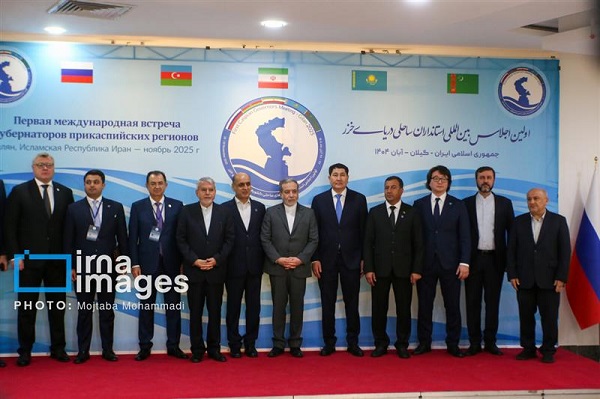
The inaugural Meeting of Governors of Coastal Provinces of the Caspian Sea Littoral States opened on Tuesday (18 Nov) in Rasht, the capital of Iran’s northern Gilan province, under the motto “Caspian: A Bridge for Friendship and Regional Development.”
Hosted by Iran, the two-day forum brought together governors and high-level delegations from all five Caspian littoral states: Russia (Astrakhan Oblast, Republic of Dagestan, Republic of Kalmykia), Azerbaijan (Baku city, Lankaran and Sumqayit), Kazakhstan (Mangystau and Atyrau regions), Turkmenistan (Balkan province), and Iran’s five Caspian provinces (Gilan, Mazandaran, Golestan, and the Caspian coastal areas of Ardabil and East Azerbaijan).
The opening ceremony was addressed by Iranian Foreign Minister Seyed Abbas Araghchi and Minister of Cultural Heritage, Tourism and Handicrafts Reza Salehi Amiri.
The meeting also brought together Iran’s ministers of economy and road and urban development, ambassadors of the Caspian states, the Secretary-General of the Economic Cooperation Organization (ECO), and other senior officials.
Speaking at the opening of the forum, foreign minister of Iran Araghchi described the gathering as a “new initiative” in Caspian cooperation and a practical step toward strengthening neighborly relations, which he called the “most important core principle” of Iran’s foreign policy.
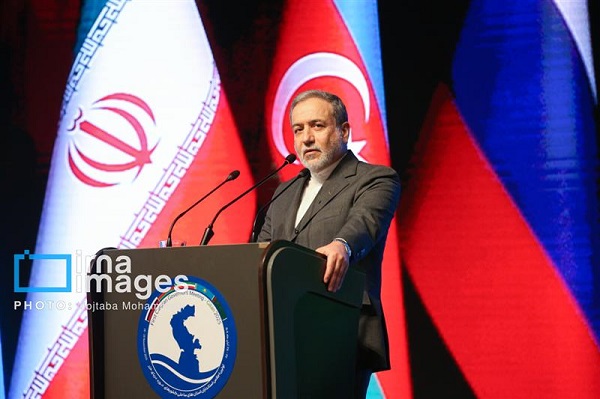
“Our priority is our neighbors,” Araghchi told the audience. “We have excellent and, in some cases, strategic relations with all Caspian littoral states.” He highlighted recent high-level visits, including President Masoud Pezeshkian’s trips to Russia and Azerbaijan, with forthcoming visits planned to Kazakhstan and Turkmenistan within the next month.
The minister noted that the Caspian Sea region is important in terms of energy, corridors, and transit routes. “Economic and trade cooperation between the countries in this area, utilizing the Caspian Sea route, holds paramount importance for all member countries”, he said.
Deputy Minister for Legal and International Affairs Kazem Gharibabadi has emphasized that the future of the Caspian Sea should be based on collaboration and shared benefits, describing the sea as a unified civilizational, economic, environmental, and security area, which links the fates of the coastal provinces. [IRNA].
He described the significance of the Caspian Sea, not just as a maritime territory, but as a vital resource for fisheries, energy, and trade routes.
He noted that the Caspian Sea is home to the world’s largest sturgeon population, underscoring the need for sustainable management practices to protect this essential food source.
Furthermore, he pointed out the region’s substantial oil and gas reserves, which present opportunities for economic growth through collaborative projects and investments.
The conference agenda is divided into three panel discussions:
- Economic Cooperation: investment opportunities, trade facilitation, agricultural collaboration, and tourism development.
- Transit and Transport: advancement of the International North-South Transport Corridor (INSTC), maritime links, railway connectivity, and customs coordination.
- Environmental Protection: restoration of the Caspian ecosystem, wetland conservation, sustainable fisheries management, and promotion of a green economy.
The meeting concludes on Wednesday, 19 November 2025.
The Caspian littoral states cooperate through several five-party formats, including summits at the level of heads of state, regular meetings of foreign ministers, the Commission for the Conservation and Rational Use of the Caspian Sea’s Aquatic Biological Resources, as well as Caspian economic forums and media forums. ///nCa, 19 November 2025