


On 5 August 2025 the first interactive thematic round table was held on the sidelines of the Third UN Conference on Landlocked Developing Countries. The event was themed “Structural transformation, diversification, and science, technology and innovation as drivers of prosperity in landlocked developing countries”.
This session highlighted the importance of structural transformation, especially through science, technology, and innovation, as crucial for boosting productivity and economic growth. Agriculture, a key sector in many landlocked developing countries, was discussed as an area needing diversification and innovation.
Moderated by Mariin Ratnik, Deputy Minister for Economic and Development Affairs of Estonia, and Edil Baisalov, Deputy Chairman of the Cabinet of Ministers of the Kyrgyz Republic, the round table featured a keynote address by Uchral Nyam-Osor, First Deputy Prime Minister and Minister for Economy and Development of Mongolia.
The panelists included: Sepp Schellhorn, State Secretary at the Federal Ministry for European and International Affairs of Austria; Claver Gatete, Executive Secretary of the United Nations Economic Commission for Africa; Deodat Maharaj, Managing Director of the UN Technology Bank for the Least Developed Countries; and Prudence Sebahizi, Minister for Trade and Industry of Rwanda.
Highlighting Estonia’s experience with digital transformation, Mariin Ratnik noted that her country is also an “early adopter of artificial intelligence” and is using it to accelerate data-based and efficient public services. Financing remains a critical bottleneck, she noted, pointing to the essential role of green bonds and private capital. Also crucial is operationalizing the Sevilla Commitment, the outcome document of the recently held Fourth International Conference on Financing for Development, she said, calling for “solidarity, innovation and shared accountability”.
Her co-chair, Edil Baisalov, Deputy Chairman of the Cabinet of Ministers of Kyrgyzstan, noted that structural transformation is at the heart of the ambitious vision of the Awaza Programme of Action. Increasing labour productivity and decent employment are not abstract targets, but actionable and timebound goals. Many landlocked developing countries are heavily reliant on the export of unprocessed commodities, he noted, stressing the need to prioritize investments in rural infrastructure and agricultural innovation. In that regard, he called for regional agricultural research hubs, as well as equitable management of critical minerals that are needed for the global green energy transformation.
Mongolia Hails Transformative Power of Science, Technology and Innovation in Landlocked Developing Countries’ Economies
“With the right investments and reforms, STI can support LLDCs in digitizing trade logistics, strengthening food systems, expanding access to services, and enabling youth entrepreneurship,” said Uchral Nyam-Osor, First Deputy Prime Minister and Minister for Economy and Development of Mongolia.
“In Mongolia, we are approaching STI not as a lofty ideal, but as a practical driver of sectoral and structural reform,” he said, noting his Government is working to mainstream science and technology into core development strategies, with clear national priorities and a strong emphasis on outcomes.
These include legislative reforms to improve intellectual property protection and research and development governance; support for public-private partnerships in agriculture innovation and climate resilience; the establishment of local innovation hubs in secondary cities to foster rural entrepreneurship and applied research; and reforms in public procurement to create space for domestic innovation.
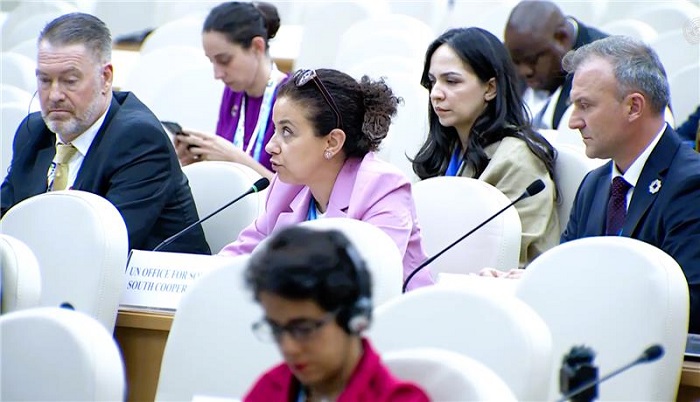
Landlocked Developing Countries Must Invest Heavily in Border Infrastructure to Enable Smooth Trade, Economic Commission for Africa Head Says
“One of the biggest problems is what happens at the border,” said Claver Gatete, Executive Secretary of the United Nations Economic Commission for Africa, highlighting the complexity of border logistics, from cold storage for perishable goods to identification systems.
Highlighting an example from eastern Africa, he said that the President of Rwanda “put people in a truck to understand what was happening on the road”, and found that trade between his country and its immediate neighbours was running into long delays due to multiple road blocks, weigh bridges and vehicle searches, as well as problems caused by multiple insurance systems.
The countries concerned took a decision to remove all roadblocks and most weighbridges, introduced an electronic tracking system, enabled movement of people using IDs and promoted a single insurance. As a result, trade that took 21 days was reduced to 5 days.
Holistic Approach Focused on Agrifood, Agro-Processing Value Chains Key for Agricultural Transformation, Austria’s State Secretary Says
“As a former chef I know what I am talking about,” said Sepp Schellhorn, State Secretary at the country’s Federal Ministry for European and International Affairs, stressing that by ordering food products collectively, consumers are able to access low prices while small-hold farmers can sell large volumes directly to consumers.
Toward that end, in 2024, his Government and the World Food Programme (WFP) gave the Kofi Annan Award for Innovation in Africa to a digital startup that created a farm-to-fork operation.
And in Ethiopia, in partnership with the United Nations Industrial Development Organization (UNIDO), his Government helped establish a post-harvest management mechanization centre, which benefits small-hold famers and emerging agribusinesses by reducing post-harvest loss and fostering value addition.
Geographical, Structural Challenges Put Landlocked Developing Countries at Double Disadvantage, UN Technology Bank Official Says
Research and development spending remains low while the digital divide exacerbates inequalities and in some landlocked developing countries that are also among the least developed countries, such as Burundi, the Internet penetration is a mere 5 per cent, said Deodat Maharaj, Managing Director of the UN Technology Bank for the Least Developed Countries, stressing: “These are not mere gaps, but barriers”.
Structural transformation starts with raising productivity, he said, with the international community investing in climate-smart farming techniques, regional research hubs and digital tools that link farmers to markets. Landlocked developing countries must also move up value chains.
The Awaza Programme of Action has the “most ambitious [science, technology and development] targets” ever adopted by landlocked developing countries, he said, calling for financing and South-South cooperation to achieve this.
UN Technology Bank for Least Developed Countries
Türkiye’s speaker drew attention to the UN Technology Bank for Least Developed Countries, which is hosted by her country. The Bank has been carrying out projects aiming to strengthen their science, technology and innovation capacity, she said, calling on other development partners to increase engagement with the Bank. Burundi’s delegate said her country is focusing on modernizing agriculture and bridging the digital gap. She also stressed the need for partnerships to ensure equitable development of natural resources, including minerals.
The speaker for the World Intellectual Property Organization (WIPO) noted that filings of patents by residents of landlocked developing countries remain flat despite a more than 200 per cent increase in trademark filings over the last decade. Promoting intellectual property skills is crucial for broadening the entrepreneurial base, he said, noting WIPO has developed specific projects providing targeted support and mentoring for women entrepreneurs and youth in Kyrgyzstan, Tajikistan, Uzbekistan, Uganda, Botswana and other landlocked developing countries.

Countries Helping Each Other to Develop Science and Technology
In the ensuing interactive dialogue, representatives of Member States shared examples of how they have harnessed science and technology and called for international support for such efforts. Uganda has positioned science, technology and innovation as a cornerstone of the country’s economic strategy, its representative said. Agricultural produce that used to be sold as raw materials is increasingly being sold as value-added goods, she said, noting that her country also has Africa’s largest pharmaceutical vaccine manufacturing capacity.
The representative of Turkmenistan said that her country launched an information system to analyse labour market needs and designed an “atlas of professions of the future”. It also established a business incubator programme in 17 universities to train young entrepreneurs. Iran, that country’s delegate said, bridges Asia, Europe and the Middle East. This geographical advantage coupled with a robust logistical and transportation infrastructure makes it a natural partner for landlocked developing countries. The sanctions imposed on her country have in fact, helped improve its education system, she said.
“We may be a landlocked country, but we also see ourselves as being land-linked,” Eswatini’s representative said, pointing to its investments in space technology, science education for women and girls and digital services for its citizens. Uzbekistan’s delegate highlighted its proposal to create a regional agro-innovation hub in his country.///nCa, 6 August 2025 (based on press releases, issued by UN Media Coverage and PRs website)