


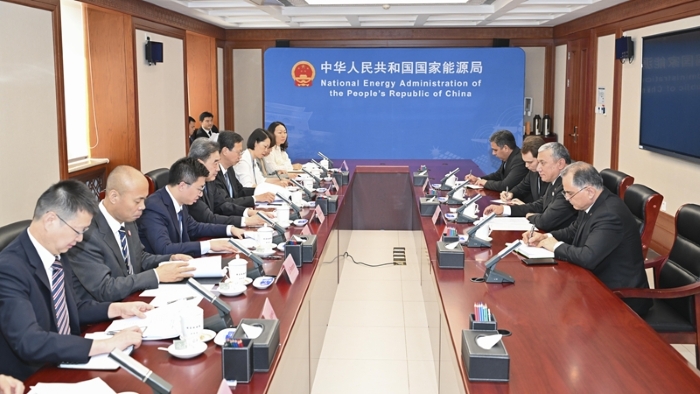
On 2 September 2025, a meeting took place in Beijing between Wang Hongzhi, head of China’s National Energy Administration (NEA), and Turkmenistan’s Deputy Prime Minister for oil and gas sector Batyr Amanov.
The meeting took place on the sidelines of the Turkmenistan President’s visit to China to attend the Shanghai Cooperation Organization (SCO) summit and celebrations marking the 80th anniversary of Victory in World War II.
During the meeting, the parties explored prospects for cooperation in the oil and gas sector and other areas. Wang Hongzhi emphasized that China and Turkmenistan are reliable partners, and their strategic cooperation, guided by the leaders of both countries, is reaching new heights. Energy cooperation is a key component of practical collaboration between China and Turkmenistan and is consistently under the close attention and personal oversight of the leadership of both nations. The NEA expressed its readiness to strengthen ties with Turkmenistan to further develop energy partnerships.
Batyr Amanov, in turn, praised the rich history and fruitful outcomes of Turkmen-Chinese energy cooperation. He affirmed Turkmenistan’s commitment to implementing agreements reached by the leaders of the two countries and to deepening energy partnerships.
The meeting was attended by NEA Deputy Head Ren Jingdong, China’s Ambassador to Turkmenistan Ji Shumin, Turkmenistan’s Ambassador to China Parahat Durdyev, and heads of departments responsible for oil, gas, and international relations.
On the same day, a meeting between the President of Turkmenistan and the Chairman of the People’s Republic of China took place in Beijing. It was noted that the China won a tender for the development of the fourth phase of the giant Galkynysh gas field (estimated reserves of 27.4 trillion cubic meters of hydrocarbons). Additionally, a draft General Agreement on the Basic Principles of Gas Cooperation was prepared, which will serve as the foundation for further partnership development.
China’s National Energy Administration, under the State Council’s National Development and Reform Commission, is responsible for formulating and implementing China’s energy policies. The NEA promotes reforms in the power sector, regulates energy sectors including coal, electricity, oil and gas, and nuclear power. It also supports science and technology research on energy efficiency and renewable energy.///nCa, 8 September 2025