


Tariq Saeedi
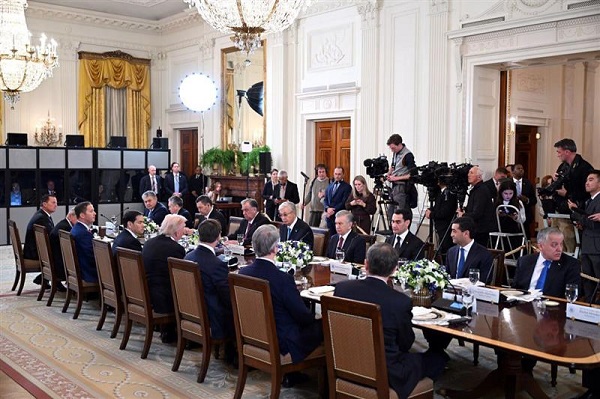
President Donald Trump hosted the leaders of Kazakhstan, Kyrgyzstan, Tajikistan, Turkmenistan, and Uzbekistan at the C5+1 summit in Washington, DC, on November 6, 2025.

According to the early reports, here are the main outcomes of the summit:
- Joint partnership for tungsten development in Kazakhstan: The US company Cove Kaz Capital Group will take a 70 percent stake in developing one of the world’s largest untapped tungsten deposits, alongside Kazakhstan’s state mining firm. The venture is estimated to cost $1.1 billion, with the US Export-Import Bank issuing a letter of interest to fund $900 million.
- Boeing aircraft deal: An agreement to sell up to a combined 37 Boeing jets to the national airlines of Kazakhstan, Tajikistan, and Uzbekistan (details yet to be fully specified).
- Starlink integration with Veon networks: Starlink, owned by Elon Musk, will integrate its satellite Internet services with telecom company Veon’s networks, starting with its operator Beeline in Kazakhstan.
- Kazakhstan’s intention to join the Abraham Accords: Kazakhstan announced it expects to join the US-led framework for cooperation between Israel and Arab/Muslim nations, with President Qasym-Zhomart Toqaev (Kassym-Jomart Tokayev) planning a phone call with Israeli Prime Minister Benjamin Netanyahu to formalize this; this builds on Kazakhstan’s existing diplomatic ties with Israel for over 30 years.
- Focus on critical minerals and trade opportunities: The summit emphasized expanding US investments in Central Asia’s rare earth elements and strategic minerals (e.g., uranium, copper, gold) to reduce global dependence on China, which controls nearly 70% of rare earth mining and 90% of processing; this aligns with a one-year pause on some Chinese export restrictions following a Trump-Xi meeting in late October.
- Signal of renewed US commitment: US officials, including Secretary of State Marco Rubio and Commerce Secretary Howard Lutnick, highlighted the alignment of national interests and opportunities for responsible development, positioning the C5+1 format as a key part of Trump’s foreign policy to counter Chinese and Russian influence in the region’s mining, processing, and logistics.
- Repeal of Jackson-Vanik amendment: A bipartisan group of U.S. senators introduced legislation to repeal outdated Soviet-era trade restrictions (such as the Jackson-Vanik amendment) to facilitate greater American investment and business opportunities in the region.
- U.S. support for the development of the Middle Corridor: The U.S. has expressed support for the development of the Middle Corridor transport route, with former Ambassador John Herbst noting Washington’s commitment to using its capacity to advance this project for mutual economic benefits.
* * *
The outcomes, as we know from the early reports, are encouraging in that they build on the mutual compatibilities rather than disruption of the existing partnership structures in the region.
However, in the case of such mega events, the outcomes – and their nuances – do not come to light in on go. There are several phases of the information reaching the public domain. Three of the usual phases are:
- Statements and announcements of the participants immediately after the summit
- Later announcements and statements by the top- and mid-level officials in various contexts over a somewhat prolonged period
- Actions by the participating countries in the coming weeks and months following the summit, demonstrating the way the participants interpret the outcomes
It is noteworthy that within the past few months, the C5+1 format saw similar meetings of the leadership of Central Asia with Russia, China, and the EU.

* * *
A summit of this nature is not an island. — It exists in a contiguous geopolitical territory.
Central Asia is the same as it was before the Washington Summit and it will continue to be the same after this grand meeting. — The Washington Summit has helped highlight the areas of mutual compatibility and the desire to build on them.
The real outcomes of the summit will not come out in one neat chunk – this is not in the nature of modern diplomacy. We need to wait and see.
* * *
When the leaders sit down across the table for this kind of summit, they are trying to protect their national interests while looking for the areas of potential interaction in the national interests of the other side.
This can be expressed in a simile – the front of a shirt has two sides, one with buttons and the other with buttonholes. The side with buttons is called button placket and the side with holes is called buttonhole placket.
Sometimes there is a mismatch between the button placket and the buttonhole placket. It is called placket warping. It occurs when the buttons and buttonholes are misaligned, leading to distortion in the placket (the overlapping front sections of the shirt). The solution is to remove the button and stitch it back to align with the buttonhole.
From the information available so far, the Washington Summit did not lead to any placket warping. The buttons and the buttonholes align satisfactorily. This shows, yet again, the flexibility and pragmatic approach of the Trump administration going forward. /// nCa, 7 November 2025 (photo credit – official website of President of Uzbekistan)