


On 21 October 2025, a solemn event dedicated to Uzbek Language Day was held at the Turkmen National Institute of World Languages named after Dovletmammed Azadi in Ashgabat. The event was organized in cooperation with the Embassy of the Republic of Uzbekistan in Turkmenistan.
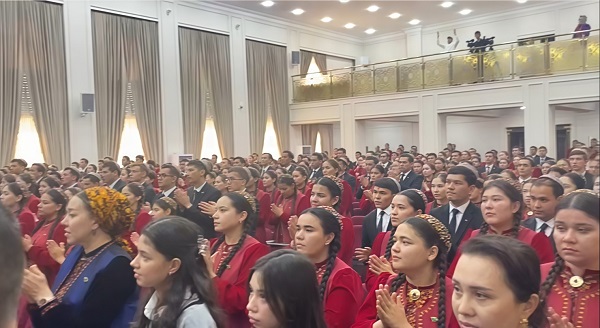
The event was attended by faculty members and students of the institute, Ambassadors of Kazakhstan, Kyrgyzstan, Tajikistan, Azerbaijan, and Türkiye, as well as representatives of the diplomatic corps, the public, and the media.
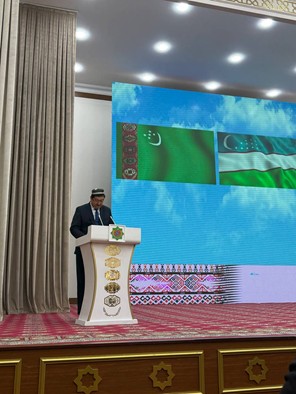
At the opening ceremony, welcoming speeches were delivered by Maksat Chariyev, Rector of the Turkmen National Institute of World Languages named after Dovletmammed Azadi, and Ravshanbek Alimov, Ambassador of the Republic of Uzbekistan to Turkmenistan. In their remarks, they emphasized the invaluable role of the native language in shaping personality, spiritual identity, and national consciousness, noting that the preservation and development of language are closely linked to the growth and prosperity of a nation.
It was noted that the Uzbek language has a centuries-old history and a rich literary heritage, and that the modern Uzbek language, evolving from these historical foundations, has become a vibrant expression of Uzbekistan’s independent development.
The adoption of the Law “On the State Language” on October 21, 1989, and the widespread celebration of Uzbek Language Day since 2020 were highlighted as contributing to the strengthening of the language’s status and enhancing public respect for the native tongue.

Speeches also emphasized the closeness of the Uzbek and Turkmen languages, their shared roots and historical ties. The similarity in vocabulary and grammar was cited as a vivid testament to the centuries-old friendship and cultural kinship of the two brotherly peoples.
It was especially noted that thanks to the initiatives and efforts of the leaders of Uzbekistan and Turkmenistan, relations of friendship and comprehensive cooperation between the two countries continue to strengthen and develop in all directions.
During the event, students of the institute recited poems by prominent Uzbek and Turkmen poets—Alisher Navoi, Magtymguly Pyragy, Abdulla Aripov, Mollanepes, Erkin Vakhidov, Dovletmammed Azadi, Zulfiya, and others—bringing to life the spiritual and cultural unity of the two peoples. Uzbek and Turkmen songs and dances performed on stage added an atmosphere of joy and inspiration to the celebration.
At the conclusion of the event, the Ambassador of Uzbekistan expressed deep gratitude to the staff of the Turkmen National Institute of World Languages named after Dovletmammed Azadi, addressing the students with the words:
“Today you have once again proven that the Uzbek and Turkmen languages are embodiments of beauty, closeness, and spiritual strength that unite peoples. Your poems and dances are vivid evidence of the spiritual kinship and shared hope of our nations for a bright future.”
On behalf of the Embassy of the Republic of Uzbekistan in Turkmenistan, commemorative gifts were presented to active participants of the event, and the institute’s library received a five-volume “Explanatory Dictionary of the Uzbek Language”—a valuable resource in Uzbek linguistics.
This event was not only a celebration of Uzbek Language Day, but also another step in strengthening cultural and spiritual cooperation between the two brotherly peoples—Uzbek and Turkmen.///nCa, 22 October 2025 (in cooperation with the Embassy of Uzbekistan in Turkmenistan)