


During his visit to Austria, the National Leader of the Turkmen people, Gurbanguly Berdimuhamedov, participated in the International Vienna Energy and Climate Forum (IVECF), held on 9–10 April 2026, under the guiding motto “Powering Prosperity, Security and Stability.”
IVECF 2026 convened leaders from governments, international organizations, the private sector, financial institutions, research communities, and civil society to accelerate action toward equitable and climate-resilient development.
The Forum was organized by the United Nations Industrial Development Organization (UNIDO) in partnership with the Federal Ministry for European and International Affairs of Austria, the Austrian Development Agency (ADA), and the International Institute for Applied Systems Analysis (IIASA).
During the opening UNIDO Director General Gerd Müller emphasized: “This Forum takes place at a time of growing geopolitical instability and conflict. Rising prices for energy, fertilizers and food affect everyone – but once again, it is developing countries that pay the highest price, just as they do when it comes to climate change. But it is also a moment of opportunity. Developing countries have the potential not only to meet their own energy demand, but to become exporters of clean energy and to accelerate their sustainable industrial development, through local value addition and job creation in the sector.”
Austria’s Federal Minister for European and International Affairs, Beate Meinl-Reisinger, noted: “The volatility we are once again witnessing in supply and prices is a stark reminder that energy dependence comes at a cost – not least in terms of stability and security. We must accelerate the transition to sustainable, secure and affordable energy through stronger international cooperation.”
Convened at a time of heightened global uncertainty and an ongoing energy crisis, the Forum underscored the urgency of advancing solutions that confront these challenges by accelerating energy transition, green industrialization and climate resilience.
The energy transition, coupled with green industrialization, has the potential to expand access to sustainable energy sources, stimulate the creation of new eco-friendly industries, and promote economic diversification and increased competitiveness. Developing countries rich in minerals and renewable energy sources have the opportunity to move beyond raw material exports and capture higher-value roles within global value chains.
The forum delved into specific solutions for countries most vulnerable to climate change, with a strong focus on expanding South–South and triangular cooperation. This includes scaling successful policy models, disseminating technologies, and engaging in joint investment with Least Developed Countries (LDCs), Landlocked Developing Countries (LLDCs), and Small Island Developing States (SIDS).
Key Ideas Presented by Turkmenistan at IVECF 2026
In his address, the National Leader of Turkmenistan proposed a series of practical measures aimed at the recovery and stabilization of global energy realities. Furthermore, Turkmenistan’s vision regarding the climate agenda was presented.
Global Security Strategy: Turkmenistan once again drew attention to its initiative to develop a Global Security Strategy. This strategy is built upon the principle of the indivisibility and interconnectedness of various aspects of security, with energy security serving as a cornerstone.
Energy Code: Turkmenistan called for the complete depoliticization of the energy space, noting that political conditionality hinders sustainable development and lacks economic rationale. In this regard, Turkmenistan proposes considering the development of a UN-sponsored “Energy Code” to formalize the rejection of the politicization of the energy sector.
Energy Connectivity: Turkmenistan intends to submit a draft resolution to the UN General Assembly titled “The Key Role of Reliable and Stable Energy Connectivity in Ensuring Sustainable Development.” The goal is to create a universal international legal instrument aimed at global energy cooperation based on new principles, including the regulation of production, transit, and consumption of energy resources.
Non-Discriminatory Access to Energy: Turkmenistan calls for ensuring free, stable, and non-discriminatory access to energy, asserting that this is a legitimate right of any people and nation.
Hydrogen Energy: The creation of a Global Program for the Transition to Hydrogen Energy for a ten-year period. Turkmenistan is open to discussing the modalities for developing such a document with the UN.
Climate Change: In the near future, the UN Regional Center for Technologies related to Climate Change in Central Asia will begin operations in Ashgabat.
LLDCs: Landlocked Developing Countries (LLDCs) must be guaranteed equal and equitable access to water, water resources, and waterways.
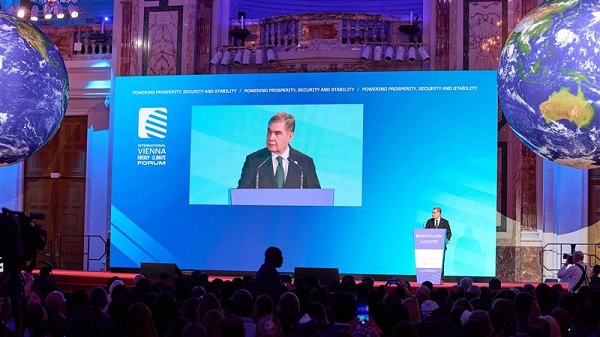
Here is the full text of the speech delivered by Gurbanguly Berdimuhamedov at the International Vienna Energy and Climate Forum:
Distinguished Madam Moderator! Thank you for the floor! Distinguished Heads and members of delegations! Ladies and Gentlemen!
First of all, let me express my deep gratitude to the Federal President of the Republic of Austria, His Excellency Mr. Alexander Van der Bellen, the Director General of UNIDO, Mr. Gerd Müller, and the Federal Minister for European and International Affairs of Austria, Ms. Beate Meinl-Reisinger, for the invitation to participate in the International Vienna Energy and Climate Forum.
The highly representative composition of this Forum testifies to the high interest of the world’s nations in addressing the pressing issues of the climate and energy agendas.
Turkmenistan, as an active member of the international community, contributes to the implementation of large-scale and long-term United Nations strategies and programs in the field of energy sustainability and ensuring climate well-being.
Distinguished participants!
This Forum is taking place at a challenging time for the world. Energy and climate stand as some of the most vulnerable segments of the global agenda.
As one of the world leaders in hydrocarbon reserves, and a major producer and exporter of energy, Turkmenistan pursues a responsible and consistent policy aimed at creating reliable political, international legal, and practical prerequisites and guarantees for mutually beneficial and equitable multilateral partnerships in this field.
Today, building upon significant past experience and an objective analysis of current processes, we propose a series of practical measures aimed at the recovery and stabilization of energy realities and the transition toward a meaningful and far-sighted dialogue.
First: Turkmenistan again draws attention to its initiative to develop a Global Security Strategy. I would like to recall that its primary substantive concept is the indivisibility and interconnectedness of various aspects of security, among which energy security stands as a key component.
Second: Turkmenistan calls for the complete and guaranteed depoliticization of the energy space. It goes without saying how much the imposition of political conditions hinders sustainable development and, certainly, has nothing to do with economic expediency. In this regard, Turkmenistan proposes to consider the development of an “Energy Code” under the auspices of the UN, which would clearly reflect the rejection and renunciation of the politicization of relations in this sphere.
Third: We propose to join efforts in the practical implementation of our country’s proposal to create a universal international legal UN document aimed at global cooperation in the energy sector based on new principles, including those regulating the production, transit, and consumption of energy resources. In this context, Turkmenistan has already authored three UN General Assembly resolutions on the reliable supply of energy resources, which received unanimous support from member states with a significant number of co-sponsors. This serves as a solid foundation for further joint work. Building on these activities, our country will submit a draft resolution to the UN General Assembly titled “The Key Role of Reliable and Stable Energy Connectivity in Ensuring Sustainable Development.”
Fourth: We call for ensuring free, stable, and non-discriminatory access to energy. This is not a privilege, but a natural and legitimate right of any people and state, regardless of its size, political system, economic potential, or current geopolitical circumstances.
Distinguished Delegates!
Having first initiated a broad multilateral dialogue on energy security nearly two decades ago, Turkmenistan proceeded from the necessity of giving this process a systematic, long-term character based on an international legal framework. Time has proven the validity and correctness of our approaches.
The proposals presented today are highly specific, aimed at practical results and impact. We are open to the closest and most substantive interaction with all interested parties regarding these measures and stand ready to take a leadership role within the UN in conducting the relevant consultations and negotiations.
Turkmenistan approaches climate issues with equal practicality and constructiveness.
In this regard, we reaffirm our full and unconditional commitment to achieving the goals of the Paris Agreement on climate change. We advocate for the launch of joint projects in the field of “green energy,” specifically regarding the utilization of wind and solar power.
As we begin the practical development of hydrogen energy in Turkmenistan based on natural gas, we are ready to work in this direction across the widest range and with all interested international partners. In this connection, we propose an initiative to create a Global Program for the Transition to Hydrogen Energy for a ten-year period. We are open to discussing the modalities for developing such a document with the United Nations.
We proceed from the necessity of strengthening regional cooperation, intensifying scientific research, and implementing new technologies. In the near future, the UN Regional Center for Technologies related to Climate Change in Central Asia will begin its operations in Ashgabat. The Government of Turkmenistan will provide maximum assistance to this new agency and ensure the most favorable conditions for the effective fulfillment of its tasks and goals.
Regarding another theme of the current Forum—support for vulnerable regions, particularly Landlocked Developing Countries (LLDCs)—Turkmenistan’s position is perfectly clear and principled. This category of nations must be guaranteed equal and equitable access to water, and in a broader sense, to water resources and waterways. This postulate serves as a decisive condition of not only a political and legal nature but also a moral one, a matter of responsibility toward current and future generations.
In August 2025, our country hosted an event of major global significance—the Third UN Conference for Landlocked Developing Countries. The Avaza Declaration adopted there has received the status of an official UN document; it reflects the fundamental principles and approaches to be implemented to ensure the legitimate rights and needs of tens of millions of people living in 44 states.
Turkmenistan will resolutely and persistently strive for the implementation of all provisions of this crucial document. We count on broad international support and understanding.
In partnership with the UN, Turkmenistan is working toward the implementation of the Sustainable Development Goals (SDGs).
Building upon the General Assembly resolutions adopted at our country’s initiative in the fields of energy and environmental security, transport connectivity, and the protection of the interests of landlocked developing countries, among other vital topics, Turkmenistan will continue to facilitate the joining multilateral efforts and the effective coordination of practical actions between states and the UN and its specialized agencies—particularly UNIDO—to achieve the stated objectives. It is from this perspective that we view the focus of this Forum, and we expect it to yield effective, practical results.
In conclusion, I would like to express my gratitude to the organizers of the International Vienna Forum for the excellent working conditions provided, and to wish its participants successful and fruitful work toward the realization of the high ideals and values of the United Nations. ///nCa, 12 April 2026