


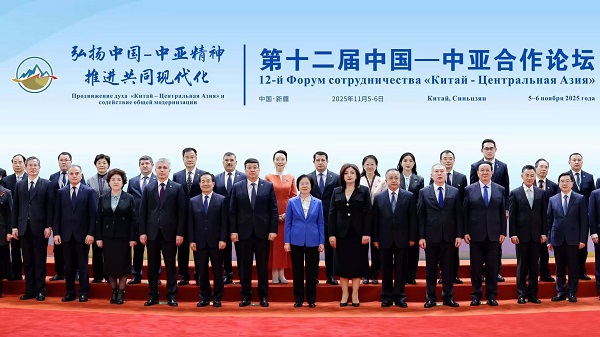
On 5-6 November 2025, in Urumqi, China, the 12th China–Central Asia Cooperation Forum was held, dedicated to the theme “Promoting the Spirit of ‘China–Central Asia’, Facilitating Common Modernization,” according to a SCO press release.
The event was organized by the Chinese Committee of the Shanghai Cooperation Organization for Good-Neighborliness, Friendship and Cooperation and the People’s Government of the Xinjiang Uyghur Autonomous Region.
The opening featured speeches by Shen Yueyue, Vice Chairman of the National Committee of the Chinese People’s Political Consultative Conference; Chen Xiaojiang, Secretary of the Party Committee of the Xinjiang Uyghur Autonomous Region; high-level representatives from Central Asian states; Sun Weidong, Secretary-General of the China–Central Asia Mechanism; and Piao Yangfan, Deputy Secretary-General of the SCO.
Forum participants reaffirmed renewed commitment to building a closer China-Central Asia community with a shared future, with a focus on enhancing practical cooperation in trade, green development, security, and regional connectivity, as reported by Global Times.

The event concluded with the adoption of the Initiative of the 12th China–Central Asia Cooperation Forum.
The initiative calls for strengthening mutual trust and support, as well as implementing global initiatives on development, security, civilization, and governance.
It also declares the optimization of cooperation with a focus on trade, industrial investment, connectivity, clean minerals, modern agriculture, and people-to-people exchanges.
The document addresses strengthening regional security, with a call to deepen interaction between law enforcement and security services. It emphasizes the need for joint efforts to prevent extremist ideologies, decisively combat the “three forces” of terrorism, separatism, and extremism, and maintain peace and stability in the region.
Some high-ranking officials from Central Asian countries highly praised the practical significance of the forum.
“In recent years, the China-Central Asia cooperation mechanism has become an indispensable part of the regional interaction architecture,” said Kyrgyzstan’s Deputy Prime Minister Bakyt Torobaev, noting that the mechanism has evolved into an effective platform for coordinating efforts, discussing current issues, and developing joint solutions for sustainable regional development.
This mechanism has proven its practical value and ability to adapt to global and regional changes, reflecting the shared will of Central Asia and China to expand cooperation, strengthen stability, and ensure sustainable development.
“Today, we can confidently say that the Central Asia-China relationship has reached an unprecedented level, showing not only a quantitative but also a qualitative improvement in all areas,” said Tajikistan’s Deputy Prime Minister Dilrabo Mansuri at the forum’s opening ceremony.
“The goal is to bring the total trade volume between China and Central Asian countries to $100 billion in the near future,” she said, noting that China has become one of our largest and most reliable investors, supporting key infrastructure projects and contributing to the creation of modern joint production in the region.
Merdan Yazyyev, a researcher at the CAREC Institute from Turkmenistan, told Global Times that in recent years, China has become more open to Central Asian countries. As an example, he cited Kazakhstan and Uzbekistan, which have mutual visa exemption agreements with China. “This means more businesses and tourists will come to China, especially to Xinjiang, and explore new investment opportunities,” he said.
“Likewise, Chinese businesses and entrepreneurs will also have the chance to explore more opportunities in these countries, particularly in Kazakhstan. We hope this trend will continue and expand to other Central Asian nations as well,” Yazyyev added.
“Kazakhstan has always been a strong supporter of the development of the China-Central Asia partnership,” emphasized Kazakhstan’s Ambassador to China, Shakhrat Nuryshev.
“We have consistently supported China’s initiatives to strengthen cooperation. The second China-Central Asia Summit, held in June this year, was an important step in the development of this partnership,” said the Kazakh diplomat.
“Therefore, we believe that this partnership model is in high demand, and everyone is very clear about its significance. The China-Central Asia partnership model offers advantages not only to the countries and neighboring nations involved but also to countries outside Central Asia,” he added. ///nCa, 7 November 2025 (photo credit – SCO)