


nCa Report
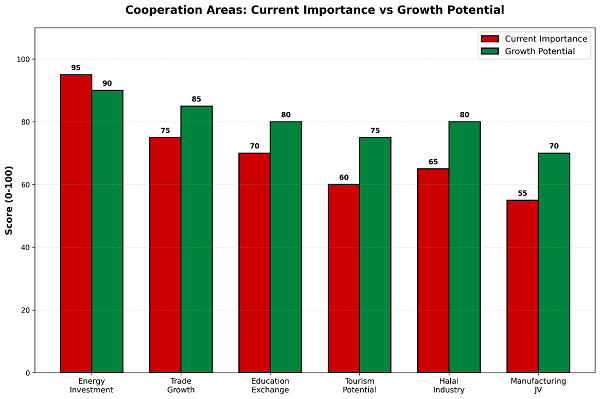
The prospects for cooperation between Turkmenistan and Malaysia look promising, with a solid foundation in energy and growing opportunities in trade, education, tourism, and other sectors.
Recent developments, such as the restructuring of the Petronas Production Sharing Agreement (PSA) in the Caspian Sea and a surge in bilateral trade, suggest potential for deeper economic ties.
While challenges like geographical distance exist, shared interests in areas like the halal industry and manufacturing could drive mutual benefits, though outcomes will depend on sustained diplomatic efforts and market conditions.
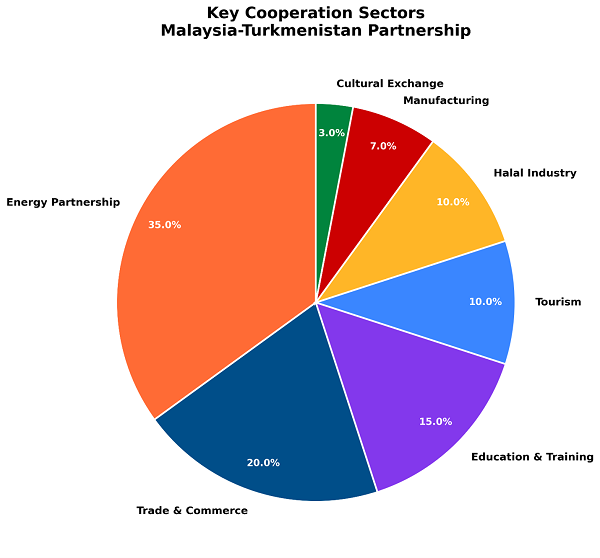
- Energy Sector as a Cornerstone: The long-standing partnership through Petronas, involving tens of billions in investments, remains central, with recent inclusions of UAE-based entities and the Turkmen government indicating room for expanded collaboration in oil, gas, and possibly renewables.
- Trade and Economic Growth: Bilateral trade has grown significantly, up over 70% in recent periods, pointing to untapped potential in commodities like palm oil and rubber, alongside joint ventures in manufacturing.
- Education and Human Capital: Thousands of Turkmen students study in Malaysia, particularly at institutions like Universiti Teknologi Petronas, fostering long-term knowledge exchange that could extend to vocational training.
- Tourism and Cultural Links: Malaysia’s appeal to Turkmenistan’s emerging middle class, combined with new air services and tourism agreements, may boost people-to-people connections, while cultural MoUs enhance heritage sharing.
- Halal and Emerging Industries: Malaysia’s global leadership in halal products aligns with Turkmenistan’s development goals, offering avenues for certification, exports, and joint initiatives in agriculture and food processing.
- Broader Prospects: Opportunities in transportation, innovation, and sustainable development appear viable, though they require careful navigation of global economic shifts.

These areas build on diplomatic relations established in 1992, with recent high-level visits reinforcing commitment. The energy partnership exemplifies mutual benefits, where Malaysian expertise meets Turkmenistan’s vast resources. In education, ongoing exchanges suggest a pathway for skill-building in Turkmenistan’s educated workforce.
Tourism could see growth through better connectivity, appealing to Turkmen travelers seeking diverse destinations. Overall, while prospects are optimistic, they hinge on implementing recent agreements and exploring new synergies.
Recent analyses indicate that both nations are poised to leverage their strengths for balanced growth, with Malaysia offering advanced industries and Turkmenistan providing market access to Central Asia. Hedging against uncertainties, such as fluctuating commodity prices, will be key to realizing these opportunities.
In the evolving landscape of international partnerships, the relationship between Turkmenistan and Malaysia stands out as a model of pragmatic cooperation, rooted in shared economic ambitions and cultural affinities.

Established on May 17, 1992, their diplomatic ties have matured into a multifaceted engagement, particularly highlighted by the official visit of Turkmenistan’s President Serdar Berdimuhamedov to Malaysia in December 2024, his first since assuming office in 2022.
Invited by Malaysian Prime Minister Anwar Ibrahim, this visit not only reaffirmed commitments to equality and mutual benefits but also resulted in a joint statement that outlined a roadmap for enhanced collaboration across various domains.
At the heart of this partnership lies the energy sector, where Malaysia’s Petroliam Nasional Berhad (Petronas) has been a pivotal player since 1996, investing tens of billions of dollars in Turkmenistan’s Caspian Sea hydrocarbon resources.

The recent restructuring of the Petronas Production Sharing Agreement (PSA) for Block 1 in the Caspian sector, announced around May 2025, marks a significant evolution. This deal now incorporates Dragon Oil from the UAE—specifically through Abu Dhabi’s XRG, an arm of ADNOC, holding a 38% stake—alongside Petronas at 57% and the Turkmen state enterprise Hazarnebit at 5%.
This tripartite arrangement not only diversifies investment but also strengthens regional energy security, with potential extensions into gas processing, chemical industries, and even innovative urban planning tied to energy infrastructure.
Petronas’ longstanding operations have yielded mutual benefits, including technology transfer and job creation in Turkmenistan, while providing Malaysia with access to vast natural gas reserves that could support its energy transition goals.
Beyond energy, trade has emerged as a dynamic pillar, experiencing robust growth that underscores the untapped potential between these two nations. From January to October 2024, bilateral trade surged by 74.8%, reaching RM63.28 million (approximately US$14.5 million) compared to RM36.19 million in the prior year. In 2023, Turkmenistan ranked as Malaysia’s fourth-largest trading partner in Central Asia, with total trade valued at RM48.62 million. This upward trajectory is fueled by commodities such as Malaysian palm oil, rubber, and cocoa, which align well with Turkmenistan’s import needs.
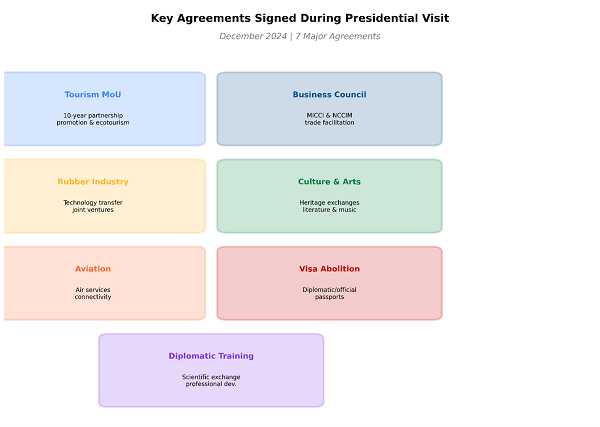
To further catalyze this, the establishment of the Turkmen-Malaysian Business Council during the 2024 visit serves as a platform to invigorate business and investment ties. Memoranda of understanding signed between the chambers of commerce—specifically the Malaysian International Chamber of Commerce and Industry (MICCI), the National Chamber of Commerce and Industry of Malaysia (NCCIM), and Turkmenistan’s Chamber of Commerce and Industry—aim to facilitate joint ventures and trade missions.
Additionally, a memorandum on the rubber industry and economic cooperation highlights Malaysia’s expertise in this area, potentially leading to technology transfers and joint production facilities in Turkmenistan.
Education represents another longstanding avenue of cooperation, with a large number of Turkmen students pursuing higher education in Malaysia, particularly at Universiti Teknologi Petronas (UTP), where scholarships and programs in engineering and petroleum studies have been popular for years.
In March 2025, discussions between Turkmenistan’s Minister of Education and Malaysia’s ambassador explored expanding ties in higher and vocational education, including exchange programs and capacity building.
This aligns with Turkmenistan’s nearly 100% literacy rate and hardworking population, making it an attractive partner for knowledge-sharing initiatives.
The exchange of notes on cooperation in diplomatic training and scientific exchange between the foreign affairs institutes of both countries, signed in December 2024, further extends this to professional development for diplomats.
Such efforts not only build human capital but also foster long-term interpersonal bonds that could translate into business and cultural synergies.
Tourism is gaining momentum as Turkmenistan’s middle class expands, viewing Malaysia as an appealing destination for its beaches, cultural diversity, and urban attractions. To support this, a 10-year Memorandum of Understanding on tourism cooperation was inked during the 2024 presidential visit, aiming to promote joint marketing, ecotourism, and cultural festivals.
Complementing this, the Air Services Agreement and notes on aviation industry collaboration will enhance connectivity. The direct flights between Ashgabat and Kuala Lumpur improve accessibility boosting tourist inflows, with Malaysia’s vibrant scene drawing Turkmen visitors interested in Southeast Asian experiences. In February 2025, a Turkmen delegation visited Malaysia to discuss investment and tourism, further emphasizing this sector’s growth potential.
The halal industry presents a particularly synergistic opportunity, given Malaysia’s position as a global leader in halal certification, standards, and exports, valued at billions annually.
Turkmenistan, actively developing its own halal sector to meet domestic and export demands, has been invited to participate in events like the Malaysia International Halal Showcase (MIHAS) in September 2024, where Turkmen entrepreneurs showcased products and explored partnerships. This could involve joint ventures in food processing, certification training, and supply chains, leveraging Malaysia’s expertise to help Turkmenistan access Muslim-majority markets in Asia and beyond.
Manufacturing offers fertile ground for expansion, with Malaysia’s firm grip on industries like electronics, automotive, and palm oil processing complementing Turkmenistan’s strategic location. Connected by rail and road to major markets in China, Russia, Europe, and South Asia, Turkmenistan serves as an ideal hub for Malaysian firms to establish joint ventures or relocate facilities.
Discussions in recent meetings have touched on high technologies, construction, and chemical manufacturing, where Malaysia’s innovative approaches could modernize Turkmen operations.
For instance, agricultural cooperation explored in December 2024 includes technology transfers in water resource management and capacity building, potentially extending to agro-manufacturing like food packaging or biofuels from palm oil derivatives.
Cultural and humanitarian dimensions add depth to the relationship, with memoranda on culture, arts, and heritage signed to promote exchanges in literature, music, and historical preservation. Turkmenistan’s celebration of the 300th anniversary of poet Magtymguly Pyragy in 2024 received Malaysian support, aligning with shared values in the Organisation of Islamic Cooperation (OIC). Partial visa abolition for diplomatic and official passports will ease high-level interactions.
Looking ahead, both nations are committed to broader regional frameworks. Malaysia encourages Turkmenistan’s accession to the Treaty of Amity and Cooperation in Southeast Asia (TAC) amid its 2025 ASEAN chairmanship, while supporting Turkmenistan’s “International Year of Peace and Trust” initiative for 2025.
They share stances on global issues, including peaceful resolutions to conflicts like the Palestinian cause, in line with UN principles. Challenges such as logistical barriers and economic volatility exist, but the proactive signing of over seven agreements in 2024 signals intent to overcome them.
To illustrate key aspects of this partnership, consider the following tables summarizing trade trends and signed agreements:
Bilateral Trade Growth (in RM million)
| Period | Total Trade | Year-over-Year Growth |
| 2023 (Full Year) | 48.62 | N/A |
| Jan-Oct 2023 | 36.19 | N/A |
| Jan-Oct 2024 | 63.28 | +74.8% |
(Source: BERNAMA, adapted from official figures)
Key Signed Agreements (December 2024 Visit)
| Agreement Type | Focus Areas |
| Memorandum on Tourism | 10-year partnership for promotion and ecotourism |
| Chambers of Commerce MoUs (MICCI & NCCIM) | Trade facilitation and business councils |
| Rubber Industry and Economic Cooperation | Technology transfer and joint ventures |
| Culture, Arts, and Heritage MoU | Exchanges in literature and heritage |
| Partial Visa Abolition | For diplomatic/official passports |
| Air Services Agreement | Enhanced aviation connectivity |
| Diplomatic Training Exchange | Scientific and professional development |
These elements collectively position Turkmenistan and Malaysia for a prosperous future, blending economic pragmatism with cultural harmony. /// nCa, 7 October 2025
Key Citations:
- JOINT STATEMENT between Malaysia and Turkmenistan
- Malaysia, Turkmenistan To Strengthen Ties, Petronas Central To Relationship
- Visit of the President of Turkmenistan to Malaysia: key results of talks
- Turkmenistan-Malaysia: Cooperation Memoranda Signed
- Official visit of the President of Turkmenistan to Malaysia has started
- Nearly 3 decades of strong partnership! PETRONAS’ CEO at #TEIF2025
- Turkmenistan – Malaysia: new directions and proposals for cooperation between educational institutions
- #BernamaNews : Malaysia, Turkmenistan forge 10-year tourism partnership
- Malaysia and Turkmenistan forge strategic partnership in tourism
- Turkmenistan and Malaysia explore agricultural cooperation
- Presiden Turkmenistan TYT Serdar Berdimuhamedov dan saya turut menyaksikan pertukaran Memorandum Persefahaman (MoU)
- Abu Dhabi’s XRG has partnered with Malaysia’s Petronas