


Eziz Doganlar H.J., a private economic society and a member of the Union of Industrialists and Entrepreneurs of Turkmenistan, will be a Gold Sponsor of the Turkmenistan Investment Forum (TIF 2025), which will take place on September 18–19, 2025, at the Conference Center of the Avaza Sports Complex, Avaza resort area, Caspian Sea coast (Turkmenbashi city). The Forum, organized by the Ministry of Finance and Economy and the Ministry of Foreign Affairs of Turkmenistan, will bring together representatives of business, government institutions, and the international investment community to discuss prospects for development and enhanced cooperation.
On March 12, 2025, a landmark event took place for the rapidly growing economy of independent Turkmenistan. On this day, President Serdar Berdimuhamedov attended the inauguration ceremony of an important new facility in Baherden district of Ahal province – the Baherden Ceramic Products Plant.
In his speech, the President emphasized that in accordance with state programs, special attention is paid to the consistent development of the industrial sector and construction industry, as well as ensuring the competitiveness of construction products manufactured at national enterprises. New industrial facilities equipped with innovative technologies are being built on a regular basis, producing world-standard products from local raw materials that are in demand both domestically and abroad. A vivid confirmation of this is the commissioning of the Baherden Ceramic Products Plant.
Presidential Decree of Turkmenistan No. 2503 “On the construction of a plant for the production of decorative ceramic tiles and sanitary ware in Baherden district of Ahal province” was issued on November 16, 2021. The new enterprise was built in less than four years by order of the Ministry of Industry and Construction Production of Turkmenistan by Eziz Doganlar H.J., a member of the Union of Industrialists and Entrepreneurs of Turkmenistan. Immediately after the inauguration, the plant began to fully supply high-quality construction products both to construction projects and the population.
The enterprise, occupying an area of 30 hectares, is designed to produce 3.3 million square meters of decorative ceramic tiles (1,650,000 m² of porcelain stoneware and ceramic floor tiles and 1,650,000 m² of ceramic wall tiles) and 120,000 units of sanitary ware per year. To meet production needs, the plant requires a total of 135,000 tons of raw materials (mainly local) per year.

The new plant, consisting of several buildings and workshops, provides full production and social conditions for the work of 455 employees. The Baherden Ceramic Products Plant has a certificate from SACMI Imola Societa Cooperativa, confirming that the plant is equipped with high-tech equipment and that all engineering works and equipment installed here fully comply with international standards in force in Europe. In addition, a certificate from the Italian company Associazione Costruttori Italiani Macchine Attrezzature per Ceramica confirms that production here is environmentally friendly and that the technological equipment installed here fully complies with international quality, environmental, health, and safety standards.
At the Baherden Ceramic Products Plant, modern equipment from the Italian company SACMI Imola S.C. has been installed, and all production processes are carried out in an automated mode. The plant manufactures various types of ceramic products, and in the laboratory, also equipped with high-tech equipment from SACMI, physical and chemical tests are carried out, including verification tests of weight, moisture, water absorption, strength, glazing, and the amount of additives is determined.
The production of decorative ceramic tiles begins with the delivery of raw materials to special receiving areas, where they are ground, mixed with water in powder form, and a slip (liquid clay mass) is produced, which is transferred to special underground tanks, and from there – to a spray dryer, where moisture is removed by heating, brought to a dry powder state, collected by special conveyors, and directed to the production cycle. At the second stage of production, the finished mixture is transferred to the pressing workshop, where it is distributed evenly into molds, which are then pressed. To remove moisture, the products are fed into 5-layer horizontal drying equipment. The tiles that come out of the dryer are sent to the glazing stage, where an engobe (a thin layer of clay) and glaze are applied to them.
Then the tiles are decorated using printers. After that, to preserve the strength of the tiles for a long time, their surface is re-glazed and fired at a temperature of 1230 degrees in a kiln. Then the products are sent to the rectification stage for polishing. At this stage, the edges of the tiles are trimmed, ground, and brought to the same size. After that comes the polishing stage, when production dust and chips are removed from the surface of the tiles. Before packaging, the finished products undergo a full inspection using digital technologies, the quality of the product is confirmed by a specialist, information about each tile is sorted, after which the products are packed in boxes, which also contain information about the quality of the products, caliber, and certification markings.
Sanitary ware is made from white clay (kaolin), feldspar, and quartz raw materials. After mixing and grinding, the slip is sent to underground tanks, and then transported by pipelines to standard and mechanical casting equipment, where gypsum molds are used. Under pressure, the shape of the sanitary ware is formed. In the production of sanitary ware, in addition to conventional casting, equipment for mechanical casting is also used, in which the slip is fed into production molds under high pressure. This method is intended for the formation of sanitary ware produced in large volumes. The products are then automatically dried in dryers. After that, the products undergo a cleaning and inspection process by specialists, are glazed to improve aesthetic appeal, water resistance, and hygienic properties. The glazed products are heated in a kiln to 1200 degrees, which hardens the enamel and dries the product. Then the products undergo quality control and are packed.
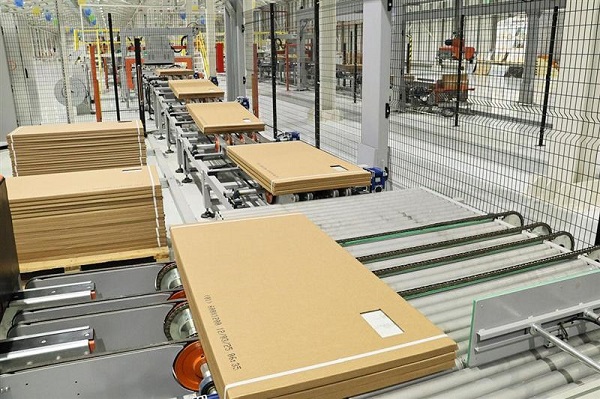
At the Baherden Ceramic Products Plant, robotic transporters and automated conveyors are used in all production units, and information technologies and artificial intelligence are widely implemented.
In Turkmenistan, new industrial enterprises equipped with innovative technologies are constantly being built, producing products that meet world standards using local raw materials, which are in great demand both domestically and abroad. A vivid confirmation of the rapid growth of the Turkmen economy was the commissioning this year of the Baherden Ceramic Products Plant, which consistently produces construction products of the highest quality. ///nCa, 10 September 2025 (in cooperation with TIF 2025 Organizers)