


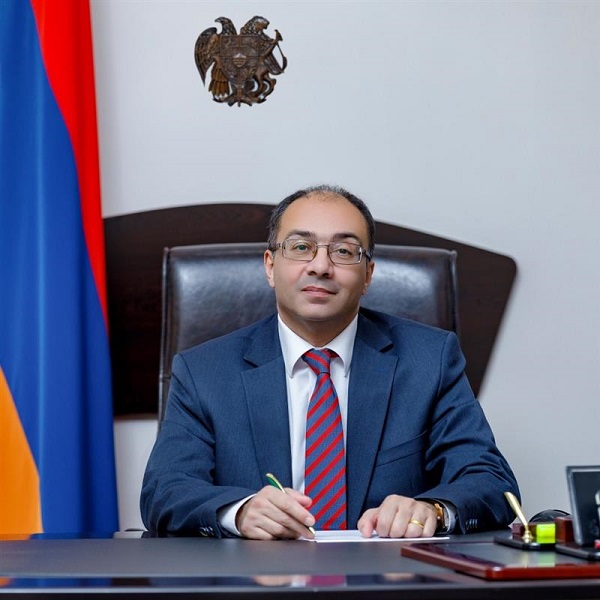
The relationship between Armenia and Turkmenistan today serves as a model of stable partnership, rooted in mutual respect. While the political dialogue between Yerevan and Ashgabat remains at a high level, both nations acknowledge the existence of significant untapped potential across various sectors.
In an exclusive interview with News Central Asia, the Ambassador Extraordinary and Plenipotentiary of the Republic of Armenia to Turkmenistan, Arsen Avagyan, provides a detailed analysis of the current state of bilateral ties. The Head of the Diplomatic Mission outlines a vision for a “roadmap” of cooperation: moving from traditional industries and transport to strategic projects in the fields of Artificial Intelligence and high-performance computing. Special emphasis is placed on the cultural dimension and historical heritage, which serve as a spiritual foundation for the modern rapprochement of the two nations.
Interview with the Ambassador of Armenia to Turkmenistan
1. What is the current state of relations between Armenia and Turkmenistan?
At the present stage, relations between the Republic of Armenia and Turkmenistan are characterized by stability, predictability, and mutual respect. They are free from political turbulence and are built upon a solid legal foundation, as well as a shared understanding of key issues on the international agenda.
Armenia and Turkmenistan consistently demonstrate respect for the principles of sovereignty, non-interference in internal affairs, and equality of states.
In the bilateral context, Turkmenistan’s internationally recognized status as a permanently neutral state. Turkmen neutrality is not isolation; rather, it represents a distinctive model of participation in international processes, based on balanced interests and peaceful initiatives. In this sense, our approaches to regional stability and peaceful development coincide greatly.
Political talk is regularly maintained. Contacts at the level of state leadership, parliamentary institutions, and foreign ministries help foster an atmosphere of trust. In turn, trust serves as the foundation to deepening cooperation in economic and humanitarian fields.
At present, economic interaction does not fully reflect the potential of our countries. However, it is important to emphasize that modest trade figures do not indicate weakness in this relationship; rather, they point to structural constraints related to logistics and geography, as well as the need for more systematic engagement with business communities. The political will to develop economic ties is clearly present, and that is fundamentally important.
The humanitarian aspect of our relations also deserves particular attention. Cultural and humanitarian contacts create an atmosphere of goodwill and mutual respect, which carries no less significance than official diplomacy.
More broadly speaking, Armenian–Turkmen relations today exist in a state of stable equilibrium with the potential to move toward a more thorough phase of development. We have a stable political foundation and a greatly positive atmosphere, which creates favorable conditions for expanding cooperation in trade, transport, energy, innovation, and scientific fields.
In other words, the current state of our relations can be described as stable, constructive, and oriented towards gradual expansion of cooperation. The next logical step would be to transform political stability into larger-scale economic and technological projects.
2. It is speculated that the potential of bilateral relations remains underutilized. How could that potential be fully utilized?
The speculation that there in more potential to be utilized in Armenian–Turkmen relation indeed is not groundless. Despite the presence of stable political talk and mutual trust, the economic and technological aspect of our cooperation have not yet developed to the extent of the objective capacities of the two countries. However, I would view this not as a problem, rather as an opportunity for growth.
First and foremost, we must realistically assess the reasons behind this situation. Geographic distance, the absence of direct transportation, and limited awareness among business communities are all objective factors. Yet, systematic work aimed at overcoming these constraints can become the key to unlocking the potential that was spoken of.
I see several interconnected ways of realizing it.
First — the institutionalization of economic talk.
It is important to ensure the regular functioning of intergovernmental mechanisms, to activate the work of joint commissions, and to establish direct interaction between chambers of commerce and industry, as well as sectoral associations. Businesses require clear signals, predictability, and reliable information. The more structured conversation is, greater the level of confidence among entrepreneurs.
Second — moving from declarations to pilot projects.
Potential is not unlocked through general statements but through concrete initiatives, even small ones, that can be implemented in practice. One or two successful joint projects can create a multiplier effect and demonstrate the practical value of partnership. These could include joint production initiatives, technological projects, or logistic solutions.
Third — the complementarity of our economies.
Armenia and Turkmenistan are not competitors. Turkmenistan possesses a powerful resource and industrial base, a strategic transit position, and significant infrastructure capabilities. Armenia, for its part, has strong human capital, engineering expertise, a dynamic IT sector, and experience in applied technologies. The combination of these factors could become an important point of growth.
Fourth — strengthening transport and logistic connectivity.
Amid the ongoing transformation of Eurasian trade routes, new opportunities are emerging to align our interests. More active use of multimodal routes through the Caspian region could become an important element in expanding economic ties.
Fifth — the humanitarian and educational dimension.
Long-term partnership cannot develop without human connections. Academic exchanges, joint research programs, and cultural initiatives create the foundation for sustainable business and technological cooperation of the future.
Strategically speaking, unlocking this potential requires three key conditions: political will, institutional consistency, and the active involvement of the private sector. Political will is already present. The next step is to give our cooperation a more practical and pragmatic side.
I am convinced that Armenian–Turkmen relations have reached a point where qualitative growth can be achieved not through abrupt steps, but through consistent and thoughtful deepening of interaction. The potential is indeed significant; the question is how systematically we approach its realization.
3. Trade, industry, transport, and energy — how can mutually beneficial formats be created?
If we look at this issue systematically, creating mutually beneficial partnership formats in these sectors requires moving beyond the traditional “export–import” model toward a more complex architecture of interaction — including industrial cooperation, technological integration, and logistical connectivity.
For now the trade turnover between our countries does not reflect the real potential. To change this situation, it is necessary to establish sustainable trade opportunities.
Armenia can offer:
- pharmaceutical products and medical technologies
- IT solutions and digital services
- equipment and software solutions for precise agriculture
- processed agricultural products
- jewelry and other high valued goods
Turkmenistan, in turn, possesses significant potential in the fields of energy resources, petrochemicals, construction materials, and textile production.
A key instrument in this regard should be direct contacts between businesses, participation in exhibitions, the creation of B2B platforms, and informational support for entrepreneurs. On 15 February 2026, a business forum involving leading Turkmen companies was held in Yerevan. Financial infrastructure is equally important — including settlement mechanisms, export insurance, and banking support.
Starting point could be the establishment of joint production or assembly facilities, as well as technological alliances.
The Armenian side possesses strong engineering competencies and experience in microelectronics, instrument engineering, IT, and automation. Turkmenistan has an industrial base and substantial infrastructure capabilities.
Possible formats may include:
- localization of specific production processes
- establishment of equipment service centers
- introduction of Armenian technological solutions in Turkmen industrial enterprises
Such an approach would allow us not simply to exchange goods, but to create added value within the partnership itself.
Transport and Transit: Connecting Infrastructure Advantages
Turkmenistan occupies a strategic position within Eurasian transport corridors, possessing modern Caspian port infrastructure and a developed railway network.
Armenia, for its part, is interested in diversifying logistic routes and expanding participation in international transport chains.
A mutually beneficial format may include:
- development of multimodal routes through the Caspian region
- integration of Armenian cargo flows into Turkmenistan’s transit capabilities
- coordination with other regional states to optimize transport routes
In the context of global logistic restructuring, this approach acquires strategic importance.
Energy: Strategic and Technological fields.
Energy has traditionally been one of the key sectors of Turkmenistan’s economy. However, cooperation can extend beyond the traditional framework of energy supplies.
Promising areas could include:
- exchange of experience in energy efficiency
- digitalization of energy systems
- joint research in renewable energy sources
- training of specialists and technological consultations
It is important to emphasize that energy cooperation may have not only a commercial but also a technological aspect.
Thus, creating mutually beneficial partnership formats requires a comprehensive approach:
- Political support and intergovernmental coordination
- Active involvement of the private sector
- Implementation of pilot projects with measurable results
- Adequate logistical and financial infrastructure
Armenia and Turkmenistan possess complementary capabilities. If we succeed in synchronizing Turkmenistan’s resources with Armenia’s technological potential, our cooperation could move to a qualitatively new level — from friendly relations to a strategic economic partnership.
4. Is there a foundation for cooperation in artificial intelligence, robotics, and high-tech solutions?
Certainly, such a foundation exists, and today it is becoming not merely theoretical but increasingly infrastructural in nature.
When speaking about the potential for cooperation in artificial intelligence, robotics, and high-tech solutions, it is important to understand that Armenia is entering a new phase of technological development. This is not only about strong traditions in mathematics, cybernetics, and engineering sciences, but also about the creation of powerful world-class computational infrastructure.
In February 2026, the U.S.-based company Firebird announced the second stage of its major AI project in Armenia. After receiving a U.S. export license and regulatory approval, the project oversees the delivery of an additional 41,000 NVIDIA GB300 GPUs to build a supercomputing cluster. The total investment is estimated to be 4 billion dollars.
In effect, this will form one of the five largest GPU clusters for AI in the world. This is not simply a data center — it is an infrastructure platform enabling research in biological sciences, robotics, space technologies, and next-generation artificial intelligence.
Several aspects are particularly important:
- The project is implemented with the support of the U.S. government and complies with U.S. export regulations, which reflects a high level of institutional trust.
- It builds upon a memorandum between Armenia and the United States in semiconductors and artificial intelligence.
- It aims at creating a sustainable technological ecosystem rather than a single facility.
As a result, Armenia gains access to infrastructure that is simply unavailable in most countries.
What does this mean in the context of Armenian–Turkmen cooperation?
It means that cooperation could be built not only on the exchange of expertise but also access to real world-class computing capacity.
1. Joint research
Turkmen scientific and sectoral institutions could utilize Armenian supercomputing infrastructure for:
- agro-climatic modeling
- water resource optimization
- crop yield forecasting
- energy modeling
- biomedical research
2. Applied AI for the agricultural sector
Given Turkmenistan’s climatic conditions, solutions in precise agriculture, soil data analysis, and intelligent irrigation systems are particularly valuable. Powerful computing infrastructure enables the creation of more accurate and adaptive algorithms.
3. Robotics and industrial automation
High-performance computing forms the foundation of modern robotics, digital twins, and simulation systems, opening opportunities for joint projects aimed at modernizing production processes.
4. Education and human capital
Joint research programs, exchange of graduate students and engineers, and the integration of Turkmen specialists into Armenian AI clusters could help form a new generation of regional experts.
Today we are witnessing a shift from conceptual discussions of cooperation toward the existence of a real technological platform. The Firebird project demonstrates that Armenia is becoming not only a consumer of technologies, but also a center for their development and scaling.
If Armenian–Turkmen interactions become integrated into this emerging infrastructure, it could represent a new type of cooperation — based on shared use of advanced computing capacity, knowledge transfer, and the development of applied solutions for concrete economic challenges.
In the 21st century, strategic partnership is defined not only by trade volumes but also by the ability to create intellectual value together. In this context, the foundation for cooperation clearly exists — and it is rapidly strengthening.
5. What are the medium-term prospects and what could a realistic roadmap look like?
Looking at the horizon of the next three to five years, I would describe the prospects for Armenian–Turkmen cooperation as optimistic. Our countries already share a solid political foundation — trust, the absence of contradictions, and mutual respect for each other’s sovereign development paths. This is an important basis. However, in the medium term the key task will be to fill these relations with more concrete economic and technological substance.
A realistic roadmap should not be built on declarative ambitions or excessive expectations. It should be grounded in consistency and pragmatism. First of all, cooperation needs greater institutional density: regular meetings of relevant intergovernmental commissions, sectoral consultations, and systematic interaction between the ministries responsible for economy, transport, energy, and digital development. It is important that engagement becomes continuous rather than episodic.
The next logical step is to focus on a limited number of priority areas where tangible results can be achieved within a reasonable timeframe. Practice shows that several successfully implemented projects often produce a greater effect than a wide range of framework agreements. These may include joint initiatives in digitalization, the application of artificial intelligence solutions in the agricultural sector, the creation of service or technology platforms, as well as the development of sustainable logistics routes through the Caspian region and the South Caucasus.
In the medium term, the involvement of the private sector will become particularly important. Governments create the necessary conditions, but sustainable partnerships emerge where businesses see predictability, transparency, and economic feasibility. Therefore, alongside political dialogue, it is essential to stimulate direct contacts between entrepreneurs, banks, industrial companies, and technology firms.
Other promising fields to improve is include scientific and technological cooperation. The development of joint research programs, the exchange of specialists, and the use of modern computational infrastructure for applied tasks represent an investment not only in the economy but also in the long-term intellectual connectivity of our countries.
Overall, within the next three to five years we can expect a gradual increase in trade turnover, the emergence of stable trade, the first technological cooperation projects, and clearer integration into the region’s transport and logistics processes. However, the key indicator of success will not be merely the growth of quantitative indicators, but the transition from episodic interaction to a systemic model of partnership.
In other words, if political will is reinforced by institutional consistency and active engagement from the business community, Armenian–Turkmen relations could, within a few years, reach a qualitatively new level — deeper, more practical in orientation, and more resilient to fluctuations in the international environment.
6. Is there anything else you would like to add?
In conclusion, I would like to emphasize that relations between Armenia and Turkmenistan have not only political and economic aspects, but also a deep historical and cultural context.
Our countries treat each other’s historical heritage with respect. In Turkmenistan, the building of the Armenian church in the city of Turkmenbashi has been preserved. It remains an important spiritual and cultural landmark, serving as a living testament to the long-standing presence of the Armenian community and to the state’s careful attitude toward religious and cultural diversity.
For its part, Armenia is home to the mausoleum of Turkmen emirs located in the village of Argavand. This monument reflects the multilayered historical connections within the region. The fact that this monument has been preserved and remains part of Armenia’s historical and cultural landscape also testifies to our respect for the heritage of the Turkmen people.
Such symbols carry particular significance. They demonstrate that our relations are based not only on contemporary interests but also on historical memory, which is treated with responsibility and dignity.
At the same time, an important practical step toward strengthening humane and business ties could be the establishment of direct air connectivity between Yerevan and Ashgabat. A direct flight is not merely a logistical matter. It is a symbol of closeness and a catalyst for business, tourism, academic exchanges, and cultural exchange. In today’s world, transport connectivity largely determines the intensity of interaction, and we hope that such a step may become possible in the foreseeable future.
More broadly, I believe that Armenian–Turkmen relations possess a certain calm maturity. There are no sharp fluctuations between us, no political contradictions — instead there is respect, balance, and space for further development. In a transforming international environment, relationships of this kind become particularly valuable.
If we succeed in combining pragmatism in economics, strategic thinking in technology, and careful respect for historical heritage, our cooperation will be not only stable but truly substantive.
And this, in my view, represents the main perspective: a steady, mutually respectful, and futuristic partnership between our two countries.///nCa, 17 March 2026