


The Ambassador of Turkmenistan to Belgium and the European Union, Sapar Palvanov, held two separate meetings in Brussels dedicated to deepening the partnership between Ashgabat and Brussels in the humanitarian sphere. The diplomat discussed prospects for cooperation in scientific research, high technologies, innovation, education, youth policy, and addressing climate challenges.
During a meeting with Marc Lemaître, Director-General of the European Commission’s Directorate-General for Research and Innovation (DG RTD), the parties examined in detail opportunities for expanding interaction in science, high technology, and innovative development. It was particularly noted that elevating relations between the EU and Central Asia to a strategic level opens new horizons for bilateral partnership.
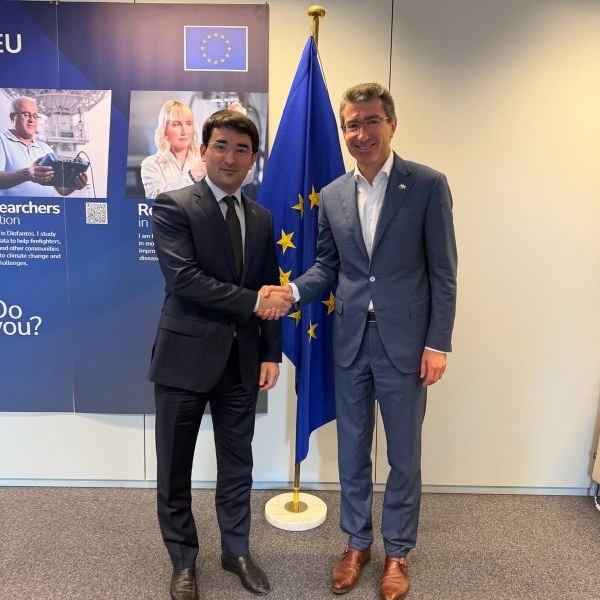
Ambassador Palvanov emphasized that, based on the analysis of Turkmenistan’s international priorities for 2025 and plans for 2026, the European Union is ranked among the country’s top three key foreign policy and economic partners. Priority areas include high technology development, the climate agenda, and artificial intelligence.
Special attention was paid to the environmental and climate challenges facing Central Asia. The region confronts serious issues: shifts in the water balance, the declining level of the Caspian Sea, and the consequences of global warming. In this regard, the importance of science-based analysis, the implementation of modern monitoring systems, and the application of advanced technologies was underscored.
The Turkmen side presented an initiative to establish a Regional Center for Innovation and Technology, specializing in environmental monitoring, climate research, and risk assessment in Central Asia. Such a center could serve as a platform for joint scientific projects, data exchange, and technology transfer with European partners.
The sides also discussed expanding the participation of Turkmen scientific and educational institutions in EU programs, as well as prospects for developing framework agreements and creating sustainable cooperation mechanisms. At the end of the meeting, both sides confirmed their mutual interest in deepening the partnership and expressed readiness to continue practical dialogue.
Ambassador Palvanov also met with Normunds Popens, Deputy Director-General of the Directorate-General for Education, Youth, Sport, and Culture (DG EAC). The conversation focused on prospects for deepening cooperation in education, youth policy, and cultural exchange.
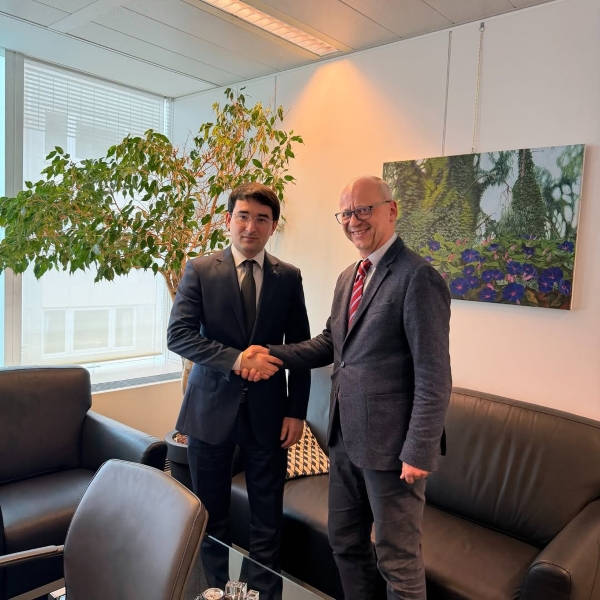
The Ambassador noted that human capital development remains a top priority of Turkmenistan’s state policy. The country has completed the formation of its national education model and has begun actively implementing international standards. In recent years, higher education institutions have introduced a multi-level training system based on the bachelor’s and master’s model, facilitating integration into the global educational space.
The Ministry of Education of Turkmenistan is showing increasing interest in European approaches to educational quality, academic mobility, the credit-module system, digitalization, and modern university management models. Currently, Turkmen universities collaborate with EU institutions to update curricula, introduce new methodologies, and strengthen the scientific component of higher education.
The parties exchanged views on increasing the participation of Turkmen universities and youth organizations in European programs, including academic exchanges, joint educational projects, and training initiatives in high technologies, digital transformation, and the “green” economy.
A separate part of the discussion was dedicated to youth policy: the importance of contacts between youth organizations, leadership programs, the development of digital and entrepreneurial skills, and the exchange of experience in youth employment.
Following the meeting, mutual interest in the institutional development of cooperation was confirmed, including the elaboration of framework agreements and the creation of coordination mechanisms between relevant agencies. /// nCa, 20 February 2026