


Ashgabat, 2 April 2026. The International Organization for Migration (IOM) supported more than 20 engineering and technical specialists—including representatives of local administrations, farmers and members of the Afghan community in Lebap province—in strengthening their knowledge and practical skills in the application of modern technologies for the efficient and sustainable use of water resources, as part of a two‑day seminar held in the city of Seydi on 31 March–1 April 2026 with the support of the Lebap provincial administration.
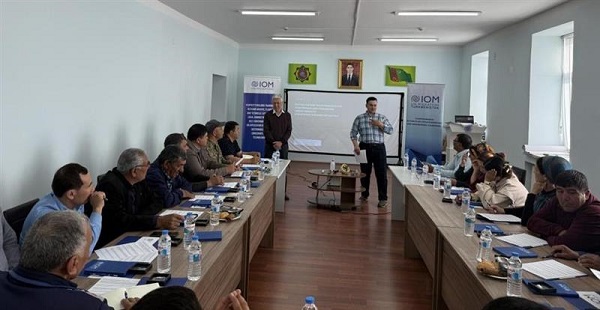
In light of current challenges related to increasing water scarcity driven by climate change—which in turn affect the sustainability of livelihoods and may heighten the risks of economic migration — the seminar focused on improving the efficiency of irrigated land and pasture use in Lebap province through the application of modern agro‑climatic data, digital monitoring tools, and technological solutions.
In this context, IOM national experts introduced participants to rational water‑use technologies applied both in Turkmenistan and internationally, as well as to practical examples of their adaptation to the conditions of Lebap province.
As part of the seminar, participants also reviewed examples of using agrometeorological data for water‑use planning, including the application of information on air temperature, precipitation, evaporation and soil moisture to more accurately determine irrigation volumes and schedules for agricultural crops. Participants also analysed the situation of pasture water supply in Lebap province, assessed the conditions of watering infrastructure, and familiarized themselves with successful solutions implemented in countries with similar climatic conditions.
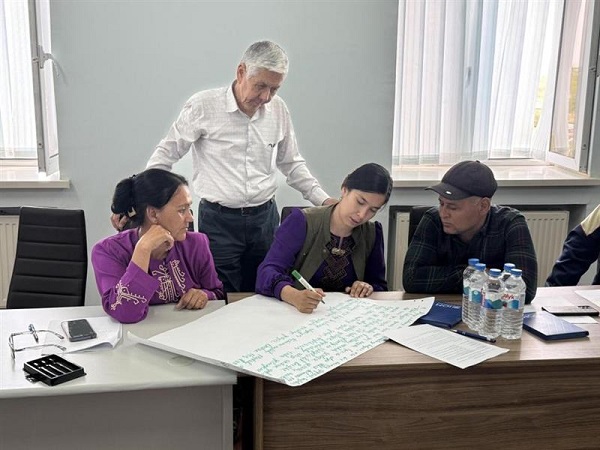
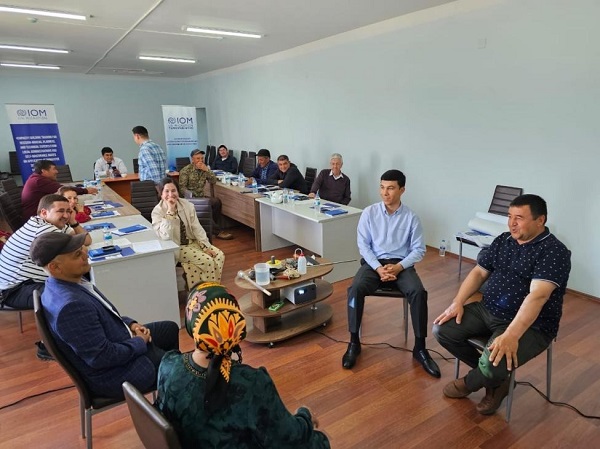
“The seminar provided valuable information on modern technologies and effective practical approaches to water resource management. The knowledge gained will allow me to conduct more accurate water measurements and use water more efficiently on my farm. Despite my many years of farming experience, I learned a great deal of new and useful information to further improve the efficiency of my work,” said Mahmut Yollyev, a tenant farmer from the Ysbaz gengeshlik of the Dänew district in Lebap province.
During the practical sessions, participants worked with soil moisture sensors, analysed digital data on crop conditions, and developed recommendations to optimize irrigation regimes and improve water‑use efficiency. Active discussions facilitated experience‑sharing and the development of joint proposals to enhance water resource management at the local level.
*****
The seminar was conducted within the framework of the IOM regional project “Comprehensive Action Plan for Afghanistan and Neighbouring Countries.” In Turkmenistan, the project focuses on providing comprehensive support to Afghan communities residing in the country, with a particular emphasis on women and girls, to ensure long‑term sustainable development and strengthen social cohesion at the local level.
As part of the project, a Mobile Resource Centre is successfully operating and has to date provided medical and legal consultations to more than 6,000 beneficiaries from the Afghan and local communities. With project support, a medical facility in the village of Parahatçylyk, Ahal province, was upgraded to ensure the provision of long‑term, quality medical services to Afghan and local populations.
In addition, the project supported vocational tailoring training for 170 women from the Afghan community in Ahal and Lebap provinces in 2024–2025. ///IOM Turkmenistan, 2 April 2026