


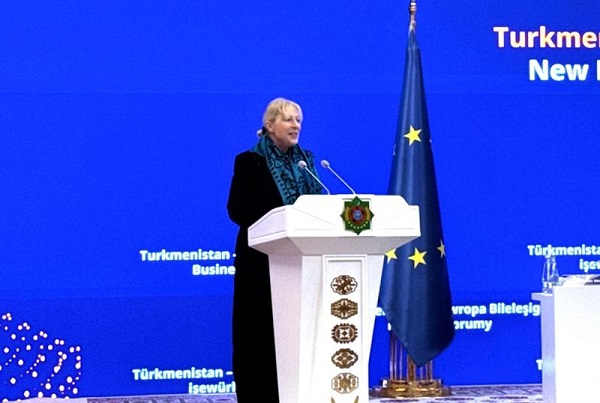
Speaking at the Turkmenistan–European Union Business Forum in Ashgabat on 26 March 2026, the EU Ambassador to Turkmenistan, Beata Peksa, underscored that amid evolving global trade routes and reshaped supply chains, Turkmenistan is increasingly positioning itself as an important link between Europe and Asia.
“We see strong potential to deepen our economic ties, and today’s Forum reflects our shared ambition to translate this potential into concrete cooperation,” she stressed.
Global Gateway: The Engine for Connectivity
The Ambassador identified the Global Gateway strategy as the primary instrument for deepening ties. For Central Asia and Turkmenistan, the strategy focuses on four critical pillars:
- The development of the Trans-Caspian Transport Corridor;
- Digital connectivity and trade process digitalization;
- Securing supply chains for Critical Raw Materials;
- Addressing water, energy, and climate challenges.
“The Global Gateway is about building sustainable and trusted partnerships and mobilizing high-quality investments,” Ambassador Peksa stated. She emphasized that it is about working together with businesses, governments and international financial institutions to deliver concrete projects in transport, energy and digital sectors.
Improving the Investment Climate
Citing the OECD project “Building a Competitive Investment Landscape in Turkmenistan,” implemented under the EU-funded Prosperity Programme, the Ambassador offered a candid assessment of the reforms needed to attract foreign direct investment (FDI).
Key recommendations supported by the EU include:
- Simplifying business procedures and improving regulatory transparency;
- Investing in digitalization;
- Strengthening human capital and innovation;
- Addressing the dual exchange rate regime.
Green Transition and Methane Reduction
A significant portion of the remarks was dedicated to the “Green Transition.” With climate change posing shared risks to water resources and agriculture, the EU is positioning itself as a key partner for Turkmenistan’s environmental goals.
The Ambassador highlighted the “Green Turkmenistan” project, currently being implemented by GIZ in close cooperation with Turkmengaz and other national institutions. This initiative focuses on the development of renewable energy resources and the reduction of methane emissions.
A Vision for Future Cooperation
Looking ahead, Ambassador Peksa outlined clear priorities for the EU-Turkmenistan partnership, which include further integration into the global trading system, improvement of the business and investment environment, and the development of efficient and reliable connectivity links between Central Asia and Europe.
” The European Union remains committed to working closely with Turkmenistan and all partners present here today to unlock all possible opportunities and to build a more connected, sustainable and prosperous future together,” the Ambassador concluded. ///nCa, 26 March 2026