


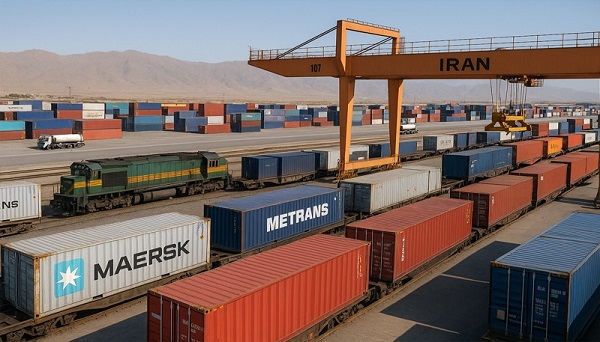
Iran has established a significant new container transport complex at Sarakhs, a strategic border town with Turkmenistan in northeastern Iran, positioning the Islamic Republic as a crucial transit hub between China, Central Asia, and Europe, according to recent reports.
The terminal, currently being constructed by China on the Iran-Turkmenistan border, marks a major expansion of the Southern Transit Corridor and is expected to dramatically increase container traffic along the China-Central Asia-Iran-Turkey-European Union route, as reported by Trend News Agency and The Astana Times.
According to Tehran Times, Iranian authorities announced in August 2025 that more than half of the project had been completed. The terminal is part of a broader infrastructure push that includes the electrification of a 1,000-kilometer railway section from Sarakhs to Razi on the Turkish border, as part of agreements between Beijing and Tehran.
The ambitious project aims to triple freight capacity to 15 million tons annually and raise cross-border freight volumes at Sarakhs to 20 million tons per year, including up to 6 million tons transported by rail, according to reporting from multiple regional sources.
The Sarakhs container terminal’s importance extends beyond bilateral Iran-Turkmenistan trade. The facility serves as a critical node in multiple international transit corridors, including the International North-South Transport Corridor (INSTC) and emerging China-Europe rail routes.
“The transit capacity of the country has increased to 20 million tons and by planning and taking appropriate measures, transiting 300 million tons of commodities per year can be reached,” Iranian First Vice President Mohammad Mokhber stated during a ceremony marking the arrival of Russia’s first transit cargo train through Sarakhs in 2022, as reported by IRNA and bne IntelliNews.
According to data from Iran’s Customs Administration cited by Tehran Times, transit through Sarakhs customs terminal recorded exceptional growth of 148 percent in the Iranian calendar year ending March 2025, making it one of the fastest-growing border crossings in the country. News Central Asia reported that cargo entering Iran for transit through Sarakhs increased by 250 percent in the first nine months of 2025.
Iran and Turkmenistan signed an agreement in August 2025 to construct two additional railway lines at the Sarakhs border crossing—one standard-gauge and one broad-gauge line—to alleviate freight congestion, according to Tehran Times coverage of statements by Jabbarali Zakeri, head of the Islamic Republic of Iran Railways.
The development comes as Central Asian nations increasingly view Iran as essential for accessing both European markets via Turkey and maritime routes through Iran’s Persian Gulf ports of Bandar Abbas and Chabahar. Uzbekistan announced plans in 2023 to build terminal facilities at Chabahar port, while Kazakhstan declared its intention in 2025 to construct a logistics terminal at Bandar Abbas, according to The Astana Times and Eurasianet.
The Sarakhs terminal plays a pivotal role in China’s Belt and Road Initiative, which Iran formally joined in 2021 through a 25-year comprehensive cooperation agreement with Beijing. The southern route through Iran offers significant advantages for containerized freight between China and the European Union, whose mutual trade reached $850 billion in 2025, according to The Astana Times.
Iran’s Minister of Roads and Urban Development Farzaneh Sadegh confirmed in November 2025 that early discussions were underway to launch electric rail service between Sarakhs and Cheshmeh-Soraya as part of the China-Europe network, Tehran Times reported.
In November 2025, Iran joined China, Kazakhstan, Uzbekistan, Turkmenistan, and Turkey in signing a multilateral agreement in Istanbul aimed at expanding rail freight movement along the southern Eurasian transit corridor through unified tariffs, shortened travel times, and upgraded infrastructure, according to Tehran Times.
Beyond the Chinese-built terminal, Russian company EPT announced plans in December 2023 to develop grain and container terminals in Sarakhs as part of a project estimated at 17 billion rubles, with a feasibility study expected in 2025, according to Interfax news agency.
In 2025, Iran’s Ministry of Roads and Urban Development announced plans to construct nine transit railway corridors with a total length of 17,000 kilometers at an estimated cost exceeding $10 billion, positioning the country as a major player in Eurasian logistics networks, The Astana Times reported.
The Sarakhs terminal development represents Iran’s determination to capitalize on its strategic geography despite international sanctions, offering landlocked Central Asian countries crucial access to global maritime trade while providing China and regional partners with faster overland routes to European markets. /// nCa, 12 February 2026