


nCa Report
Germany solidified its commitment to Central Asia on Wednesday, hosting the first-ever ministerial-level meeting in the C5+1 (Z5+1) format with all five Central Asian nations, marking a significant step in the deepening “Strategic Regional Partnership” between the regions.
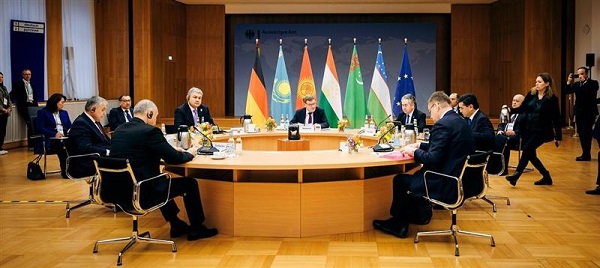
The high-level diplomatic gathering brought together Foreign Minister Johann Wadephul of Germany with his counterparts from Kazakhstan (Yermek Kosherbayev), the Kyrgyz Republic (Jeenbek Kulubayev), Tajikistan (Sirojiddin Mukhriddin), Uzbekistan (Bakhtiyor Saidov), and Deputy Foreign Minister of Turkmenistan (Akhmet Gurbanov). EU Special Representative for Central Asia Eduard Stiprais also attended, underscoring the Team Europe approach to regional engagement.
Presidential Reception at Bellevue Palace
The meeting commenced with German President Frank-Walter Steinmeier personally receiving the Central Asian delegation heads at Bellevue Palace, where discussions covered energy security, critical raw material supplies, the Afghanistan situation, and water resource management.
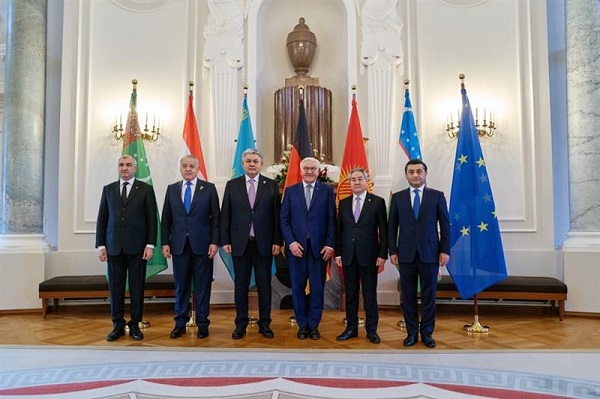
According to German presidential sources, Berlin views the Central Asian states, particularly Turkmenistan, as reliable partners capable of ensuring stability in Eurasia.
The presidential meeting also served as preparatory groundwork for the next summit of heads of state and government in this format, following successful summits in Berlin (September 2023) and Astana (September 2024).
Berlin Declaration: Cementing the Partnership
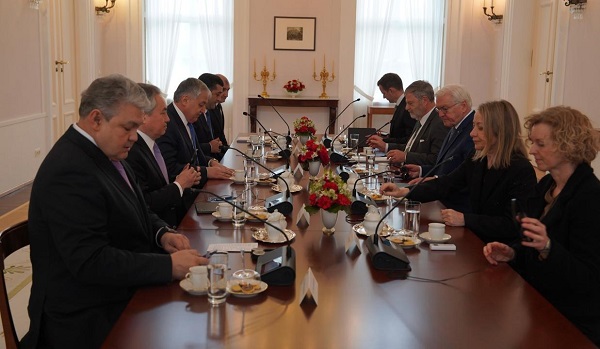
The ministerial talks at the German Foreign Ministry produced a comprehensive Berlin Declaration that formally establishes Central Asia as Germany’s “preferred partner” in the region. The ministers underlined the positive development of relations between Germany and the Central Asian states over the past three decades and recognized the importance of previous high-level meetings.
Key initiatives announced include:
Trans-Caspian Transport Corridor Development: Germany committed €2.7 million for the coordination platform of the Trans-Caspian Corridor (also known as the Middle Corridor). German logistics companies expressed willingness to invest in Turkmen ports and railways to accelerate cargo flows from Asia to Europe. This builds on the broader EU commitment of €10 billion announced at the January 2024 Global Gateway Investors Forum to develop this strategic trade route that bypasses Russia.
Green Energy and Climate: A €250 million portfolio will support decarbonization and renewable energy development projects across Central Asia through Germany’s Green Initiative.
Science and Education: A memorandum of understanding on cooperation in science, research and innovation will be signed between the Federal Ministry of Research, Technology and Space and Central Asian counterparts at the German–Central Asian Higher Education and Science Forum in Halle in February 2026. The PASCH (Schools: Partners for the Future) network, with over 50 schools teaching German across the region to more than 500,000 learners, will continue to expand.
OSCE Cooperation: Germany reaffirmed its substantial support for OSCE programs in Central Asia, having allocated more than €13 million to the region since 2022. This includes the Prevention of Violent Extremism program active in Kazakhstan, Tajikistan, Uzbekistan (since 2020), and Kyrgyzstan (since 2023), as well as the E-VIDENCE project supporting electronic evidence frameworks.
Economic Engagement and Investment Guarantees
A business forum featuring 30 of Germany’s largest companies ran parallel to the ministerial meeting. The ministers agreed to support economic activities through government instruments such as export credits and investment guarantees, with particular focus on the chemicals, agriculture, and personnel training sectors in Turkmenistan and across the region.
Geopolitical Context and Strategic Importance
Foreign Minister Wadephul emphasized that Europe must develop new partnerships and diversify economic relationships, particularly regarding critical raw materials and rare earth elements. He noted that Central Asia stands at a geopolitical crossroads, contending with both Chinese interests and threats posed by Russia.
The ministers also addressed the ongoing Russia-Ukraine conflict and EU sanctions. Wadephul asked his Central Asian counterparts to help prevent sanctions evasion and work closely with the EU, warning that circumvention attempts would support Russia’s war effort and threaten European security interests.
Looking Ahead
The meeting marks the first ministerial-level gathering in this format since the elevation of relations to a Strategic Regional Partnership at the 2023 Berlin Summit. Germany continues to position itself as a key player with significant influence on EU policy toward Central Asia, with Chancellor Friedrich Merz’s government actively pursuing diversification of energy imports and rare earth supplies away from Russia and China.
Trade between Germany and Central Asia reached $11 billion in 2022, with Kazakhstan accounting for 83% of this volume. Germany’s strategic engagement reflects both economic interests and broader geopolitical goals of strengthening ties with a region traditionally caught between Russian and Chinese spheres of influence.
Berlin Declaration by the Ministers of Foreign Affairs of Central Asia and Germany
Text from German Federal Foreign Office, 11 February 2026
On 11 February 2026, the Federal Minister for Foreign Affairs Johann Wadephul welcomed Minister for Foreign Affairs of the Republic of Kazakhstan Yermek Kosherbayev, Minister for Foreign Affairs of the Kyrgyz Republic Zheenbek Kulubaev, Minister for Foreign Affairs of the Republic of Tajikistan Sirojiddin Muhriddin, Minister for Foreign Affairs of the Republic of Uzbekistan Bakhtiyor Saidov and Deputy Minister for Foreign Affairs of Turkmenistan Ahmet Gurbanov in Berlin for the meeting of the Foreign Ministers “Central Asia and Germany”.
In an open and constructive exchange, the Ministers underlined the positive development of relations between Germany and the Central Asian states over the past three decades. They recognised the importance of the meeting of the Heads of State of Central Asia and the Chancellor of the Federal Republic of Germany in September in Berlin in 2023 and in Astana in September 2024. The Ministers reiterated the importance of the Strategic Regional Partnership between Central Asia and Germany, established in 2023, as a framework for the cooperation.
They reaffirmed their commitment to further strengthen the German-Central Asian partnership, based on shared values and mutual interests, and to continue the high-level dialogue. They emphasised the diverse and multi-faceted bilateral cooperation, as well as German-Central Asian cooperation within the framework of the European Union (EU) and multilateral formats.
The Ministers welcomed the results of the Seventh Consultative Meeting of Central Asian Heads of State in Tashkent on 16 November 2025. The Federal Minister expressed Germany’s support for the efforts of the Central Asian states to further develop regional cooperation aimed at ensuring prosperity, peace, sustainable development and good neighbourly relations in Central Asia.
The Ministers expressed satisfaction with the intensification of relations between the Central Asian countries and the EU. They noted with appreciation the EU–Central Asia Summit which took place on 4 April 2025 in Samarkand, emphasising the continued significance of the EU Strategy for Central Asia with its focus on resilience, prosperity and regional cooperation. The Ministers welcomed the presence of the EU Special Representative for Central Asia Eduards Stiprais at the Ministerial Meeting on 11 February 2026.
The Ministers reaffirmed their commitment to cooperation in support of peace, security and democracy, and to full respect for international law, including the Charter of the United Nations and the fundamental principles of respect for the independence, sovereignty and territorial integrity of all States, the non-use of force or threat of its use, and the peaceful settlement of international disputes.
Transport and Connectivity
Considering the growing significance of regional connectivity, the Ministers emphasised the importance of the Trans-Caspian Corridor as a sustainable and efficient multimodal transport link between Central Asia and Europe. They agreed to promote cooperation on the development of the corridor and to support the participation of German railway and logistics companies in transport, infrastructure and consulting projects. The Ministers acknowledged Germany’s contribution of 2.7 million euro to the Trans-Caspian Transportation Corridor Coordination Platform.
With a view to implementing sustainable infrastructure projects along the corridor, the Ministers agreed to cooperate in the framework of the Global Gateway initiative of the European Union and its Member States.
Multilateral Cooperation
The Ministers welcomed joint activities and projects in multilateral fora, in particular in the United Nations. They welcomed the engagement of the Organization for Security and Co-operation in Europe (OSCE) in the region and recalled Germany’s financial support for regional projects in all three dimensions of the OSCE, notably in the fields of border management and prevention of violent extremism, amounting to more than 13 million euro since 2022. The Ministers also took note of the latest contribution of 3 million euro to the Response to the Implications of Afghanistan for the OSCE Region (RIAOR) fund by Germany in 2025 – supporting projects on border management, capacity building, water and conflict management, fight against terrorism, organised crime, drug and human trafficking.
The Ministers expressed their appreciation for Germany’s stabilisation commitment in the region, including the 2nd phase of the Prevention of Violent Extremism in Central Asia Programme and cross-border cooperation in the framework of PATRIP with new projects planned for 2026.
Ukraine and Sanctions
The Ministers emphasised the importance of achieving, as soon as possible, a comprehensive, just and lasting peace in Ukraine in line with the principles of the Charter of the United Nations.
The Ministers underlined the importance of continued cooperation and close exchange with the European Union and its Member States on sanctions regimes and emphasized the significance of further collaboration to enhance the prevention of sanctions circumvention.
Afghanistan
The Ministers reaffirmed their intention to continue engagement within the international community towards Afghanistan upholding its international obligations, in particular in the field of human rights, especially those of women and girls. They acknowledged the efforts of the international community to provide humanitarian assistance to the Afghan people in a principled manner. They underlined the importance of an inclusive and representative government and the respect for and protection of the basic human rights and fundamental freedoms of all Afghan citizens.
Economic Cooperation
The Ministers noted the dynamic economic development in Central Asia and reaffirmed the importance of ongoing reforms aimed at further developing a favourable business environment, with particular emphasis on the rule of law, human rights, property rights, independent judiciary.
The Ministers welcomed growing economic cooperation of the Central Asian countries with Germany and expressed their shared intention to further develop bilateral trade, investment and favourable business environment. They agreed to support such activities through government instruments such as export credits and investment guarantees. In this context, the Ministers welcomed the Meeting with German business representatives in the framework of the Ministers Meeting on 11 February 2026.
The Ministers underlined the importance of strengthening economy, trade and investment relations within the framework of the Strategic Regional Partnership between Central Asia and Germany.
The Ministers appreciated the ongoing work of the German Chamber of Commerce Central Asia and the German Eastern Business Association to support and promote German business in Central Asia, including the organisation of events with the participation of all five Central Asian countries.
The Ministers reaffirmed the need for continuing cooperation in the many sectors the region offers, including, but not limited to, cooperation in the fields of natural resources (including hydrocarbon), energy (including renewable energy, e.g. hydroenergy), agriculture, chemical industries as well as the training of skilled workers from which labour markets on both sides of the cooperation can profit. In the important field of energy, areas of cooperation include renewable energies, energy efficiency and green hydrogen.
The Ministers noted transport infrastructure projects pursued by the Central Asian countries, contributing to sustainable and diversified transport connectivity between Central Asia and Europe.
The Ministers expressed their appreciation for the Federal Ministry for Economic Affairs and Energy’s programme Partnering in Business with Germany and the market reconnaissance trips.
The Federal Minister highlighted the regional development cooperation with a current portfolio of 90 million euro. The Ministers appreciated Germany’s support, especially for improving cross-border trade along regional trade routes, and welcomed facilitating business visits for investment purposes.
Climate and Environment
The Ministers underlined the importance of cooperation on reducing greenhouse emissions and adapting to climate change in the framework of the German Green Central Asia Initiative with a portfolio of 250 million euro. They also expressed their appreciation for Germany’s continued support for OSCE activities in the field of climate and environmental protection in Central Asia, including contributions to the Climate and Security and the Disaster Risk Reduction OSCE funds.
The Ministers acknowledged the contribution of German development cooperation, in particular in the framework of the regional programmes Integrated Water Management, Climate-sensitive Land Use, Management of Climate Risks and Renewable Energy.
The Ministers emphasised that the Central Asia region has high potential for renewable energies and hydrogen production. They also underlined the importance of existing German support for regional programmes for the energy transition.
They noted with appreciation the ongoing preparations for the establishment of a Regional Environment and Climate Partnership between the Federal Ministry for the Environment, Climate Action, Nature Conservation and Nuclear Safety and its Central Asian counterparts. They also took note of the knowledge-based dialogue between the Federal Ministry for the Environment and Central Asian counterparts aimed at strengthening climate change resilient infrastructure as well as the conducting of an Environmental Performance Review for Central Asia and the upcoming pilot phase of a regional project aimed at leveraging private sector investments for energy efficiency and decarbonisation.
Governance and Reforms
The Federal Minister welcomed ongoing domestic reform efforts in Central Asian states, covering socio-economic as well as democratic-participatory areas and reiterated Germany’s readiness to support such reforms.
People-to-People Contacts
The Ministers underlined the importance of people-to-people contacts between their countries, including cooperation in the fields of science and higher education, language and culture exchange, studying and preserving historical and cultural heritage. They highlighted the importance of exchange on different societal levels, such as youth, students, researchers, scholars and artists. They noted the growing interest in studying and working experience in the respective other countries. The Minsters also welcomed initiatives to strengthen existing and institute new city partnerships.
The Ministers noted the Memorandum of Understanding on cooperation in science, research and innovation within the framework of the C5+1 Process to be signed between the Federal Ministry of Research, Technology and Space and its Central Asian counterparts on the margins of the German–Central Asian Higher Education and Science Forum in Halle in February 2026.
The Ministers reaffirmed their commitment to supporting the teaching of the German language, e.g. through programmes of the Goethe-Institute and more than 50 PASCH (Schools: Partners for the Future) schools. A total of more than 500,000 persons in the region are learning German. They also welcomed Germany’s initiative to foster participation of Central Asian diplomats in seminars organised by the Training for International Diplomats division of the Federal Foreign Office’s Foreign Service Academy.
The Ministers welcomed considerations about an exchange between German and Central Asian policy research institutes.
The Ministers welcomed the activities of voluntary services programmes for young people in Central Asia and Germany, such as the international cultural volunteer programme kulturweit and the development volunteer service weltwärts, for the mutual benefit of both Central Asia and Germany.
Migration and Mobility
Regarding migration and mobility, the Ministers expressed their interest in further exploring possibilities for mutually beneficial cooperation. They expressed their support for continued bilateral exchanges on combating illegal migration and enhancing return cooperation. The Ministers acknowledged the ongoing and prospective cooperation between Germany and Central Asia in the field of migration.
The Ministers also emphasised the need for continued visa facilitation, noting its positive contribution to strengthening business-to-business and people-to-people contacts.
Conclusion
The Ministers of the Central Asian countries expressed their gratitude to the Federal Minister for the warm hospitality and excellent arrangements made for their delegations during their stay. The Ministers agreed to promote further contacts at all levels and reaffirmed their readiness to continue and deepen their dialogue within the framework of the C5+1 process. /// nCa, 12 February 2026