


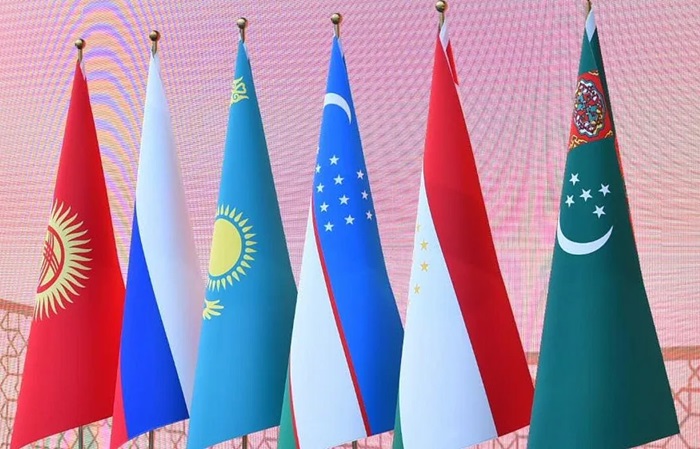
The Moscow-based Russian Civil Society Fund recently released a report titled “A Decade of New Opportunities: Outlines of a New Strategic Partnership Between Russia and the Countries of Central Asia.”
The report provides a comprehensive analysis of the strategic partnership between Russia and the Central Asian states over the past decade (2015-2025). It also forecasts the trajectory of this partnership for the next ten years (2025-2035).
The authors explore in detail the dynamics of trade relations between Russia and the five Central Asian countries, highlighting significant growth in trade turnover and investments in the energy, industrial, and transportation sectors. Particular attention is given to joint projects in the oil and gas industry, including the use of transit corridors for resource exports and the construction of new nuclear power plants.
How Have Economic and Energy Ties Between Russia and Central Asian Countries Changed?
Over the past decade, economic and energy ties between Russia and the Central Asian (CA) countries have undergone a fundamental transformation, shifting from inertial post-Soviet interactions to a new strategic partnership driven by the global rebalancing of the world order. The region has evolved from a “periphery” into a key continental pillar of Russia’s economic strategy, providing it with “economic depth” and access to markets in the Global South, as emphasized in the report’s materials.
The main changes over the past 10 years can be divided into several key directions:
- Macroeconomic Adaptation and Growth in Trade Turnover
From 2022 onward, trade with Central Asian partners surged dramatically amid sanctions restrictions and the restructuring of global logistics. The combined trade turnover between Central Asian countries and Russia reached about $45 billion in 2024. There has been a significant shift toward non-commodity exports (such as food products, chemicals, and agricultural machinery) and the use of the region as a hub for parallel imports. For example, in Kazakhstan’s exports to Russia, the share of machinery and equipment has sharply increased, including computing and construction technology that the country does not produce. Russia and the Central Asian nations are steadily transitioning to settlements in national currencies. In 2024, the share of such transactions with Kazakhstan and Kyrgyzstan reached 80%, and with Uzbekistan—55%.
- Energy Pivot: From Import to Export
Historically, Russia was a buyer of gas from Central Asia, but the situation has now reversed: Gazprom has shifted from being a purchaser to a supplier. In addition to traditional gas partnerships, cooperation is expanding in nuclear energy and hydropower. Rosatom has been selected as the general contractor for building Kazakhstan’s first nuclear power plant (at Balkhash) and is implementing a small-capacity nuclear power project in Uzbekistan. In Kyrgyzstan and Tajikistan, Russian companies (RusHydro and Rosatom) are involved in the modernization and construction of hydroelectric power stations.
- Logistical “Crossroads”
Central Asia has become the heart of Eurasian transit through the International North-South Transport Corridor (INSTC) and its actively developing internal infrastructure.
- Investments and Technological Cooperation
Russian businesses are actively localizing production in the region. By 2025, more than 24,000 enterprises with Russian participation are operating in Central Asia, with a total investment portfolio exceeding $38 billion. A new area of growth is collaboration in AI and big data, where Russia and Kazakhstan are joining their software and hardware expertise.
Scenarios for the Partnership Development Until 2030
The report outlines scenarios for the further development of relations between Russia and the Central Asian countries through 2030. It identifies three main scenarios, differing in the degree of integration and the influence of external factors.
The Inertial Scenario (“Managed Adaptation”) (probability around 50%) assumes the continuation of current trends without radical breakthroughs. Trade turnover will grow by 4–6% annually, with Kazakhstan solidifying its role as a “regional intermediary.” However, Russia may gradually lose competitive niches to China.
The second is the Positive Scenario (Deep integration, probability 30%). This scenario envisions a qualitative leap forward and the creation of “Eurasian Economic Space 2.0.” In this case, the Eurasian Economic Union (EAEU) becomes the core of the continental economy, fostering shared scientific clusters and unified educational standards. This represents a model of mature integration, where Russia and Central Asia transition from simple cooperation to joint development.
The Negative Scenario (Fragmentation and Stagnation, probability around 20%) is linked to a sharp tightening of sanctions and rising internal instability. Central Asia turns into an arena of fierce competition among other powers, with Russia losing its economic leadership. As a result, trade turnover could fall by 20–30%, common trade rules disintegrate, and regional countries shift to bilateral formats with other players.
“In the outlook through 2030, the most likely remains the managed adaptation scenario, but it is precisely the positive scenario—deep integration—that can transform Eurasia into one of the centers of the global multipolar economy,” the report concludes.
The Civil Society Development Fund is a non-profit organization specializing in research on politics, regional development, and modern media.
The full text of the report can be accessed here: http://civilfund.ru/mat/view/166
///nCa, 31 December 2025