


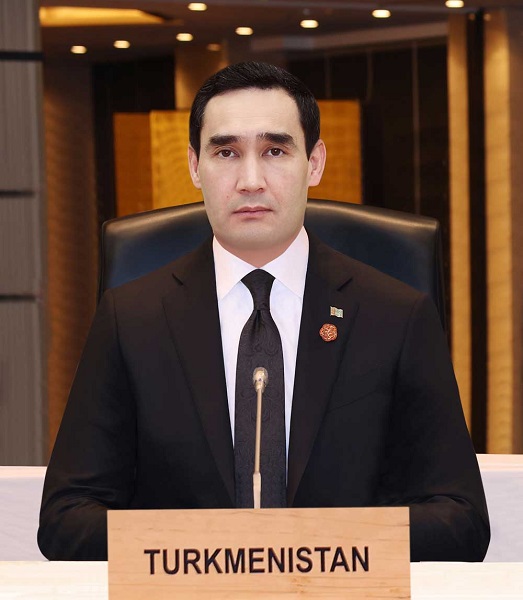
The address by President of Turkmenistan Serdar Berdimuhamedov at the historic first “Central Asia + Japan” leaders’ summit was dedicated to strengthening the multifaceted partnership between the regions.
The President emphasized that this meeting in Tokyo, chaired by Japanese Prime Minister Sanae Takaichi, was a milestone event laying the foundation for long-term relations amidst the growing role of Asia in global economics and politics.
Among the priorities for cooperation, the head of Turkmenistan highlighted the active involvement of Japanese business in the region as a primary goal. He specifically pointed to Japanese expertise in “green” energy, energy conservation, methane emission reduction, and alternative energy sources.
Special emphasis was placed on hydrogen energy (notably cooperation with the University of Tsukuba). Berdimuhamedov proposed formalizing common approaches to the “green transition” and developing “green diplomacy.”
The President of Turkmenistan proposed specific mechanisms to deepen the dialogue:
- Establishment of the “Central Asia – Japan” Youth Forum — to facilitate student, youth, and academic exchanges.
- Creation of a permanent platform, “Dialogue of Women of Central Asia and Japan” — to foster broad interaction among women across various fields.
- Proclaiming 2028 as the Year of International Law — to strengthen the international legal framework and the rule of law (with a call for support at the UN).
Speech by President of Turkmenistan Serdar Berdimuhamedov at the Central Asia–Japan Dialogue Summit
Your Excellency, the esteemed Prime Minister Sanae Takaichi, Your Excellencies the Heads of State, ladies and gentlemen!
Let me express my gratitude to the Government of Japan for its hospitality and warm welcome.
Turkmenistan views today’s meeting as a crucial milestone, a starting point for a high-quality, meaningful renewal of relations between the countries of Central Asia and Japan, focused primarily on the realities of the current global geo-economics and politics, the obvious growth of Asia as a global development center, and the formation of promising, attractive areas and areas of partnership there.
We believe that, in this configuration and taking into account new trends and factors, the consistent and targeted strengthening of ties between the countries of Central Asia and Japan is a natural process. I am confident that the very holding of this Summit is a clear confirmation of our countries’ determination and readiness to become active participants and to build mutual relations on a long-term basis.
It’s no exaggeration to say that today, here in Tokyo, we are jointly laying the foundation for the future architecture of multifaceted relations between Central Asia and Japan, creating the preconditions for rapprochement and better understanding, and fostering an atmosphere of trust and openness. I am confident that these principles will become defining, positively influencing the course and nature of future cooperation between our countries, and facilitating the implementation of large-scale joint endeavors and projects.
We also hope that the Central Asia–Japan Dialogue Summit will become a regular practice. I believe that this format and level of communication between our countries will allow us to most effectively and efficiently utilize our joint potential, channel it in the right direction, and thus ensure the desired results.
Turkmenistan is ready for constructive work with its Dialogue partners.
The First Central Asia–Japan Dialogue Summit holds a special place in the history of our relations. For the first time, our countries gathered at the highest level, reaffirming their shared commitment to building a long-term, sustainable, and multifaceted partnership.
For Turkmenistan, this format of relations is a significant factor and an integral part of its foreign policy and economic strategy, in which Japan occupies a rightful place as a leader in the global economy, an authoritative and influential member of the international community, and a significant contributor to the development of global processes.
We support the further expansion of ties between Central Asia and Japan, enriching them with new areas and practical content. We attach particular importance to economic and investment cooperation, considering the active participation of Japanese businesses in the region’s development an absolute priority for our cooperation.
For many years, we have been effectively collaborating with leading Japanese companies such as Itochu, Mitsubishi, Kawasaki, Sumitomo, Toyo, Sojitz, Komatsu, Toyota, and others, with whom we are implementing a number of large-scale, long-term projects in strategically important sectors: the gas industry, chemical industry, electric power, transportation, and water management.
Turkmenistan highly values the achieved level of bilateral relations with Japan and the established mechanisms for business cooperation, which have proven their effectiveness and mutual benefit.
This is clearly confirmed by the implementation of large-scale joint projects in the energy and industrial sectors, which demonstrate the scale and potential of the Turkmen-Japanese partnership.
I am convinced that by developing relations with Japan from a long-term and strategic perspective, we are moving in the right direction. The Central Asian states have significant resources for cooperation with Japan, and our shared goal is to maximize the strengths of all Dialogue participants, focusing our efforts on truly major and strategic areas.
One such area is “green transformation.” Turkmenistan is highly interested in Japanese initiatives in green energy and sustainable development. For our country, one of the world’s largest energy producers, cooperation in this area is of fundamental importance.
Turkmenistan is consistently pursuing energy conservation, reducing methane emissions, and implementing alternative and renewable energy sources. Hydrogen energy deserves special attention.
Recognizing that hydrogen is the energy of the future, we have already begun exploring substantive collaboration with Japanese companies. Our partner in this area is the University of Tsukuba and its relevant departments. Overall, we are deeply interested in close collaboration with Japan, which boasts unique experience and advanced technologies in green energy, energy conservation, and environmentally friendly manufacturing.
We believe it would be appropriate to establish, within the framework of the Dialogue, common approaches to the “green transition” in Central Asia as part of global efforts to ensure sustainable development.
In this context, we assign a special role to “green diplomacy” – the promotion of cooperation models on the international stage based on shared responsibility and work for a common future.
In this vein, we consider it important to develop cooperation on the climate agenda, including supporting the creation of specialized centers in the region, including a Regional Climate Technology Center for Central Asia. Japan’s assistance in this area would be of great importance.
Referring to connectivity, I would like to emphasize that Turkmenistan prioritizes the development of transport and transit connectivity. We believe in the need to establish fair and inclusive principles of cooperation, whereby new routes complement, rather than replace, existing ones. Our country is actively implementing multimodal transport projects connecting Europe, the Middle East, and the Asia-Pacific region.
We invest our own financial and material resources in them. For example, in close cooperation with a number of foreign companies, Turkmenistan, at its own expense, supported the construction and commissioning of the modern Turkmenbashi International Seaport on the Caspian coast, new airports in the capital and in the country’s provinces, and new railways connecting Turkmenistan with neighboring countries—Kazakhstan, Iran, and Afghanistan.
Construction of highways with access to Uzbekistan and Kazakhstan is actively underway.
Human development is also an important focus. Central Asia is a region with a young and dynamic population, offering significant opportunities for cooperation in education, science, technology, and humanitarian exchanges. Turkmenistan places particular emphasis on educational cooperation with Japan, including Japanese language studies, which currently reach thousands of students and schoolchildren in our country.
In this regard, to ensure contacts between youth, students and academics, we are taking the initiative to establish the Central Asia–Japan Youth Forum.
We also propose the creation of a permanent platform, “Dialogue between Women of Central Asia and Japan,” whose main goal should be close cooperation between women in our countries across a wide range of areas.
Dear participants!
In today’s realities, open and constructive international partnerships are becoming especially relevant.
In this context, I would like to specifically emphasize the significance of the major International Forum held in Ashgabat on December 12 of this year, dedicated to the International Year of Peace and Trust, International Neutrality Day, and the anniversary of Turkmenistan’s neutral status.
The forum has become an authoritative international platform for discussing current issues of strengthening peace, trust, and dialogue in contemporary international relations.
I take this opportunity to express my sincere gratitude to the participants of the Central Asia–Japan Dialogue, who actively participated in the work of this Forum. This is a convincing confirmation of the relevance of the ideas of peace, trust, and constructive dialogue, as well as the commitment to their practical advancement.
Turkmenistan, as a neutral state, believes that all international issues should be resolved only by peaceful means, in strict accordance with the UN Charter and international law.
The determining factor is compliance with the principles of the rule of international law, the further development and strengthening of the international legal framework, as well as increasing the effectiveness of the practical implementation of conventions, treaties, agreements and other multilateral UN documents.
In this regard, I ask you to support Turkmenistan’s initiative to declare 2028 the Year of International Law.
Another priority is to strengthen trust in Asia and create strong conditions for multilateral partnership based on the norms and principles of the UN Charter.
In this context, Turkmenistan also places great importance on strengthening cooperation in such important areas as non-proliferation, banning all types of nuclear testing, and disarmament. We view cooperation in these areas as an important contribution to global security and strategic stability.
Dear participants!
The first Central Asia–Japan Dialogue Summit opens new horizons for cooperation. Turkmenistan stands ready to actively promote trust, an equal, and mutually beneficial partnership between our countries, and to be an active participant in this format.
We are convinced that the Central Asia–Japan Dialogue meets the long-term interests of our peoples and has the potential to become an important factor in the development of sustainable and effective mechanisms for international cooperation. ///nCa, 22 December 2025