


How Active Neutrality Illuminates the Path to Affordable Electricity for Central and South Asia

Tariq Saeedi
A village not connected to the electrical grid is a village deprived of half of its potential. Time itself seems to change character after sunset. The productive hours shrink to the daylight period, children struggle to complete their homework, women rush to prepare meals before sunset, and entire communities retreat into an enforced isolation once night descends. This is not a historical curiosity—it is the present-day reality for millions of people across Central and South Asia.
Some fifteen years ago, I had the privilege of providing solar lanterns to a small village in Pakistan’s Balochistan province. These were modest devices—inexpensive and with limited battery life of about two hours on a single charge. Each household received two lanterns, providing perhaps four hours of light after sunset. The technology was simple, the investment minimal, yet the impact was transformative.
When I returned months later, the village elders told me something that has stayed with me ever since: the children were performing better in school because they could complete their homework. Women no longer needed to rush their cooking before darkness fell. Men had time to visit neighbors and maintain the social fabric of their community. Just a few hours of light—not bright, not constant, but simply available—had fundamentally improved the quality of life in that village.
This experience taught me something essential: providing electricity is certainly a business transaction, but it is far more than that. — It is a humanitarian cause. It is about dignity, opportunity, and the fundamental right of every human being to participate fully in modern life. And it is precisely this understanding—this recognition that energy security transcends mere commerce—that lies at the heart of Turkmenistan’s approach to regional electricity cooperation.
The Vision Articulated in Tashkent
“Today, we discuss the importance of expanding the electric power sector and creating a powerful network for electricity production, supply, and consumption in our region and its surrounding areas. This will create a reliable material base for the sustainability of the entire electricity supply system and ensure protection against potential negative external factors.”
— President Serdar Berdimuhamedov
7th Consultative Meeting of the Heads of State of Central Asia
Tashkent, November 16, 2025
When President Serdar Berdimuhamedov spoke these words at the historic gathering in Tashkent, he was articulating more than an energy policy. He was expressing a philosophy—one deeply rooted in Turkmenistan’s thirty years of permanent neutrality—that views regional energy security as a shared responsibility, a common good that transcends narrow national interests.
This philosophy is not abstract. It manifests in concrete decisions and deliberate policies that position Turkmenistan’s abundant energy resources for the benefit of the region and beyond.
The connection between neutrality and energy policy may not be immediately obvious, yet it is fundamental. A neutral nation, by definition, does not instrumentalize its resources for geopolitical leverage. It does not weaponize energy supplies. Instead, it can serve as a reliable, stable provider—a role that becomes increasingly valuable in an era of global energy uncertainty.
The Power Behind the Promise: Turkmenistan’s Generation Capacity
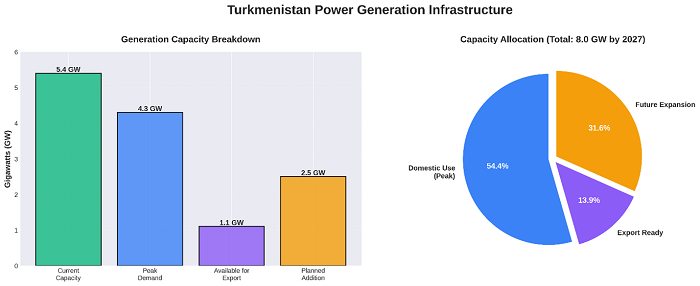
Turkmenistan’s ability to play this stabilizing role is not merely aspirational—it is grounded in substantial infrastructure and proven capability. The country possesses more than 5.4 gigawatts of installed power generation capacity, nearly all derived from its abundant natural gas resources, which constitute the world’s fourth-largest proven reserves.
Current Generation Capacity: Over 5.4 GW of installed capacity
Peak Domestic Demand (2024): Approximately 4.3 GW
Available Export Capacity: Significant surplus for regional markets
Planned Expansion: 1.6 GW combined-cycle facility announced November 2025
The government has been steadily expanding this capacity. Plans include adding 2.5 gigawatts of additional capacity to provide adequate headroom for both domestic consumption and export.
This expansion is not happening in isolation—it is accompanied by massive investments in transmission infrastructure. The Asian Development Bank-supported National Power Grid Strengthening Project is building approximately 1,100 kilometers of new transmission lines (110-kV, 220-kV, and 500-kV), constructing four new substations, and expanding three existing ones. This infrastructure spans four of Turkmenistan’s five regions and is creating an interconnected national transmission grid designed explicitly to improve both domestic reliability and export capabilities.
Hydrocarbon-rich Turkmenistan has historically been an exporter of baseload power to its neighbors, particularly Afghanistan. This role was envisioned during the Soviet era when Turkmenistan’s power system was developed with a strong export orientation, leveraging its rich hydrocarbon resources and proximity to large populations in surrounding countries. Today, that legacy infrastructure is being modernized and expanded to meet twenty-first-century needs.
Afghanistan: A Case Study in Humanitarian Energy Policy
Perhaps nowhere is Turkmenistan’s philosophy of energy neutrality more evident than in its electricity relationship with Afghanistan. For more than two decades, Turkmenistan has supplied electricity to Afghanistan at preferential rates—rates significantly below international market prices.
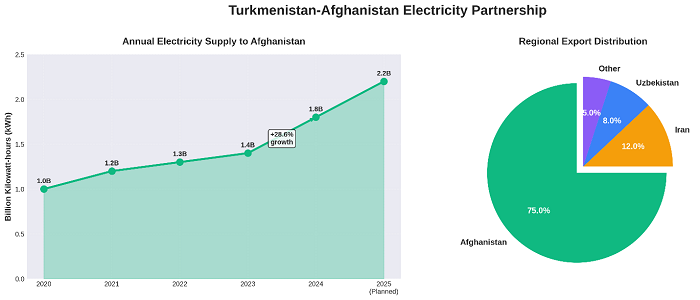
2024 Supply Agreement: 1.8 billion kilowatt-hours (up from 1.4 billion kWh in 2023)
Preferential Pricing: Historically as low as $0.02 per kWh, recently increased to $0.04 per kWh
Planned Expansion: Up to 1,000 MW capacity through new infrastructure
Transmission Lines: Four major lines serving northern, northwestern, and western Afghanistan
This is remarkable when one considers the economics. Afghanistan imports more than 80% of its electricity, spending between $250 and $280 million annually on these imports. The country faces chronic electricity shortages, with less than 50% of the population having access to reliable power. For Afghanistan, Turkmenistan’s electricity is not merely an import—it is a lifeline.
The infrastructure investment Turkmenistan has made reflects this commitment. Ashgabat built the transmission lines Imamnazar-Andkhoy, Serhetabat-Herat, and Rabatkashan-Kalainau at its own expense, connecting to the Afghan city of Mazar-i-Sharif. The recently completed 500-kilovolt Arghandi substation project, costing $183 million, will significantly expand import capacity and extend service reach to Kabul.

The Afghan Chamber of Commerce and Industry has explicitly noted that the electricity supply price from Turkmenistan is low. This is not market-driven pricing—it is policy-driven pricing, reflecting a deliberate decision to prioritize regional stability and humanitarian need over profit maximization.
It represents what we might call “humane commerce“—business conducted with conscience, trade executed with awareness of its broader social impact.
Beyond Afghanistan: A Regional Vision
While Afghanistan represents Turkmenistan’s most significant electricity export relationship, the vision extends far beyond bilateral arrangements. Turkmenistan has historically exported electricity to Iran, Uzbekistan, and Kyrgyzstan, and ambitious plans envision much broader regional integration.
The Turkmenistan-Afghanistan-Pakistan (TAP) Power Interconnection Project represents one of the most ambitious elements of this vision. This 700-kilometer transmission line essentially follows the route of the planned TAPI (Turkmenistan-Afghanistan-Pakistan-India) gas pipeline and aims to transfer 4,000 MW of power from Turkmenistan, with 1,500 MW allocated to Afghanistan and the remainder to Pakistan. The project, entrusted to Turkey’s Çalık Holding with a $1.6 billion investment commitment, would create transit revenues for Afghanistan while providing desperately needed power to Pakistan’s growing economy.
The broader TUTAP (Turkmenistan-Uzbekistan-Tajikistan-Afghanistan-Pakistan) project envisions an even more extensive integration, with a 500 MW HVDC back-to-back converter station in Pul-e-Khumri, Afghanistan, serving as a transit hub to synchronize the Turkmen and Afghan power systems.
Looking westward, preparations are underway to create overhead power transmission lines Mary-Sarakhs-Mashhad (Iran) and Balkanabat-Gonbad, potentially extending supplies to Turkey through transit via the Iranian energy system. This would leverage submarine transmission infrastructure across the Caspian Sea, as discussed in President Berdimuhamedov’s recent meeting with Turkish energy officials.
The Renewable Energy Horizon
While Turkmenistan’s current electricity generation is almost entirely gas-based, the country is actively developing renewable energy capacity—a development that aligns perfectly with global energy transition goals while maintaining its neutral, reliable supplier role.

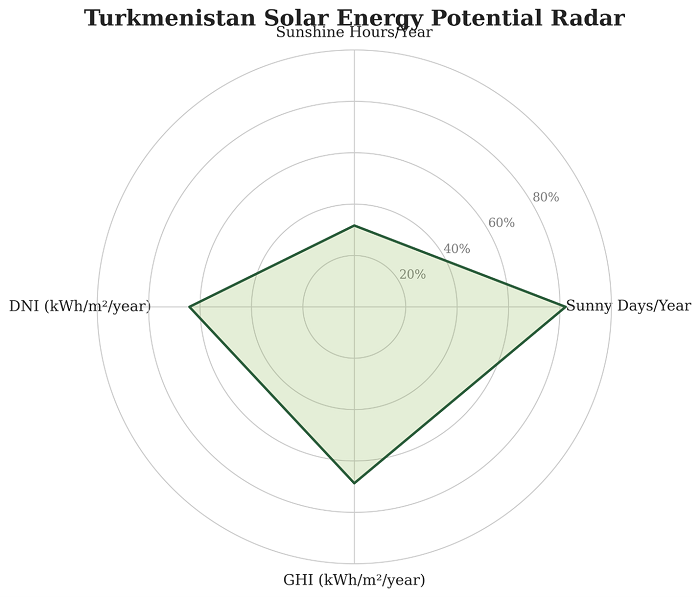
Solar Energy Potential:
- Over 300 sunny days annually
- Average sunshine hours: 2,774 hours yearly
- Average Direct Normal Irradiation (DNI): 1,603.33 kWh/m²/year—exceptionally high for concentrated solar power
- Average Global Horizontal Irradiation (GHI): 1,716.5 kWh/m²/year—strong potential for photovoltaic systems
Major Renewable Projects:
- 100 MW solar park – agreement signed with UAE’s Masdar (estimated 160-180 GWh annually)
- 10 MW hybrid solar-wind plant (7 MW solar, 3 MW wind) with Turkish firm Çalik Enerji near Altyn Asyr Lake, completed in Balkan velayat
- Pilot project for 50 MW combined gas turbine and solar power station
The legislative framework for renewable expansion is robust. In 2021, Turkmenistan adopted the Law on Renewable Energy Sources, followed by the National Strategy for the Development of Renewable Energy Sources until 2030 and the Program to Strengthen Turkmenistan’s International Cooperation in Renewable Energy for 2025–2030. These laws provide incentives including tax exemptions, reduced customs duties, and preferential land access for renewable energy projects.
With support from the European Union, the Scientific and Production Center for Renewable Energy Sources was established under the State Energy Institute of Turkmenistan. The center has created a digital database for assessing solar and wind resources across the country, identifying optimal locations for power plants. The Asian Development Bank is supporting renewable energy development through technical assistance, including a demonstration project in the new Arkadag Smart City targeting more than 4 GWh of renewable energy production annually.
The State Energy Institute now offers a specialization in “Non-traditional and Renewable Energy Sources,” ensuring that the next generation of Turkmen energy professionals will be equipped to manage an increasingly diverse energy portfolio. Research includes not only solar and wind energy but also solar-hydrogen systems to increase energy efficiency for decentralized consumers—particularly relevant for remote communities not connected to the central grid.
The Economics of Neutrality
Critics might question the economic rationale of selling electricity at preferential rates or investing heavily in transmission infrastructure that primarily benefits neighboring countries. Such criticism misunderstands both the economics and the philosophy at work.

First, the economic benefits of stable, long-term electricity exports are substantial even at preferential rates. Electricity export provides revenue diversification beyond raw natural gas sales, offers higher value-added returns, and creates sustained demand for Turkmenistan’s gas resources. The government is continuously investing in modernizing and expanding the electricity and heat sector, recognizing that while the energy sector is heavily subsidized domestically (with citizens receiving free or highly subsidized electricity, heat, and gas), exports can generate significant foreign currency earnings.
Second, the regional stability that reliable, affordable electricity helps create generates indirect economic benefits that far exceed the immediate pricing differential. Afghanistan’s economic development, for instance, directly impacts Turkmenistan through reduced migration pressures, enhanced border security, increased legitimate trade, and the potential for Afghanistan to serve as a transit corridor for electricity to Pakistan and beyond. The $50 million in annual transit fees that Afghanistan expects to earn from the TAP project represents economic capacity that can be recycled into the region.
Third, Turkmenistan’s approach creates goodwill and political capital that no amount of traditional diplomacy can purchase. When Turkmenistan announced it would reduce electricity prices for Afghanistan despite economic pressures, this decision resonated far beyond the energy sector. It demonstrated that neutrality is not passive or self-interested—it is active and other-regarding.
The Holistic Concept: Everything Connected
There is an ancient philosophical principle that everything is connected to everything else. In the modern context of energy security, this principle finds concrete expression. Electricity availability affects education outcomes. Education outcomes affect economic development. Economic development affects political stability. Political stability affects regional security. Regional security affects trade flows. Trade flows affect prosperity. And prosperity circles back to create demand for more electricity.
Turkmenistan’s approach recognizes these interconnections.
The holistic concept that underpins decision-making in Ashgabat does not view energy policy in isolation. It understands that providing affordable electricity to Afghanistan is inseparable from promoting Afghan stability, which is inseparable from Turkmen security, which is inseparable from regional prosperity.
This holistic thinking extends to infrastructure development. The massive investment in transmission lines and substations is not merely about moving electrons—it is about connecting communities, integrating economies, and building the physical infrastructure of regional cooperation. When Turkmenistan invests in a 500-kV transmission line or constructs a new substation on Afghan soil, it is literally building the circuits through which regional integration can flow.
Supply Chain Integrity: The Neutral Corridor
One of the most valuable contributions a neutral nation can make to regional energy security is ensuring supply chain integrity. In electricity markets, this means maintaining reliable transmission capacity and protecting energy infrastructure from political interference.
Turkmenistan’s neutral status provides unique advantages here. While Turkmenistan operates in parallel with Iran’s electrical grid (having voluntarily exited the Central Asia Power System in 2003), it maintains flexibility to work with all regional partners. This flexibility is crucial for projects like TUTAP that require coordination across multiple national systems with different operational standards and political relationships.
The country’s geographic position further enhances this role. Bordering Afghanistan, Iran, Kazakhstan, and Uzbekistan, with access to the Caspian Sea, Turkmenistan sits at a natural crossroads. The development of port facilities at Turkmenbashi and investment in railway infrastructure create what might be called “neutral corridors”—pathways through which energy (and other goods) can flow regardless of the political relationships between ultimate origin and destination points.
This becomes especially important for South Asian access to Central Asian energy. The complexities of India-Pakistan relations and ongoing security concerns in Afghanistan create obvious obstacles to direct energy trade. A neutral Turkmenistan, maintaining stable relations with all parties and demonstrating consistent reliability regardless of political shifts, can serve as a trusted intermediary—not in a diplomatic sense, but in the practical sense of being the stable provider that allows energy transactions to proceed even when direct bilateral relationships are strained.
Light in the Darkness: The Human Impact
I return, in closing, to that village in Balochistan—to those solar lanterns and the transformation they enabled. The parallel to Turkmenistan’s electricity exports is not exact, of course. The scale is vastly different: billions of kilowatt-hours flowing through high-voltage transmission lines versus a few watts stored in small batteries. Yet the principle is identical.
Both recognize that electricity is not merely a commodity. It is opportunity. It is dignity. It is the difference between a child who can study after dark and one who cannot. It is the difference between a business that can operate reliably and one held hostage to unpredictable power cuts. It is the difference between a hospital that can store vaccines and perform surgery and one that cannot. It is, quite literally, the difference between light and darkness.
When Turkmenistan provides electricity to Afghanistan at subsidized rates, it is not engaged in charity. It is investing in regional stability. It is building relationships that transcend individual transactions. It is demonstrating that neutrality—properly understood—is not about standing apart but about serving as a reliable partner to all.
The millions of people across Central and South Asia who lack access to reliable electricity do not care about the geopolitical theories or diplomatic frameworks. They care about whether the light turns on when they flip the switch. They care about whether their children can do homework after sunset. They care about whether their small businesses can operate without constant interruptions. They care about whether hospitals can save lives with modern equipment that requires stable power.

Turkmenistan’s energy policy, grounded in its thirty years of permanent neutrality, addresses these fundamental human needs. It does so not through grand proclamations but through consistent, reliable action: building transmission lines, maintaining substations, honoring supply commitments, and pricing electricity affordably enough that it reaches those who need it most.
Toward December 12: Lessons and Vision
As the international community gathers in Ashgabat on December 12, 2025, to commemorate thirty years of Turkmenistan’s neutrality, the electricity sector provides a powerful case study in how neutral principles translate into practical benefits.
The lessons are clear:
- Neutrality enables reliability: A nation that does not weaponize its resources can become a trusted, consistent supplier regardless of regional political shifts.
- Infrastructure is diplomacy: Transmission lines and substations create physical connections that transcend political relationships, building the foundation for long-term cooperation.
- Preferential pricing is strategic: Affordable electricity promotes regional stability, which generates security and economic benefits that far exceed the pricing differential.
- Holistic thinking produces better outcomes: Viewing energy security as inseparable from education, health, economic development, and political stability leads to policies that address root causes rather than symptoms.
- Long-term commitment matters: Two decades of consistent electricity supply to Afghanistan, through multiple regime changes and security challenges, demonstrates reliability that creates trust no diplomatic communiqué can match.
Looking ahead, Turkmenistan’s vision for expanding regional electricity cooperation—articulated by President Berdimuhamedov in Tashkent—offers a roadmap not just for Central Asia but for other regions struggling with energy security challenges. The emphasis on creating “a powerful network for electricity production, supply, and consumption in our region and its surrounding areas” recognizes that energy security in the twenty-first century requires regional solutions, not isolated national ones.
The planned expansion of generation capacity, the massive investment in transmission infrastructure, the development of renewable energy potential, and the commitment to maintaining preferential pricing for neighbors in need—all of these represent active neutrality in practice. This is neutrality not as passivity or isolation, but as engaged, constructive partnership.

The Moral Dimension
There is, ultimately, a moral dimension to energy policy that transcends economics and geopolitics.
When a country with abundant energy resources shares those resources affordably with neighbors whose people live in darkness, it is making a moral choice. When it builds infrastructure at its own expense to ensure reliable supply to regions struggling with poverty and conflict, it is acting on moral principles. When it maintains supply commitments through political upheavals and payment difficulties, it is demonstrating moral consistency.
This is the essence of Turkmenistan’s approach, grounded in thirty years of neutrality: the recognition that nations with abundance have responsibilities to those without, that energy security is a precondition for human dignity, and that cooperation serves everyone better than competition.
The solar lanterns I provided to that village in Balochistan eventually wore out—battery life degraded, solar panels became less efficient, bulbs failed. But the principle they demonstrated remains valid: even modest sources of light, provided reliably and affordably, can transform lives.

Turkmenistan’s electricity exports operate on the same principle, just at a vastly larger scale. The transmission lines carry not just electrons but opportunity. The substations transform not just voltage but possibilities. The affordable pricing opens not just markets but futures.
As we approach the December 12 conference, Turkmenistan’s energy policy offers a compelling example of how neutrality—properly conceived and actively pursued—can illuminate practical solutions to humanity’s most pressing challenges. In a world often darkened by conflict, competition, and narrow self-interest, Turkmenistan is quite literally providing light. And in that light, we can all see a better path forward. /// nCa, 21 November 2025
Disclaimer: The facts, figures, and data in this report have been taken from reliable sources and the links to the sources are embedded throughout in the text. However, nCa or anyone associated with nCa cannot be held responsible for any problems, complications or confusion arising from the use of this report. Moreover, the focus here is on the use of the power generation and supply capacity of Turkmenistan as a part of its policy of neutrality. Ed.