


nCa Report
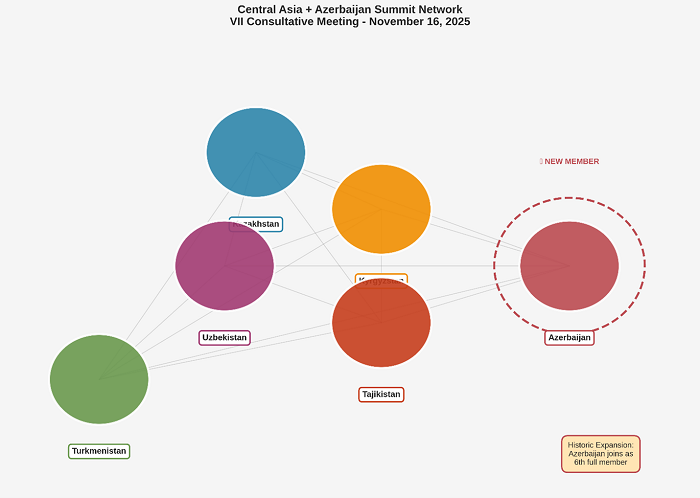
In a historic gathering that reshaped the geopolitical landscape of Eurasia, the presidents of five Central Asian nations convened on 16 November 2025 for the seventh consultative meeting of regional heads of state, unanimously admitting Azerbaijan as a full member and laying the groundwork for deeper economic, security and cultural integration.
The summit, hosted in Uzbekistan’s capital amid a backdrop of global uncertainties, underscored a collective resolve to transform Central Asia from a post-Soviet periphery into a unified powerhouse bridging East and West.
The event, held at the modern Congress Center under tight security, brought together President Shavkat Mirziyoyev of Uzbekistan, Kassym-Jomart Tokayev of Kazakhstan, Sadyr Japarov of Kyrgyzstan, Emomali Rahmon of Tajikistan, Serdar Berdimuhamedov of Turkmenistan and Ilham Aliyev of Azerbaijan.
This marked the first time the format expanded beyond the traditional “C5” to include Azerbaijan, a move leaders hailed as a “bridge” between Central Asia and the South Caucasus, potentially unlocking new trade routes and energy corridors.
Discussions spanned trade barriers, water scarcity, Afghanistan’s stability and climate challenges, culminating in the signing of several pivotal documents that experts say could redefine regional dynamics for decades.
A Push for Institutionalized Cooperation
Opening the proceedings, President Mirziyoyev, who chaired the summit, set an ambitious tone, proposing the evolution of the consultative meetings into a formal “Community of Central Asia.” He outlined seven key initiatives to foster unity, drawing on recent economic gains: mutual trade among the five nations reached $10.7 billion last year, with investments surging 17 percent.
“We are on the threshold of a historic revival — a New Central Asia,” Mirziyoyev declared in his address. “Our strength is in unity, our path is in friendship, and our future is shared.” He called for removing administrative hurdles, creating a common investment space and adopting a long-term economic program through 2035, emphasizing that “only by acting in the spirit of mutual support can we make the voice of Central Asia truly weighty and unified.”
Mirziyoyev also stressed environmental imperatives, proposing 2026-2036 as a “Decade of Practical Water Use” to address chronic shortages exacerbated by climate change. He advocated integrating Afghanistan into regional infrastructure, noting, “Afghanistan’s situation directly affects our development — it must be part of our energy, transport and water dialogues.” This echoed broader concerns about regional stability hinging on Kabul’s inclusion, a theme reiterated across speeches.
Voices From the Region: Quotes and Priorities
Each leader delivered remarks highlighting shared heritage and strategic synergies, with Azerbaijan’s inclusion dominating the narrative.
President Tokayev of Kazakhstan emphasized coordinated responses to water security and transport, proposing a Central Asian Framework Convention on Water Use and a unified cargo-tracking system. “Today we have made a historic decision on the accession of Azerbaijan to our format as a full-fledged participant,” he said, expressing confidence that it would bolster cooperation in rare earth metals, AI and tourism. Tokayev noted that “Central Asia is now undergoing a period of large-scale transformation,” signaling an end to “closed borders and isolation.”
Kyrgyzstan’s President Japarov supported Azerbaijan’s entry, stating it would “open new opportunities and broad horizons for cooperation, especially in international transit, logistics and energy.” He spotlighted the China-Kyrgyzstan-Uzbekistan railway as a “new transport artery” and linked it to Azerbaijan’s Zangezur Corridor project, calling it a “logical and strategic continuation” that could reformat regional logistics. “Today we can confidently say that the format of consultative meetings has proven itself as a viable platform for initiatives,” Japarov added.
Tajikistan’s President Rahmon congratulated Aliyev, saying, “It is gratifying that our platform is confidently consolidating its significance as an important participant in international and regional processes.” He underscored the need for balanced approaches to growing regional interests, though specifics from his speech focused on the platform’s evolving role.
President Berdimuhamedov of Turkmenistan, in a concise address, extended congratulations to Azerbaijan on its accession, aligning with the consensus on enhanced solidarity. As Turkmenistan assumes the rotating chairmanship, Berdimuhamedov pledged to advance the new “Central Asia + Azerbaijan” framework.
Azerbaijan’s President Aliyev, speaking as the newcomer, delivered a comprehensive address thanking hosts and highlighting deepening ties. “Relations between Azerbaijan and the states of Central Asia have a special character — we are united by centuries-long shared history, spiritual and cultural heritage, brotherhood, friendship and solidarity,” he said. Aliyev detailed economic strides, noting 14 visits to Central Asia in three years and reciprocal alliances. He praised infrastructure gifts like schools in liberated territories and touted the Middle Corridor’s 90 percent cargo growth, alongside projects like the Digital Silk Road and Caspian energy cables. “This decision once again confirms the friendly, brotherly nature of our relations and will serve to strengthen cooperation over a vast geographical space,” Aliyev concluded.
Key Outcomes and Signed Agreements
The summit yielded concrete results, with leaders signing a Joint Statement affirming priorities in security, economy and sustainability. They endorsed Azerbaijan’s full participation, tasking foreign ministers to update regulatory frameworks.
Other documents included the Concept of Regional Security, Stability and Sustainable Development; a Catalogue of Security Risks and Preventive Measures for 2026-2028; and an appeal supporting Kyrgyzstan’s UN Security Council bid for 2027-2028. A letter from UN Secretary-General António Guterres was read, praising the region’s collaborative spirit.
Infrastructure loomed large, with commitments to advance the China-Kyrgyzstan-Uzbekistan railway, Trans-Afghan Corridor and Trans-Caspian routes. An Infrastructure Development Council at the deputy prime minister level was proposed to coordinate efforts. Cultural initiatives included annual congresses on spiritual heritage and a Scientific Research Fund for AI-driven projects.
Expert Perspectives: A ‘Historic Revival’ or Cautious Optimism?
Regional scholars and analysts, many of whom previewed the summit, viewed the outcomes as a milestone in post-Soviet integration. Vladimir Norov, former Uzbek foreign minister and Shanghai Cooperation Organization secretary-general, described the meeting as a step toward “consolidation,” noting Mirziyoyev’s vision builds on principles of good-neighborliness and mutual trust. “Central Asia is emerging from the shadows,” Norov wrote in a pre-summit analysis, emphasizing how the expanded format could enhance non-governmental initiatives and cross-border cooperation.
A recent academic paper in the journal Central Asian Survey analyzed Uzbekistan’s shift toward regionalism under Mirziyoyev, crediting leadership changes for fostering trust and proposing that institutionalized formats like the proposed Community could sustain momentum amid external pressures from Russia, China and the West.
Jos Boonstra, a senior researcher at the Clingendael Institute, echoed this in a report, warning that while consultative meetings signal independence, challenges like water disputes and Afghanistan’s volatility require “balanced and committed” engagement.
Kazakhstan Institute for Strategic Studies director Yerkin Tukumov, speaking at pre-summit expert discussions, highlighted security as a core focus, noting the Catalogue of Risks addresses shared threats like extremism and climate migration. “This isn’t just symbolism; it’s about practical resilience,” Tukumov said, praising the inclusion of Azerbaijan for diversifying energy and transit options.

A lengthy joint piece by Akramjon Nematov, First Deputy Director of the Institute for Strategic and Regional Studies under the President of the Republic of Uzbekistan, and Shakhlo Khamrakhodjaeva, Leading Research Fellow at the Institute for Strategic and Regional Studies under the President of the Republic of Uzbekistan gave a well-rounded analysis ahead of the summit.
Here is the summary of their article:
The article examines the significant progress in Central Asian regional cooperation under Uzbekistan’s 2024 chairmanship of the Consultative Meetings of Heads of State, conducted under the motto “A New Central Asia: A Space of Unity, Stability, and Prosperity.”
Key Institutional Developments
The authors highlight how the five Central Asian nations have transformed their region from a space of disputes into one of cooperation. The Consultative Meeting format, initiated by President Shavkat Mirziyoyev in 2018, has become increasingly institutionalized through mechanisms like the Council of National Coordinators (established 2023) and regular ministerial meetings. A landmark achievement was Tajikistan’s accession to the Treaty of Friendship, Good-Neighborliness, and Cooperation.
Major Areas of Progress
Political Dialogue: Enhanced coordination through expert meetings, inter-parliamentary forums, and the Women Leaders’ Dialogue, which adopted the Tashkent Declaration.
Security Cooperation: Development of a draft Concept of Regional Security and Stability, along with historic first meetings of defense ministers and security service heads. The “Birlіk-2025” military exercises demonstrated practical defense collaboration.
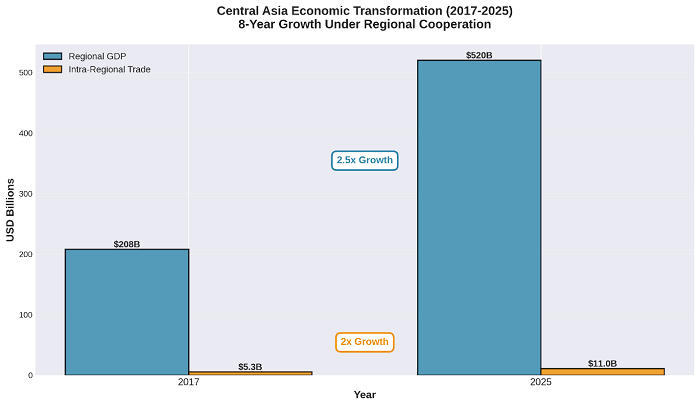
Economic Integration: Formation of the Council of Ministers of Trade and Investments, with regional GDP growing 2.5 times to $520 billion over eight years. Intra-regional trade doubled to exceed $11 billion, with mutual investments growing 5.6 times.
Transport Connectivity: Implementation of digital platforms reducing cargo transit time by 25%, alongside major railway projects connecting China, Afghanistan, and Pakistan through Central Asia.
Water, Energy, and Climate: Launch of water diplomacy initiatives, the first Central Asian Climate Forum, and development of a “Green Development” Concept for the region.
Cultural and Humanitarian Exchange: Expansion of cultural festivals, sports competitions, media platforms, and educational cooperation, including proposals for mutual diploma recognition among leading universities.
Significance
The authors emphasize that the tripoint border agreement between Tajikistan, Kyrgyzstan, and Uzbekistan, along with the Fergana Peace Forum, exemplify the region’s mature diplomacy. They conclude that Central Asia is becoming a unique model of regional collaboration based on consensus, trust, and shared destiny—potentially serving as an example for other regions worldwide. [nCa – agencies]
* * *
As fireworks lit up Tashkent’s night sky in honor of the leaders, the summit’s legacy appears poised to endure — a testament to a region charting its own course in an interconnected world. With Turkmenistan at the helm next, observers will watch closely to see if today’s pledges translate into tangible progress.
* * *

Following the VII Consultative Meeting of the Heads of State of Central Asia, the presidents signed a number of documents, Kazinform News Agency reports citing the Akorda press service.
1. Joint Statement of the Heads of State of Central Asia following the VII Consultative Meeting;
2. Appeal of the Heads of State of Central Asia to the UN member states regarding the candidacy of the Kyrgyz Republic for non-permanent membership in the UN Security Council for 2027-2028;
3. Decision on Azerbaijan’s accession as a full-fledged participant to the Consultative Meeting of the Heads of State of Central Asia.
By the Joint Statement of the Heads of State of Central Asia, the following documents were approved:
1. Concept of Regional Security, Stability and Sustainable Development in Central Asia;
2. Catalogue of Security Risks in Central Asia and Measures for Their Prevention for 2026–2028. [ Kazinform]
Dear Shavkat Miromonovich, Dear Heads of State,
Allow me to warmly greet you and express my heartfelt gratitude to the President of the Republic of Uzbekistan, the esteemed Shavkat Miromonovich Mirziyoyev, for the warm welcome, hospitality and excellent organization of this Summit.
I would also like to congratulate Ilham Heydarovich Aliyev on Azerbaijan’s accession to our format as a full member.
Dear heads of state!
I believe it is important to continue close political and diplomatic cooperation at the regional level, as well as at international forums, primarily at the UN.
Dear heads of state!
The enormous potential of Central Asian countries dictates the urgent need for further active economic cooperation in the interests of all states in the region.
Among the strategic areas, I highlight transport, energy, trade, production and technological cooperation.
Today, Central Asia is considered a key transport and transit corridor of international importance. It is already clear that this role will only increase, given the shift in economic and investment activity toward East and South Asia, and the Middle East.
Our countries must significantly intensify their cooperation in the transport sector. To this end, we believe we must begin effective and meaningful participation in the creation of combined East-West and North-South corridors.
I am confident that combining our potential to create a modern, extensive, efficient, and sustainable transport and logistics infrastructure is a worthy goal that meets the strategic interests of our countries.
Turkmenistan is also ready to discuss further concrete steps to strengthen its energy partnership. This includes more than just pipeline projects.
Today, we discuss the importance of expanding the electric power sector and creating a powerful network for electricity production, supply, and consumption in our region and its surrounding areas. This will create a reliable material base for the sustainability of the entire electricity supply system and ensure protection against potential negative external factors.
Among the pressing tasks we see are the creation of production cooperative chains in industry and the agro-industrial complex, more active participation of business circles in the creation of joint ventures of various profiles in our countries, and the expansion of cross-border and regional trade.
We look forward to further strengthening cooperation on water resources issues in the region based on equality, respect for each other’s interests, mutual understanding, and solidarity.
Overall, we support increased joint efforts to address environmental issues in the region, particularly in sensitive areas such as saving the Aral Sea and desertification. We welcome the presence of UN agencies on the environmental agenda in Central Asia and the establishment of specialized UN offices here. We are convinced of the need for our countries to develop coordinated environmental diplomacy within the UN and to attract increasing international attention to the problems of Central Asia.
I am confident that the development and support of humanitarian cooperation will always be relevant and significant for us.
Dear heads of state!
Assuming its chairmanship of the Consultative Meeting of the Heads of State of Central Asia, Turkmenistan will make every effort to strengthen our unity and cohesion, strengthen economic partnerships, and make the region attractive for significant foreign investment and the implementation of large-scale international projects in energy, transport, communications, and other areas.
In conclusion, I would like to wish the fraternal peoples of our countries peace, well-being and prosperity. /// nCa, 17 November 2025