


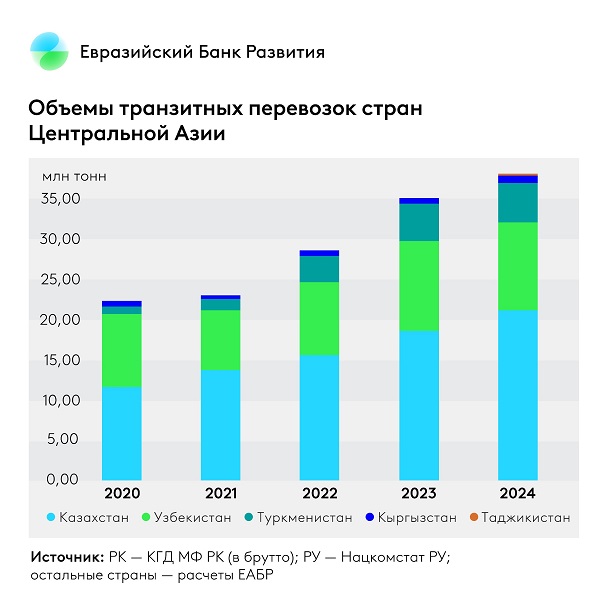
Central Asia is rapidly emerging as a key transit hub in Eurasia, proving that a lack of sea access is no barrier to economic growth. Thanks to its unique geographical position at the heart of the continent and the active implementation of infrastructure projects, the region is experiencing remarkable growth in transit transportation. According to data from the Eurasian Development Bank (EDB), transit cargo volumes increased by 70% between 2020 and 2024, reflecting a sustained trend.
Approximately 80% of transit flows pass through Kazakhstan and Uzbekistan, which have become critical nodes in Eurasian logistics. Railways play a leading role, handling about 60% of all transit cargo. Over 70% of transit routes connect China with Russia, Türkiye, Afghanistan, and European countries.
The development of the Eurasian transport framework remains the primary driver of this growth. According to the EDB’s Transport Projects Observatory, more than $52 billion will be invested in Central Asia’s transport corridors by 2035.
“Over the past five years, we have witnessed a doubling of Central Asia’s foreign trade with China, alongside a 70% increase in transit flows. However, this is just the beginning. Central Asia, one of the most geographically isolated landlocked regions from global markets, requires high-quality infrastructure. We estimate this will demand nearly $53 billion by 2035, with a significant portion allocated to transport projects along the North-South corridor. This includes not only the North-South International Transport Corridor but also the Trans-Afghan Corridor, which open new horizons for trade with the Gulf countries and South Asia,” said Evgeny Vinokurov, Deputy Chairman of the Board and Chief Economist at the EDB.
The growth in transit is supported not only by the construction of roads and terminals but also by the development of “soft infrastructure.” Simplified border-crossing procedures and coordinated tariff policies significantly accelerate cargo flows and reduce the cost of container transportation.
The surge in transit through Central Asia opens new opportunities for the region. The development of transport corridors not only strengthens economic ties between East and West but also fosters Central Asia’s integration into global trade networks. ///nCa, 20 October 2025