


Elvira Kadyrova and Ravilya Kadyrova, Awaza, Turkmenistan
On August 5, 2025, in the National Tourism Zone “Awaza,” a meeting dedicated to the preparations for the Seventh Consultative Meeting of Heads of State of Central Asia, scheduled to take place in Tashkent this fall, was held under the chairmanship of the National Leader of the Turkmen People and Chairman of the Halk Maslahaty of Turkmenistan, Gurbanguly Berdimuhamedov.
The event was attended by President of the Republic of Kazakhstan Kassym-Jomart Tokayev, President of the Republic of Tajikistan Emomali Rahmon, President of Uzbekistan Shavkat Mirziyoyev, Chairman of the Cabinet of Ministers and Head of the Presidential Administration of the Kyrgyz Republic Adylbek Kasymaliev, Prime Minister of the Republic of Azerbaijan Ali Asadov, as well as members of official delegations and representatives of the public.
Opening the forum and greeting the heads of state, Gurbanguly Berdimuhamedov emphasized that this event serves as a preparatory stage for the Seventh Consultative Meeting of Heads of State of Central Asia, to be held in the capital of brotherly Uzbekistan, Tashkent.
President of Uzbekistan Shavkat Mirziyoyev provided an overview of the joint efforts undertaken during Uzbekistan’s chairmanship of this format. Notably, at the beginning of the year, the Chairmanship Concept and a schedule of joint events were adopted.
Meetings of Security Council secretaries, heads of special services, and ministers responsible for industry, energy, water management, and ecology have already been held, alongside media and youth forums. Upcoming events include the Interparliamentary Forum, ministerial meetings on defense, trade, and transport, as well as cultural and humanitarian initiatives.
To shape a new agenda for regional partnership and strengthen its legal framework, preparatory work on conceptual documents for the upcoming meeting is underway.
***
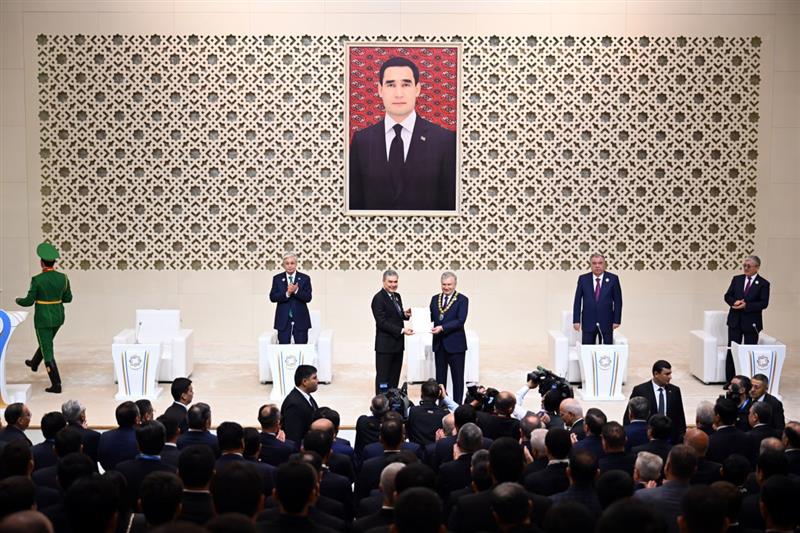
During the event, the National Leader of the Turkmen People and Chairman of the Halk Maslahaty announced the decision to award President of the Republic of Uzbekistan Shavkat Mirziyoyev the Order “Hyzmatdaşlygy ösdürmäge goşandy üçin” (“For Contribution to the Development of Cooperation”).
A solemn ceremony followed, during which President Shavkat Mirziyoyev was presented with the state award.
This prestigious honor was bestowed upon the Uzbek leader for his personal contribution to the development of bilateral friendly relations between Turkmenistan and Uzbekistan, strengthening friendship, brotherhood, and mutually beneficial cooperation between the Turkmen and Uzbek peoples, as well as enhancing Turkmenistan’s international authority through his state and public activities.
Speech by the National Leader of the Turkmen people, Chairman of the Khalk Maslahaty of Turkmenistan Gurbanguly Berdimuhamedov at the meeting of the Heads of Central Asian States
Dear Heads of State,
Dear members of the delegations!
On behalf of the people of Turkmenistan, I cordially welcome you and thank you for accepting the invitation to participate in the Third United Nations Conference on Landlocked Developing Countries.
We have proposed to hold a meeting of the heads of State of Central Asia on the platform of this highly representative Forum.
I would like to express my deep appreciation for the support of this initiative. This is an important and revealing fact that demonstrates the commonality of our thoughts, solidarity, and responsibility of the leaders of fraternal countries, and their willingness to work closely together to solve large-scale development challenges.
In this context, I would like to emphasize that cooperation between neighboring States is currently developing in an ascending line, and this, in turn, leads to the process of searching for and creating new forms of multilateral cooperation.
One of them was the Consultative Meetings of the Heads of State of Central Asia, which are now held regularly in each of the countries of the region.
As practice has shown, the initiative to hold Consultative Meetings has proven to be highly relevant and in harmony with the spirit of partnership in addressing pressing issues. It can be stated with confidence that today this format has evolved beyond a regional platform for political dialogue and has become an undeniable factor of international significance.
Being an important part of interstate cooperation in Central Asia, Consultative Meetings simultaneously have a constructive impact on strengthening relations with neighboring countries, forming models of interregional partnership, and to a large extent provide conditions for the development of mutually beneficial ties on a continental scale.
Largely due to the decisions taken at the Consultative Meetings, a productive general political dialogue has been established, systematic work is underway to ensure regional and global security, coordination of steps in international structures is being improved, and the practice of consultations and exchange of views on topical issues on the regional and international agenda is being developed.
Today, mutual understanding and trust between our countries have reached such a level that we can set ourselves bold and realistic joint goals for the long term, initiate major projects, and identify strategic vectors of cooperation. I am confident that this will not only give a powerful impetus to the social and economic development of our countries, but will also have a great positive impact on regional processes, promote the accelerated integration of Central Asia and neighboring countries into global economic relations, attract serious investments, new technologies, knowledge and competencies.
It should be emphasized that, building our relations on modern principles, we rely on a common civilizational foundation, using centuries-old positive experience, thereby ensuring historical continuity, the revival of the role and place of our states in the current geopolitical and economic realities.
The most important priority of cooperation in this format is the consistent and purposeful strengthening of economic partnership.
It would not be an exaggeration to say that the prospects in this area are immense. The consolidationof potential and the effective use of combined resource, geographic, industrial, and technological capacities can not only significantly contribute to the development of national economies, but also impart a fundamentally new meaning and character to the entire geoeconomic architecture of Eurasia.
Today, the priority of our efforts lies in the economy and its strategic sectors—energy and transport.
Serious progress has been made in the energy sector. Large volumes of energy supplies are carried out through the territories of our states, and each of them is making efforts to increase volumes and enter new markets.
The Central Asian countries have a huge resource base, occupy leading positions on the continent in the extraction and production of various types of energy, and are developing an export supply infrastructure taking into account their advantageous geographical location. We share common views and principles based on the diversification of energy flows, their safety and reliability. In this context, it becomes relevant to combine their advantages and potentials for the implementation of joint large-scale projects and the construction of modern transit infrastructure.
Our countries form a natural space on the continent designed to connect Asia and Europe through strong and sustainable transport corridors.
We are aware of the real prospects for turning Central Asia and the Caspian basin into a powerful continental transit and logistics hub in the North-South and East–West directions, thereby ensuring the revival of the Great Silk Road on modern principles.
In this regard, I believe that the current UN Conference on Landlocked Developing Countries and the decisions that are expected to be taken may be important in the context of our meeting today and planning further joint actions.
This fully applies to environmental and climate issues. Turkmenistan firmly stands for combining the efforts and competencies of the Central Asian States in the face of the current serious environmental challenges, among which the most urgent are the shallowing of the Caspian Sea, desertification, the problem of saving the Aral Sea, melting glaciers, rational use of water resources, conservation of the natural landscape, unique flora and fauna.
Equally important is the coordination of steps aimed at implementing measures to develop low-carbon industries and reduce emissions into the atmosphere.
I am confident that the cooperation and mutual support of the Central Asian countries and Azerbaijan in the implementation of these tasks will make a significant contribution to achieving the goals outlined in the Global Agenda for Sustainable Development until 2030.
Dear participants!
I would like to emphasize the importance of strengthening the multifaceted relations between our fraternal peoples. Today, against the background of complex trends taking place in the world, this task is becoming particularly relevant, dictating the need to develop coordinated, clear, responsible approaches to them.
And I am convinced that together we are capable of adequately and effectively coping with this task, not only for the benefit of our own development, but also in the interests of the whole world.
This conviction is based on the common centuries-old experience, the strength and continuity of spiritual and moral values and principles.
In fact, our peoples are one whole. We form a single civilizational space, profess the same values, and rely on the historical heritage of our great ancestors. They bequeathed to us the humanistic ideals of brotherhood, good-neighborliness and unity, the observance of which opens up wide horizons for comprehensive development and progress for our States.
It is all the more important today to cherish, preserve and multiply this baggage, strengthen mutual understanding and friendship between our peoples.
Cultural and humanitarian ties, the interaction of representatives of the creative and scientific intelligentsia, and youth should play a special role in this. I believe that they should become widespread and regular.
Government support for such ties is a contribution to the future, a solid guarantee of continuity and continuation of the traditions laid down today by our joint efforts. Including during this meeting.
Dear Heads of State,
We can rightfully be proud of the high level of relations between our countries. Their defining features are equality, respect, openness and trust.
Cooperation between the Central Asian countries is a strategic factor in regional security, an important component of sustainable development and a balance of interests in Eurasia and around the world.
I am convinced that there is a huge potential for cooperation in a wide range of areas for our further joint activities.
The next Consultative Meeting of the heads of State of Central Asia will be held in Tashkent in mid-November this year. I have no doubt that it will be held at a high substantive and organizational level, and will be marked by important decisions. And the current meeting is certainly an important stage in the preparation of the Consultative Meeting.
I am confident that the decisions to be taken by the heads of state will strengthen the solid political and legal foundation of our cooperation and will contribute to the implementation of practically significant programs and projects aimed at ensuring the well-being and prosperity of our countries and peoples.
Once again, I would like to thank you for participating in this meeting and for your willingness to work constructively and creatively together.///nCa, 6 August 2025