


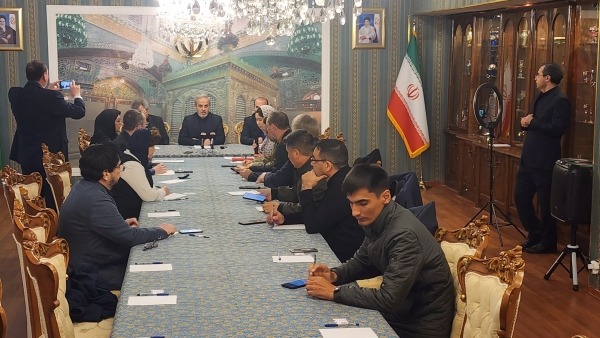
On 16 March 2026, Ali Mojtaba Rouzbehani, the Ambassador of the Islamic Republic of Iran to Turkmenistan, held a press briefing for local and international media outlets in Ashgabat. Speaking in Farsi with consecutive Russian translation, the Ambassador addressed regional security and the growing partnership between Tehran and Ashgabat.
Ambassador Rouzbehani praised the ties between Iran and Turkmenistan, describing them as “exemplary and friendly.” He emphasized that cooperation continues to strengthen across various sectors despite rising regional tensions.
The diplomat expressed profound gratitude to the Turkmen government for its recent humanitarian assistance to Iran. He also noted that Tehran received critical support from Uzbekistan, which was delivered via Turkmen transit routes. “I would like to reiterate my thanks to the state of Turkmenistan,” Rouzbehani stated.
The centerpiece of the briefing was the Ambassador’s condemnation of recent military aggression by the United States and Israel. Rouzbehani pointed out that the strikes were launched precisely while negotiations with the American side were still underway.
According to the Ambassador, the United States abandoned the negotiating table without provocation, shifting instead to military actions in which Israel played a great role.
“This is a crime being perpetrated against Iran by nuclear-armed states — America and Israel,” the diplomat stated.
He noted that the Iranian armed forces were not prepared for such sudden aggression, which resulted in civilian casualties. However, the Ambassador claimed that the U.S. was equally unprepared for Iran’s “decisive response.” He emphasized that the aggression has only served to unite the Iranian people, who have demonstrated significant strength and resolve.
Ali Mojtaba Rouzbehani provided details on the devastating impact of the strikes. He highlighted that the targets were not limited to military assets — such as a training vessel preparing for joint exercises with India — but also included strictly civilian institutions.
The diplomat expressed particular outrage over the use of Tomahawk cruise missiles against educational institutions. He reported that a “double-tap” strike on one school resulted in the deaths of more than 170 girls—an act the Ambassador cited as definitive proof of a deliberate intent to target the most vulnerable population. Other hit targets included residential buildings and sports complexes.
Addressing attempts to destabilize Iran’s internal situation, the Ambassador noted that the death of the Supreme Leader—which the organizers of the attacks had banked on—failed to weaken the state. On the contrary, he asserted that it has sparked a massive consolidation of the nation.
A new Supreme Leader was swiftly appointed, who has already declared that the government’s resolve will never falter.
In his closing remarks, Ali Mojtaba Rouzbehani emphasized that the actions of the U.S. and Israel have jeopardized not only regional security but the global economy as well. Iran intends to utilize all available means to defend its territory and hold those responsible to account.
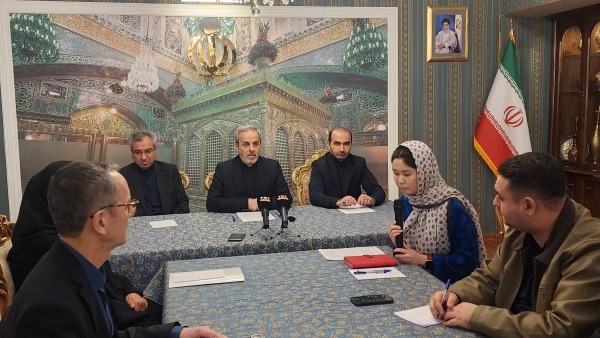
Q&A Session
Health of the Leadership
Following his formal remarks, the Ambassador opened the floor for questions. When asked about the health of the newly appointed Supreme Leader, Mojtaba Khamenei, the diplomat provided reassurances.
Citing recent statements by Foreign Minister Abbas Araghchi, the Ambassador confirmed that the Supreme Leader is in “excellent health” and is fully performing his duties.
The Iran-Turkmenistan Border: A Pillar of Strategic Stability
Addressing inquiries regarding the situation on the border, the diplomat highlighted its immense regional importance. Spanning approximately 1,200 km, the four primary border crossings serve as vital conduits not only for bilateral trade but also for broader Central Asian and international cargo flows.
The Ambassador emphasized that the governments of Iran and Turkmenistan are working closely to ensure the border continues to operate as usual, without any disruptions.
The border remains fully operational for Iranian citizens returning home and for the transit of foreign nationals traveling to their respective countries.
Rouzbehani specifically noted that Tehran views Ashgabat as one of its “most reliable and pivotal partners” in the region.
Potential Migration and National Resolve
Regarding potential migration from Iran—including among ethnic Turkmens—following the conflict, Ali Mojtaba Rouzbehani dismissed such concerns.
He stated that there has been no need for Iranian citizens to flee the country. Instead, he framed the recent aggression not merely as an attack on a state, but as an assault on a centuries-old civilization, which has only heightened the patriotic spirit.
The Ambassador noted that neighboring nations—Turkmenistan, Armenia, Türkiye, and others—can witness Iranians returning to their homeland, taking to the streets, and demonstrating their readiness to defend the nation.
“This is not a narrative; this is living history,” he remarked.
He further pointed out that even during mass Friday demonstrations, when aggressors launched strikes against civilians, there was no panic or flight.
Retaliation Against U.S. Assets and Regional Diplomacy
Commenting on the strikes against American facilities in the region, the Ambassador emphasized that Iran does not target neighboring states. He stated officially that Iran only strikes U.S. assets—including infrastructure and military bases.
“There is no benefit for the Iranian government in continuing this war,” he noted.
The Ambassador specifically mentioned Türkiye as a nation striving for a resolution to the conflict. He also categorically rejected allegations of Iranian strikes against Saudi Arabia or Azerbaijan.
According to the diplomat, Iran only responds to direct threats and has no interest in conflict with its neighbors. He asserted that following the cessation of aggression, relations with neighboring countries will remain friendly, placing the full weight of responsibility on the “aggressors” launching attacks from thousands of kilometers away.
The Strait of Hormuz
One of the most critical issues addressed was navigation through the Strait of Hormuz. The Ambassador clarified that the strait is not closed; however, as a result of the aggression, the passage of vessels has become severely hindered.
Iran’s position on this matter remains firm: If the United States seeks stability, then American and Israeli military forces must withdraw from the region. The Ambassador reiterated that Iran advocates for security and stability in the strait and has proposed a cooperation mechanism to neighboring countries. “Until the aggressor forces depart, the region will not be secure,” the diplomat emphasized.
In his closing remarks, the Ambassador addressed media propaganda, stating that the era of misinformation has passed, as nations have come to realize that major media outlets are controlled by the U.S. and Israel. He also cited examples of international law violations in Iran, Venezuela, and Libya, noting the failure of international organizations to respond effectively. ///nCa, 17 March 2026