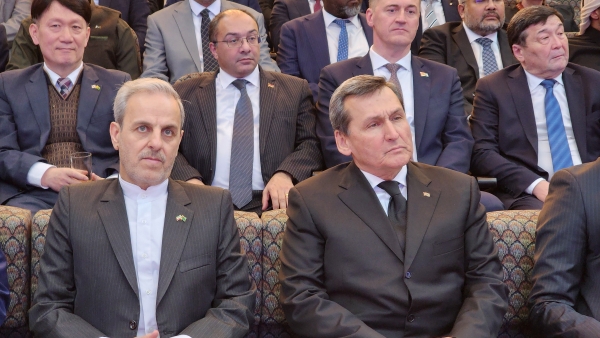
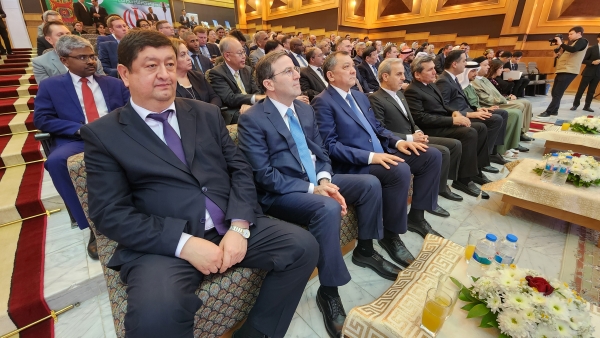
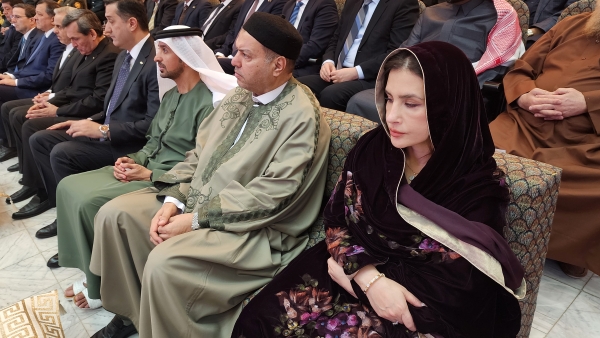
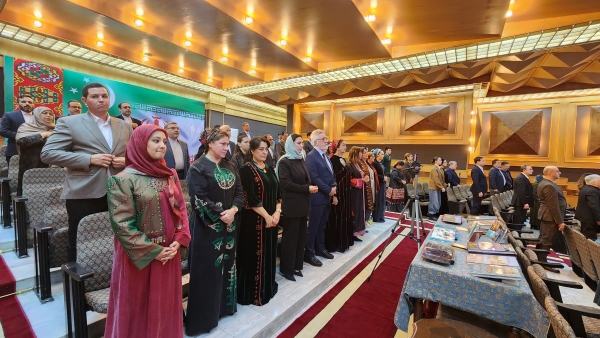
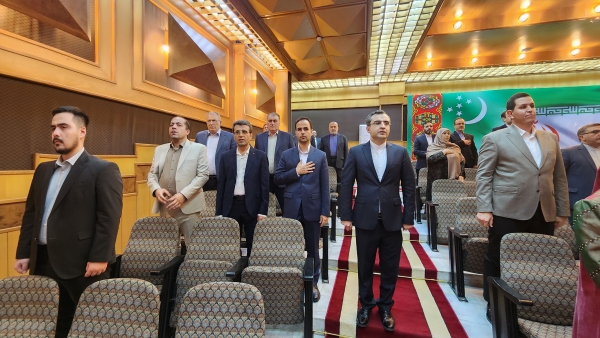
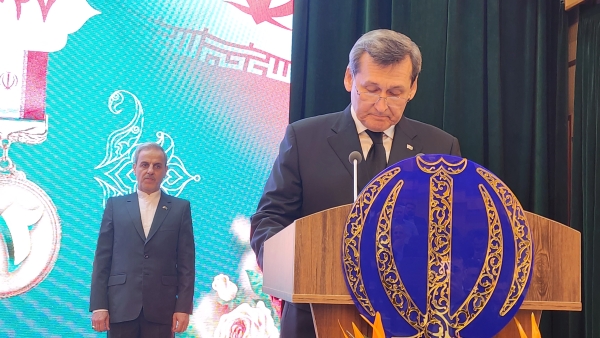
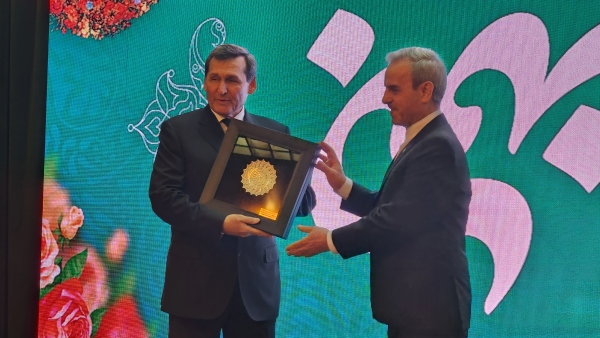
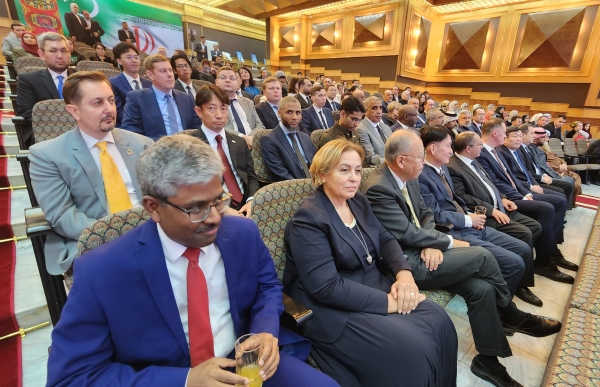
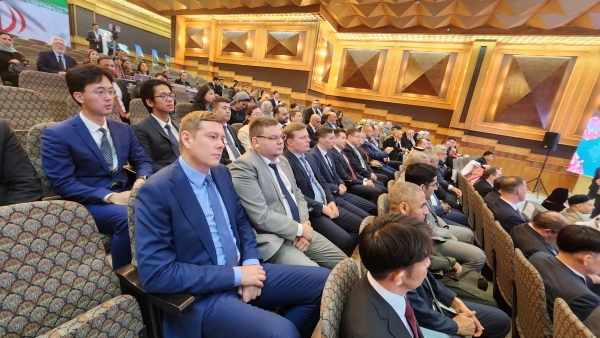
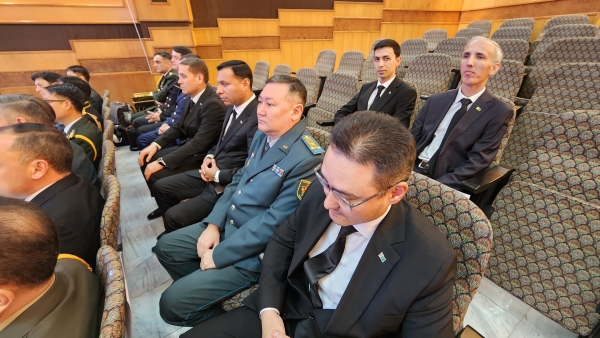
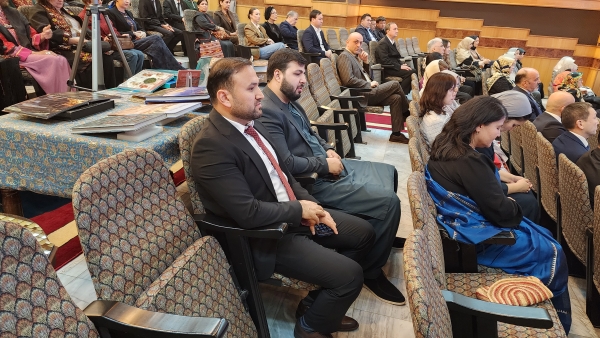
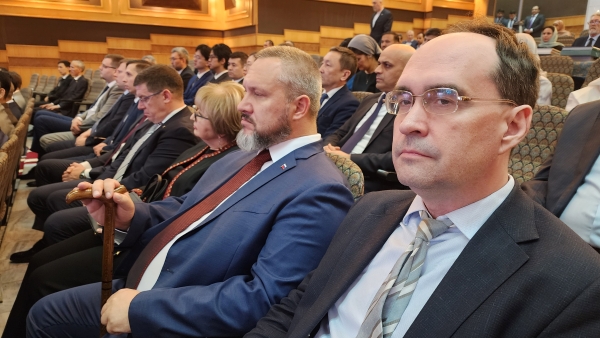
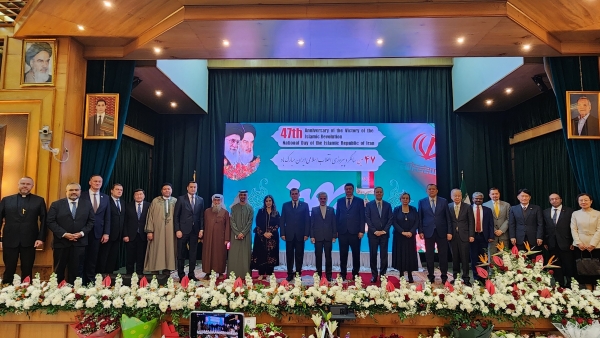
The embassy of the Islamic Republic of Iran hosted a reception on 10 February 2026 to mark the 47th anniversary of the Victory of the Islamic Revolution of Iran and the National Day of the Islamic Republic of Iran.
Here is a truncated version of the speech of Ambassador Ali Mojtaba Rouzbehani:
I am honored to welcome you, distinguished guests, on the occasion of the 47th anniversary of the victory of the Islamic Revolution and the National Day of the Islamic Republic of Iran. At the outset, I wish to extend my sincere gratitude and appreciation to His Excellency Mr. Rashid Meredov, Deputy Chairman of the Cabinet of Ministers and Minister of Foreign Affairs of Turkmenistan, as well as to the esteemed officials, ambassadors, heads of political and international missions, diplomats, military attachés, and my dear compatriots who have joined us for this ceremony.
Excellencies,
Forty-seven years ago, on days such as these, the resolute will of a nation calling for “independence, freedom, and the Islamic Republic” was realized. Today, as we commemorate this enduring and historic achievement, the Islamic Republic of Iran stands resilient and influential in regional and global affairs. Despite decades of hostility, obstruction, and pressure imposed by ill-wishers, Iran has not only overcome formidable challenges but has continued its steady path of progress.
Although the Iranian people have endured years of so-called “economic terrorism” and the harshest extraterritorial, illegal, and inhumane sanctions, the nation’s development has never been halted. Iran’s scientific growth and technological achievements during this period are both extensive and remarkable.
In 2025, Iran strengthened its standing in the global innovation index, ranking among the top ten upper-middle-income countries. In biotechnology, based on 2024 and 2025 statistics, Iran ranked first among Islamic countries and 13th globally, producing more than 1,100 scientific publications in this field. Iranian biotechnology products are now exported to over 35 countries worldwide. In stem cell research and basic medical sciences, Iran holds first place in the region and 11th worldwide. The country is also among the global and regional leaders in the production of radiopharmaceuticals, vaccines, and medicines for complex and acute diseases such as cancer and multiple sclerosis. In the field of nanotechnology, Iranian products are marketed in more than 45 countries, placing Iran fourth in the world.
Last year also witnessed the successful launch of several Iranian research satellites into space. The Kowsar, Zafar, and Paya satellites, along with the Qaem and Simorgh launch vehicles, represent major achievements in Iran’s aerospace sector.
A fundamental pillar of the Islamic Revolution has been the recognition of the dignified role of women and the provision of equal opportunities for their comprehensive growth and self-realization. Today, women constitute the majority of university graduates in Iran and play vital roles across all sectors, including industry, technology, science, politics, and culture. Numerous laws have been enacted or amended to support the individual and social development of women.
Drawing upon thousands of years of civilization and culture, the 47-year-old Islamic Republic of Iran stands strong in defense, advanced in science, and committed to just and lasting peace. With reliance on divine assistance, national will, and respect for our neighbors, we will continue our determined journey toward the heights of modern Islamic civilization.
[Remarks about attack on Iranian facilities in June 2025. Response of Iran. Protests aimed at destabilization of Iran. Foreign involvement. Containment.]
We firmly believe that human rights must never be exploited as a tool for political coercion or terrorism. While the Islamic Republic of Iran respects the right to lawful protest, it will resolutely confront any act of terrorism that threatens the safety and security of its citizens, in accordance with legal principles and sovereign responsibilities. [Condemnation of continued foreign interference.]
The cornerstone of Iran’s foreign policy is opposition to unilateralism. In response, we have adopted a strategy of active resistance combined with comprehensive diplomacy. Along this principled and forward-looking path, we extend our hand in friendship to all independent nations and governments of the world.
Dear Guests,
Within the foreign policy framework of the Islamic Republic of Iran, “neighborhood priority” is not a slogan but a strategic choice aimed at building a strong, secure, and prosperous region. In this context, relations with the friendly and brotherly nation of Turkmenistan—our gateway to Central Asia—hold a special and privileged position. The bonds between our two nations transcend geography and are deeply rooted in shared civilization, history, and culture.
We respect Turkmenistan’s policy of positive and permanent neutrality and regard it as a cornerstone of regional stability. As emphasized by the Supreme Leader, the relationship between Iran and Turkmenistan is one of kinship. In recognition of this bond, the Islamic Republic of Iran was among the first countries to recognize Turkmenistan’s independence.
Guided by the firm resolve of our senior leadership, bilateral relations have experienced a notable upward trajectory over the past year. The visit of His Excellency President Pezeshkian to Ashgabat for the International Conference on Peace and Trust last December, followed by Vice President Dr. Aref’s participation in the Third UN Conference on Landlocked Developing Countries in Avaza this past August, marked significant milestones in high-level engagement.
Throughout 2025, numerous bilateral meetings were held across various levels. Foreign ministers met in Tehran and Ashgabat in February, May, and June. Ministers of roads and transportation met in April, parliamentary delegations convened in Ashgabat in May, and Iran’s Vice President and Head of the Plan and Budget Organization visited Ashgabat in April.
Additionally, Iran’s government spokesperson attended the Avaza Summit on the Role of Women in Development in December. High-level visits also included those of Turkmenistan’s Minister of Interior in October and Minister of Railway Transport in September. Overall, diplomatic exchanges at the ministerial level and above were both frequent and substantive. Trade volume between the two countries grew by more than 25 percent in 2025.
At the regional level, cooperation between provinces and regions also expanded significantly. Key initiatives included a Turkmenistan trade exhibition in Iran’s Golestan Province in April, a reciprocal exhibition of Golestan’s manufactured goods in Turkmenistan’s Balkan Province in November, and mutual visits by provincial governors. These exchanges contributed meaningfully to the deepening of bilateral ties.
The 18th Meeting of the Iran–Turkmenistan Joint Intergovernmental Commission, held in Tehran in May 2025, was another major milestone. During this meeting, both sides set the goal of increasing transit capacity to 20 million tons and expanding bilateral trade to $3 billion. Progress in industrial, transit, energy, agriculture, transportation, and artificial intelligence cooperation, as well as activation of the North–South Corridor and rail routes through Incheh Borun and Sarakhs, will further enhance strategic cooperation. The sister-port agreement between Amirabad and Turkmenbashi will also facilitate greater access to open waters.
Cultural, artistic, and scientific exchanges flourished over the past year. Artists from both countries actively participated in cultural programs, including Iranian illumination and miniature artists, musical ensembles, and prominent Turkmen artists featured in Iranian festivals. Academic cooperation also expanded, with Iranian students and alumni participating in scientific Olympiads and conferences in Turkmenistan, and Turkmen intellectuals warmly welcomed in Iran.
The Islamic Republic of Iran firmly believes that lasting security and stability in Central Asia and the Caspian Sea region can only be achieved through regional cooperation. The borders between Iran and Turkmenistan are borders of peace, friendship, and brotherhood. We welcome Turkmenistan’s constructive role in advancing regional integration and believe that economic connectivity is the most effective path toward shared prosperity.
Once again, I extend my heartfelt appreciation to all distinguished guests for joining us in this celebration. I wish His Excellency the President of Turkmenistan, the National Leader of the Turkmen People and Chairman of the Halk Maslakhaty, as well as the government and people of Turkmenistan, continued health, prosperity, and success. /// nCa, 11 February 2026
Here are some photos from the event: