


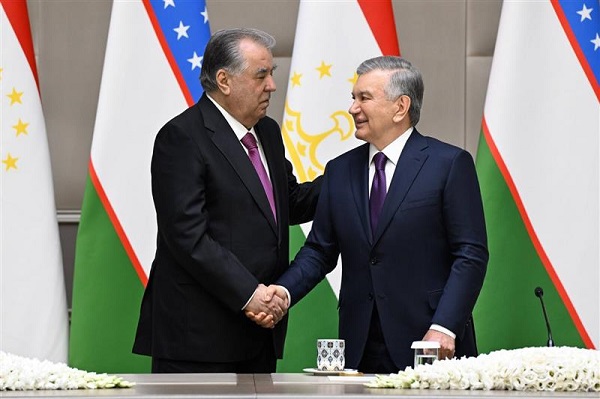
26–27 March 2026 President of the Republic of Tajikistan Emomali Rahmon paid a state visit to Uzbekistan. The events took place in Tashkent and Bukhara. The visit included high-level negotiations, the inaugural meeting of the Supreme Inter-State Council, the launch of joint projects, a business forum, a joint exhibition, and cultural events. Following the high-level talks, a substantial package of bilateral documents was signed.
Negotiations and Institutional Innovations
At the “Kuksaroy” residence in Tashkent, the leaders held narrow-format talks followed by the first meeting of the Supreme Inter-State Council. President of Uzbekistan Shavkat Mirziyoyev emphasized that this new format would elevate cooperation to a qualitatively new level and imbue the relations of strategic partnership and alliance with practical substance.
Particular attention was paid to measures for increasing bilateral trade volumes, stimulating the growth of industrial cooperation, enhancing transport connectivity, and strengthening water and energy security.
By the end of 2025, trade turnover approached $1 billion, primarily driven by mutual supplies of finished products.
The leaders set a goal to increase this figure to $2 billion by 2028. To achieve this objective, provisions include the accelerated establishment of the “Oybek – Fotekhobod” border trade center, the implementation of “e-Permit” and digital certification systems, and the modernization of border crossing points.
A dedicated Industrial Cooperation Program was adopted, covering mining, energy, agriculture, electrical engineering, light industry, and construction.
The parties also focused on interregional ties, humanitarian, educational, and scientific exchanges, as well as security coordination and interaction within Central Asian regional formats.
Launch of Joint Projects
Following the conclusion of the Council meeting, Presidents Mirziyoyev and Rahmon virtually attended the launch ceremony for major cooperation projects. In total, the implementation of 12 projects with a total value exceeding $161 million was officially initiated.
In Tajikistan, seven projects totaling $98 million were launched. These include:
- The expansion of the Artel household appliance production line;
- The construction of the “Shox Med” medical clinic in Dushanbe;
- The establishment of a textile cluster;
- The construction of a modern fruit processing line;
- The production of medical solutions;
- The launch of a furniture and industrial equipment manufacturing project in the Sughd region.
In Uzbekistan, five projects worth $63.2 million were initiated, including:
- A milk processing and cheese production project;
- Juice production;
- The naming of a new street in Tashkent as “Dushanbe”;
- The construction of a modern high-rise residential complex;
- The organization of canned food production.
Signed Documents
Following the negotiations, the Presidents signed a Joint Statement on Deepening Strategic Partnership and Allied Relations. Additionally, a comprehensive package of documents was signed at the governmental, ministerial, and departmental levels, including:
- Action Plans for cooperation in culture (2026–2027) and tourism (2026–2028).
- Roadmaps for the development of cooperation in industrial sectors, mining, agriculture, and innovations.
- Memorandums of Understanding regarding cooperation in finance, civil service, vocational education, healthcare, and the enforcement of judicial acts.
- Agreements on the mutual application of electronic product certification systems, the use of the “e-Permit” information system, the coordination of radio frequencies in border areas, and scientific cooperation between the Academies of Sciences and the Academies of the Ministries of Internal Affairs.
Furthermore, the agreement on the Tajik-Uzbek Investment Company (originally established on 10 June 2021) was formally updated.
Regional Forum in the Jizzakh Region
On the eve of the summit, on 24 March, the Second Interregional Forum of Uzbekistan and Tajikistan was held in the Jizzakh region of Uzbekistan.
The forum culminated in the signing of the Industrial Cooperation Program between Uzbekistan and Tajikistan. This program includes over 130 agreements across eight economic sectors, including: metallurgy; electrical engineering; agro-processing; construction and the production of building materials.
***
The visit was landmark for several key reasons. First, the establishment of the Supreme Inter-State Council institutionalizes dialogue at the highest level and provides a robust mechanism for monitoring and implementing agreements through a strategic “roadmap.”
Second, the emphasis on economic cooperation and concrete projects—with total investments exceeding $160 million for the newly launched facilities alone—demonstrates a pragmatic approach. Uzbekistan and Tajikistan are transitioning toward a full-scale strategic alliance, where mutual trade and industrial integration serve as the primary drivers of growth.
Third, within the broader context of Central Asia, the visit contributes significantly to regional economic integration. Coordination in the water-energy sector, transport, and security is especially vital for the two nations, which share an extensive border and common challenges, such as climate change, migration, and transit logistics.
As experts note, the development of industrial cooperation remains a top priority. In particular, there is a significant opportunity to create joint clusters for the deep processing of available raw materials. This would allow for the production of finished goods with high added value, intended for joint export to third-country markets.
“Regarding the textile sector, it is worth noting that until recently, only 10–15 percent of the cotton grown in Uzbekistan was processed domestically, while 85–90 percent was exported as fiber and yarn,” says Professor Odil Olimjonov of the Center for Economic Research and Reforms under the Administration of the President of the Republic of Uzbekistan. “Establishing textile clusters based on industrial cooperation across the regions of Uzbekistan and Tajikistan holds immense potential: exporting finished products will allow entrepreneurs, farmers, and industrial workers in both republics to generate significant additional profits.”
Professor Olimjonov further emphasizes that both Uzbekistan and Tajikistan are major exporters of raw materials and unprocessed agricultural goods in the region. Therefore, creating joint production facilities for processing these products is among the most promising directions for collaboration.
Furthermore, the financial resources of the established Tajik-Uzbek Investment Company (Joint Venture) can be leveraged to develop specialized joint industries. Increasing the output of finished products at such enterprises will lead to lower production costs and expand export opportunities to the markets of the CIS countries and China.
Additionally, Tajikistan represents a promising market for Uzbek-made goods, including automobiles, household appliances, food, textiles, and chemicals. In this context, the shared border and enhanced transport connectivity significantly reduce logistics costs.
The reached agreements to increase trade turnover to $2 billion, the launch of dozens of joint projects, and the institutional formalization of relations through the Supreme Council lay the foundation for a long-term strategic partnership. In the context of Central Asia’s changing geo-economics, this pragmatic and mutually beneficial approach appears both timely and highly promising. ///nCa, 30 March 2026