


Tariq Saeedi
In the previous part of this series, we recalled the hard-won lessons left by Robert McNamara — principles forged in the crucible of earlier conflicts that still speak directly to any nation contemplating or conducting war.
Among them was the importance of empathy: the need to understand an adversary not as a caricature, but as a people shaped by their own history, memory, and sense of self.
If there is any genuine desire among American policymakers and decision-makers to ground their choices in truthful insight and lived realities rather than assumptions, then it is worth pausing to consider who the Iranians actually are and why they respond to pressure in the way they do.
Iranians do not see themselves primarily through the lens of the last few decades of politics.
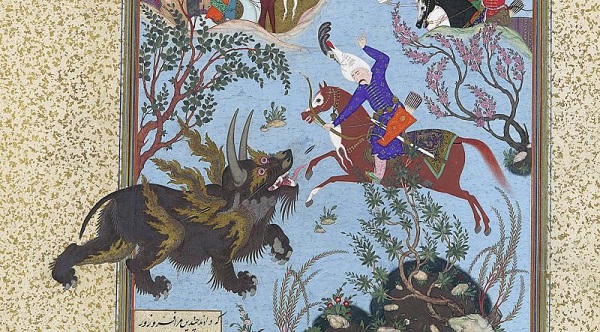
Their self-understanding is rooted in a civilisational memory that stretches back thousands of years — a memory preserved and renewed most powerfully through their literature. At the heart of that literary tradition stands one monumental work: the Shahnameh, or Book of Kings, composed by the poet Ferdowsi around the year 1010 CE.
Ferdowsi undertook his epic at a time when the Persian language itself was under threat of being eclipsed by Arabic.
Over thirty years he wove together myths, legends, and semi-historical accounts of pre-Islamic Iran into more than 50,000 couplets. — The Shahnameh is far more than a collection of heroic tales. It is a mirror in which Iranians have long seen their own defining traits: an ancient and continuous identity that survives conquests and empires; a deep belief that legitimate rule must rest on justice rather than mere power; and a stubborn resilience that allows a people to absorb shocks without losing their essential character.
Ferdowsi’s own words capture the quiet determination behind the project: he laboured so that the Persian tongue and Persian memory would not vanish from the earth.
The epic’s heroes — figures such as Rostam — are not flawless supermen. They are strong, but their strength is tested by moral dilemmas. Raw power without wisdom or fairness leads to tragedy. Kings rise when they govern justly and fall when they do not. This recurring moral has helped shape a national sensibility that values endurance, cultural continuity, and the idea that no external force can permanently erase what is deeply Persian.
Later poets and thinkers added further layers to this self-portrait. Saadi, in the thirteenth century, spoke of human unity in unforgettable lines: “The children of Adam are limbs of one body.” His Gulistan and Bustan became manuals of ethical living, emphasising kindness, justice, and humility.
Hafez, the fourteenth-century master of the ghazal, offered a more mystical and subversive voice — celebrating love, wine, and inner freedom while gently mocking hypocrisy and rigid authority. His verses have served for centuries as both consolation and quiet resistance.
Rumi (Mowlana) expanded the horizon still further, teaching that the true self transcends borders and that inner spiritual resilience can outlast any outward storm.
Even the great philosopher-physician Avicenna (Ibn Sina) contributed to this collective identity by showing that Persian intellect could master and synthesise Greek, Indian, and Islamic learning without losing its own character. — The pattern is consistent: Iran has repeatedly absorbed external influences — religions, languages, empires — while refining rather than abandoning its core sense of self.
This literary heritage helps explain much of what we have observed in the current conflict.
It illuminates the quick turn toward reconstruction amid ongoing strikes, the quiet observance of Nowruz even under bombardment, and the institutional continuity that allows the nation to absorb the loss of individuals without collapsing.
It accounts for the blend of pride and pragmatism that sees criticism of government coexist with deep attachment to the idea of Iran itself. The tradition does not preach blind obedience or perpetual resistance; it teaches endurance, renewal, and the long view of history.
None of this is meant to simplify a complex and painful war. — Iranians, like any people, contain many voices and differing views. Yet the shared literary canon — recited, quoted, and lived across generations — provides a common language of identity that has proven remarkably durable. It tells Iranians that they have outlasted Alexander, the Arabs, the Mongols, and the Timurids, emerging each time with their language, poetry, and sense of civilisation intact.
Understanding this deeper self-image does not magically resolve the present conflict. But it does suggest that any sustainable path forward must respect the depth of Iranian national consciousness rather than assume it can be easily reshaped from the outside.
Nations, like individuals, are more likely to engage constructively when they feel seen for who they truly believe themselves to be.
As the fighting continues and the search for de-escalation grows more urgent, this literary mirror remains available to all sides. In it, one finds not only the sources of Iranian resilience, but also a reminder that cultures with such long and articulate memories rarely forget — and rarely surrender — their essential story.
* * *
Here are some couplets from Shahnameh of Ferdowsi:
چو ایران نباشد تن من مباد
بدین بوم و بر زنده یک تن مباد
Meaning:
If there is no Iran, may my body not exist;
May no one live upon this land if Iran is gone.
همه سر به سر تن به کشتن دهیم
از آن به که کشور به دشمن دهیم
Meaning:
Let us all give our lives in battle;
Better that than to surrender our country to the enemy.
ز بهر بر و بوم و فرزند خویش
زن و کودک و خرد و پیوند خویش
Meaning:
For the sake of our land and our children,
Our women, our young ones, and all our kin—
بسی رنج بردم در این سال سی
عجم زنده کردم بدین پارسی
Meaning:
I suffered much during these thirty years;
I revived the Persians through this Persian (language). /// nCa, 27 March 2026