


Upcoming visit of Turkmen President Serdar Berdimuhamedov to South Korea in September to open new avenues
Turkmenistan and South Korea underscored shared values of neutrality, cultural affinity and expanding economic cooperation Wednesday, as diplomats and scholars marked the Central Asian nation’s 35th anniversary of independence.
Turkmenistan was declared a permanently neutral state on Dec. 12, 1995, under UN General Assembly Resolution 50/80, making it the only country whose neutrality is formally recognized by the United Nations. The principle, defined under the 1907 Hague Convention, refers to a state’s impartiality in conflicts, with warring parties expected to respect that status.
Speaking at a commemorative conference titled “Independent, Permanently Neutral Turkmenistan, the Homeland of Purposeful Winged Horses,” Turkmen Ambassador to Korea Begench Durdyyev highlighted 2026 as a milestone year marking 35 years since the country gained sovereignty in 1991.
“Since gaining independence, Turkmenistan has achieved important results in political, economic, social and cultural life,” Durdyyev said, referring to the symbolic meaning behind the national motto for 2026.
He emphasized the enduring cultural significance of the Akhal-Teke horse — known for its endurance and elegance — which remains central to Turkmen identity and is featured on the state emblem.
“Neutrality is the main principle of Turkmenistan’s foreign policy,” Durdyyev said, noting its repeated recognition by the United Nations. “At a time when the world faces serious challenges, this policy becomes even more relevant.”
Looking ahead, Durdyyev pointed to the planned state visit of President Berdimuhamedow to South Korea later this year, where he will attend the inaugural Korea–Central Asia Summit alongside leaders from Kazakhstan, Kyrgyzstan, Tajikistan and Uzbekistan.
“We believe that this historic event will open new opportunities for expanding cooperation between our countries,” he said.
Bilateral ties have strengthened in recent years, with trade between Turkmenistan and South Korea tripling, according to the ambassador. Cooperation in education, language and transportation has also expanded.
“As Asian nations, we share a number of commonalities,” Durdyyev said, adding that cultural symbolism — including Korea’s Year of the Blue Dragon — resonates with Turkmenistan’s national imagery.
Connectivity has also improved, with direct passenger flights launched in 2025 following earlier cargo routes.
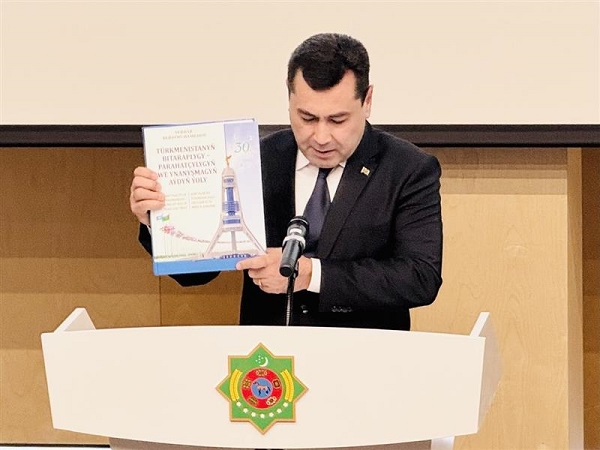
Durdyyev also introduced a recent book by President Serdar Berdimuhamedov, “The Neutrality of Turkmenistan: A Bright Way to Peace and Trust,” describing it as a contribution to global discussions on peace, cooperation and international trust.
Rhee Jong Kook, executive director of the Korea-Central Asia Cooperation Forum Secretariat, echoed the sentiment, calling the anniversary a reflection of Turkmenistan’s “steadfast development and enduring national spirit.”
“This year marks the very first Korea-Central Asia Summit, and we are committed to strengthening ties with Turkmenistan and the broader region,” Rhee said. “I look forward to seeing the friendship and cooperation between our countries continue to deepen.”
Kim Bong-chul, a professor at Hankuk University of Foreign Studies, recalled his visit to Turkmenistan, highlighting both its cultural richness and strategic importance.
“It is not only about the economy or politics. It is about human beings and culture,” he said, expressing hope for deeper academic exchanges.
The event brought together ambassadors from Central Asia, as well as students, researchers, academics, NGO representatives and media, reflecting growing international interest in Turkmenistan’s neutrality-driven diplomacy and its partnership with South Korea. /// cross post from The Korea Herald, 26 March 2026 (https://www.koreaherald.com/article/10703013)