


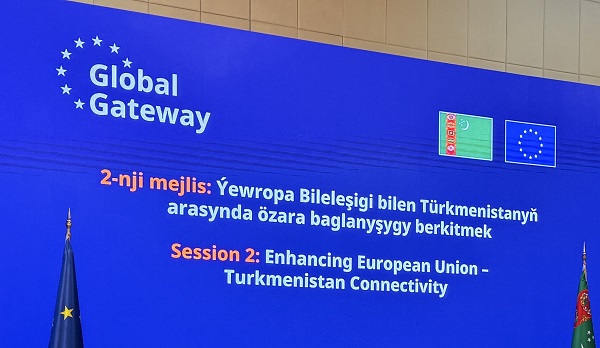
During the second session of the Turkmenistan–European Union Business Forum, focused on connectivity, Ata Rahmanov, Chief of the Automation Department of the State Customs Service of Turkmenistan, shared key results of the department’s digital transformation. The primary focus was placed on the transition to a “Smart Customs” model and the implementation of the “Single Window” system.
According to the official, the automation process has extended beyond a single agency. To date, Turkmenistan has digitized the systems of all border control authorities, including sanitary, phytosanitary, and banking services.
“The ‘Single Window’ already exists at our borders, as does the ‘Single Window’ for foreign economic activity participants to obtain permits,” Rahmanov emphasized.
A key factor in accelerating trade flows has been the widespread use of the ASYCUDA system and Electronic Data Interchange (EDI). According to provided statistics, more than 75% of cargo currently moves under pre-arrival declarations.
Information submitted to the system in advance is accepted as a full declaration, which eliminates the mandatory requirement for brokers to be present at the border. As a result, the average time for customs procedures has been reduced to just 20–25 minutes (excluding cases requiring inspection via “red corridors”).
The Service is actively implementing the Smart Customs concept, where data processing is handled by an automated risk management system. This ensures a balance between security and transit speed.
In parallel with software updates, the technical base is also being modernized. Turkmenistan regularly procures advanced equipment, including stationary X-ray units for inspecting passenger vehicles, minimizing delays in transit.
The development of “smart” customs infrastructure is part of Turkmenistan’s broader strategy to strengthen its status as a key logistical hub at the crossroads of the East–West and North–South transport routes. ///nCa, 26 March 2026