


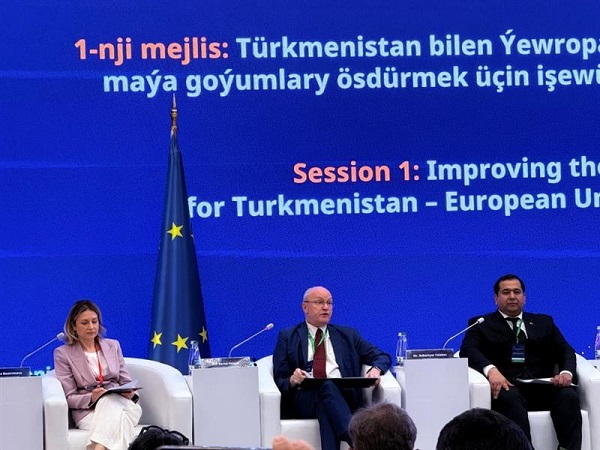
The first session of the Turkmenistan–European Union Business Forum, held in Ashgabat on 26 March, served as a platform for a sincere and constructive exchange of views on improving the business environment in Turkmenistan. Participants discussed how to translate the country’s vast economic potential into concrete investment projects, with an emphasis on transparency, fiscal incentives, and digitalization.
A View from Europe: German Ambassador Bernd Heinze on “Political Refreshment”
Ambassador Bernd Heinze highlights a period of growing political refreshment between the European Union and Turkmenistan, noting that EU companies are increasingly recognizing the significant strategic economic opportunities available in the country. There is a strong, mutual political will to enhance engagement, underpinned by Turkmenistan’s immense economic potential, which includes vast energy resources like gas, solar power, and renewable energy, as well as mineral resources and an educated, “education-hungry” labor force.
To further encourage this investment, the Ambassador outlines several key areas where continued development of the business climate will be beneficial:
- Information and Transparency: EU companies highly value access to reliable and accurate statistical economic data to inform their decisions. They also seek transparent tender processes that offer equal opportunities for all participants and results that are verifiable.
- Legal and Financial Frameworks: Providing legal certainty and the protection of property rights are central to attracting long-term investment. Investors also appreciate clear policies regarding capital transfers, liquidity, and exchange rates to ensure stable financial planning.
- Infrastructure and Connectivity: Modern business operations depend on high-speed, reliable internet (with 100 Mbps suggested as a baseline) and efficient transportation, specifically direct regional flights to facilitate travel within Central Asia.
- Institutional Support: The creation of investment promotion agencies—similar to successful models in neighboring countries—can provide a genuine constructive function for new arrivals.
The Ambassador suggests a collaborative narrative for the future, where the Turkmen government acknowledges the complexities of the market and offers to “take companies by the hand” to help them navigate the local landscape. By guiding investors through administrative and logistical steps, the government can build on the success of the many companies already operating profitably in Turkmenistan. Ultimately, the focus is on a partnership where the government and private sector work together to achieve success and unlock the country’s full potential
The Turkmen Model: Low Taxes and Private Sector Support
Deputy Minister of Finance and Economy of Turkmenistan, Babaniyaz Yalakov, presented a detailed report on the measures the government is already taking to attract capital. The main emphasis was placed on one of the most competitive fiscal regimes in the region.
According to tax legislation, there are six main types of taxes in the country, and their rates remain stable. To attract private and foreign investment into non-energy sectors of the economy, a preferential low-tax regime is utilized:
- 8% — corporate income tax;
- or 2% — tax on gross income.
The state actively subsidizes business development. Yalakov reported on concessional lending at a rate of 5% per annum for private investment projects (for a term of up to 10 years) and a unique rate of 1% for agricultural producers.
The effectiveness of the “Open Doors” strategy is confirmed by the following figures:
- Trade Growth: The creation of a free trade zone on the border with Uzbekistan led to a 40% increase in trade turnover with that country in 2025 alone.
- Private Sector Share: In the non-oil and gas sector of the economy, the share of private enterprises has reached an impressive 72.8%.
- International Recognition: In July 2025, Fitch Ratings confirmed Turkmenistan’s rating at “B+” with a positive outlook.
The Path to the WTO and a Digital Future
Turkmenistan is currently in the stage of active accession to the World Trade Organization (WTO). Massive work is underway to align national legislation with organization standards in areas such as technical regulation, standardization, and competition protection. In parallel, digital solutions are being implemented in customs and tax procedures, making the interaction between business and the state more transparent.
The session concluded with a general consensus: partnership must be built on joint efforts, where the government acts not merely as a regulator, but as an active guide for investors ready to unlock Turkmenistan’s potential. ///nCa, 26 March 2026