


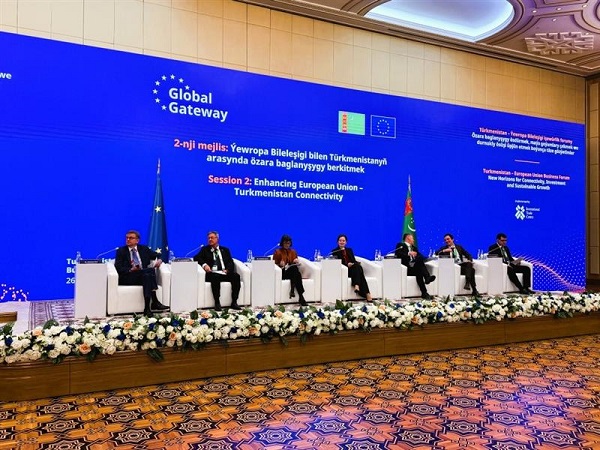
During the second session of the Turkmenistan-European Union Business Forum, focused on “Future Horizons for Connectivity,” Charlotte Adriaen, Head of Department for Central Asia and Afghanistan at the European Commission (DG INTPA), outlined the strategic evolution of the Trans-Caspian Transport Corridor (TCTC). Addressing an audience of international investors and regional partners, Adriaen emphasized that reinforced connectivity is no longer just a goal, but a geopolitical necessity for regional stability and economic growth.
The speaker noted that with the war in Ukraine in 2022, the roadmap for the TCTC was established following a comprehensive study by the European Bank for Reconstruction and Development (EBRD) and the European Transport Agency. The research identified a clear path forward through:
- 33 Hard Infrastructure Projects: Critical hard infrastructure required to make the corridor physically viable.
- 7 Soft Infrastructure Projects: Essential regulatory and digital improvements to ensure seamless operations.
While the total investment required to bridge the infrastructure gap is estimated at €18.5 billion, the EU successfully mobilized a commitment of €10 billion in January 2024 during an Investors Forum in Brussels.
Adriaen provided a crucial update on the progress of these financial commitments. “And we had a quarter of the 10 billion that were committed, which may not sound like a lot, but it’s still very important”, she said.
She highlighted the role of the TCTC Coordination Platform, which brings together the European Investment Bank (EIB), the World Bank, the EBRD, and other key partners to manage these investments.
A major focus for the EU remains making the corridor “more seamless and smooth”. Adriaen noted that soft infrastructure — such as technical assistance and procedural streamlining — is often less expensive than hard infrastructure but equally vital for the corridor’s success.
Furthermore, the EU is actively working to ensure the corridor does not terminate at the shoreline. “We are making sure that the corridor doesn’t stop at the Caspian Sea,” she explained, referring to ongoing efforts on the western side of the sea to ensure a continuous link between Central Asia and Europe.
Adriaen underscored that the EU sees “more potential” for Turkmenistan’s involvement. ///nCa, 26 March 2026