


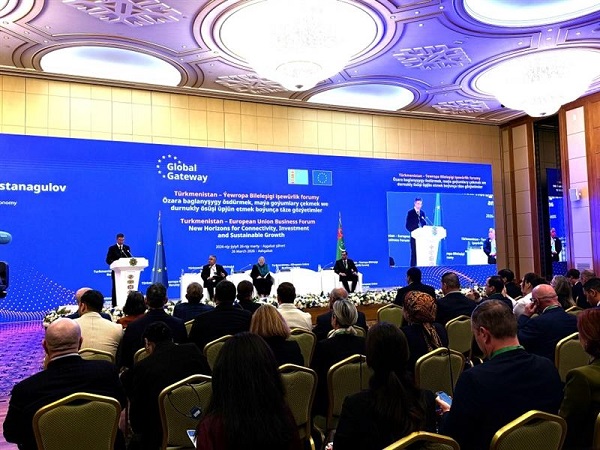
During the plenary session of the business forum “Turkmenistan – European Union: New Horizons for Connectivity, Investment and Sustainable Growth,” the Minister of Finance and Economy of Turkmenistan, Mammetguly Astanagulov, presented a detailed overview of the current state and prospects of trade and economic cooperation between Turkmenistan and the European Union. Despite the impact of external factors, the parties continue to deepen their strategic partnership, building on years of experience in collaboration.
Trade Dynamics and Geopolitical Impact
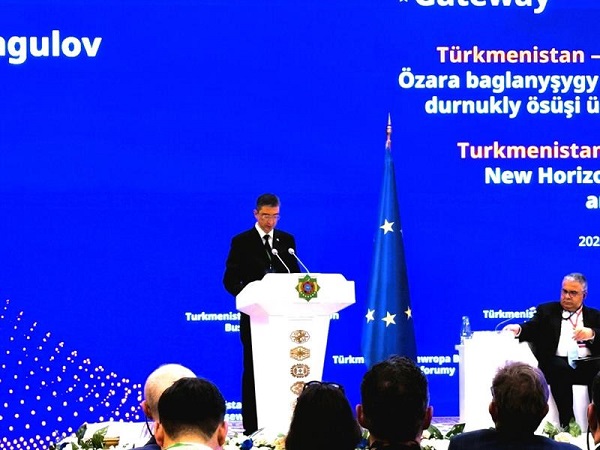
In his speech, Astanagulov, citing data from the State Statistics Committee of Turkmenistan, stated that the foreign trade turnover between Turkmenistan and EU countries for 2025 amounted to approximately US $2.1 billion. In annual terms (compared to 2024), this figure decreased by 17.7% (exports dropped by 21.2%, while imports fell by 11%). The share of EU states in the country’s total trade turnover stood at 10%.
The head of the Ministry of Finance emphasized that the 3-percentage-point decrease compared to 2024 was driven by objective reasons: rising geopolitical risks and increased transportation costs. At the same time, the trade structure demonstrates resilience, with over 63% of the volume accounted for by Turkmen exports to Europe.
“The expansion of the range of Turkmen goods supplied to EU countries is a positive development. At the same time, we see significant potential for further cooperation, which would strengthen our national economy by increasing export supplies to the EU and attracting European investment into our industrial and transport sectors,” the Minister highlighted.
EU Technical Assistance
Astanagulov provided an overview of key technical assistance projects implemented in cooperation with the EU:
Ready4Trade: In recent years, the EU has provided technical aid for several initiatives, including the Ready4Trade project. This project supports the development of intra-regional and international trade. It facilitated the creation of a trade portal detailing specific goods and cross-border procedures, built capacity in e-commerce, and supported the WTO accession process. Additionally, an export management program was launched.
Global Gateway: Under the EU’s flagship initiative, the project “Turkmenistan: Enhancing Trade Resilience and Integration” is being implemented in partnership with the International Trade Centre. The initiative has a budget of 6 million euros and is scheduled to run until March 2028.
Investment and New Horizons
Turkmenistan is focused on diversifying its export range and attracting European investment into key economic sectors—specifically industry and transport-logistics. A significant step in this direction was the signing of a Letter of Intent with the OECD in November 2024.
The dialogue continued in February of this year at the OECD Eurasia Week, where a roundtable on Turkmenistan’s competitiveness was held. These discussions laid the foundation for further improving the legal and economic framework for doing business in the country.
Concluding his remarks, the Minister of Finance and Economy underscored that Turkmenistan actively supports all areas of economic cooperation with EU countries and will continue to strive for a stronger partnership, the consistent development of innovation, and more effective use of the existing economic potential.///nCa, 26 March 2026