


nCa Report
The inaugural Turkmen–British Forum on Climate Finance, held in Ashgabat on March 3, 2026, has initiated a new era of strategic cooperation between the two nations.
Hosted by the British Embassy in partnership with TheCityUK, the forum gathered senior government ministers, state and commercial banks, and global financial leaders to discuss how climate finance can drive sustainable economic growth and resilience.
Representatives from TheCityUK, which represents a network of global banks and asset managers at the center of international capital markets, expressed a strong interest in “working with Turkmen partners to mobilise climate finance and attract greater foreign direct investment.”
The United Kingdom remains committed to “developing sustainable financial frameworks, strengthening institutional capacity and attracting international investment” to transform this high-level dialogue into practical cooperation.
1. The Core Principle: Transparency as a Catalyst for Capital
A recurring theme throughout the forum was that capital movement depends entirely on data integrity. Ruslan Sadgalin (EY) emphasized that “Climate finance follows trust,” noting that international financial institutions finance projects faster and on better terms when risks are “transparent, measurable, and comparable”.
To establish this trust, the global community is converging on the IFRS S1 and IFRS S2 frameworks as the “global baseline” for sustainability and climate disclosures. These standards are not merely accounting rules; they help link a nation’s climate agenda directly to financial planning, making priority themes—such as methane reduction and renewable energy—“банковскими” (bankable) when supported by clear data and governance accountability.
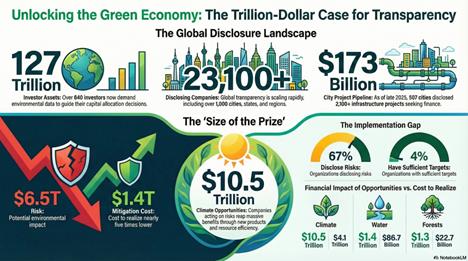
The demand for this data is immense: Bianca Barilla (CDP UK) highlighted that 544 financial institutions, managing over $145 trillion in combined assets, now use standardized environmental data to inform their investment decisions and manage exposure to climate risks.
2. Turkmenistan’s Strategic Pipeline
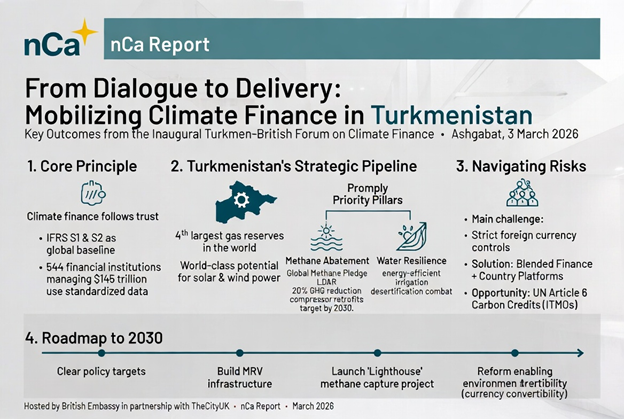
Turkmenistan possesses significant natural assets, including the world’s fourth-largest gas reserves and “world-class natural conditions for developing solar and wind power”.
Vladimir Valetka (UN RCO) noted that the nation is poised for a “new wave of technological changes” that will expand its competitive advantages in energy and agriculture while dramatically increasing the role of innovation.
Through technical sessions, experts identified three high-impact investment priorities for the country:
- Methane Abatement: As a signatory to the Global Methane Pledge, Turkmenistan can anchor donor participation through programs focusing on leak detection and repair (LDAR) and compressor station retrofits.
- Renewable Power: Utilizing the 2021 law “On Renewable Energy Sources,” the country is set to expand solar and wind capacity to displace domestic gas consumption, targeting a 20% GHG reduction by 2030.
- Water Resilience: Addressing vulnerability to desertification through energy-efficient water management and modern irrigation facilities—a sector where the UNDP is already actively building local capacity.
3. Navigating Risks with Blended Finance and Carbon Markets
Mobilizing the billions required for these transitions—against an estimated regional need of $380 billion by 2030—requires addressing significant economic hurdles.
Michael Mathres (ITMO UK) identified the government’s “strict foreign currency controls” and secondary exchange rates as the most serious impediments to private investment.
To bypass these risks, experts recommend a “Blended Finance” approach. This involves using concessional public capital from sources like the Green Climate Fund (GCF) to absorb early risks, thereby “crowding in” private commercial capital.
Standard Chartered’s John Murton emphasized the role of “Country Platforms”—strategic partnerships that coordinate multiple projects under one framework to reduce transaction costs and increase scale. Additionally, the emergence of UN Article 6 Carbon Credits (ITMOs) offers a way to monetize emissions reductions and protect biodiversity at a gigaton scale.
4. The Roadmap to 2030
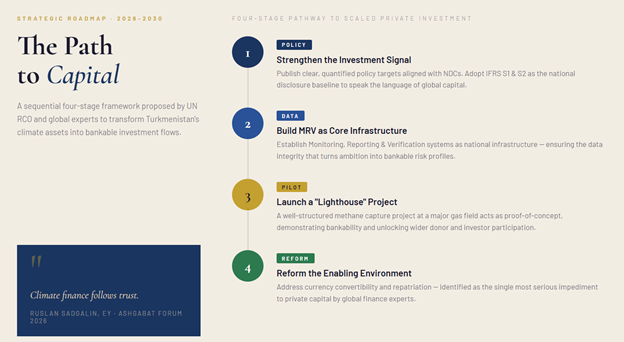
The transition from theory to capital requires a structured, sequential approach. The UN RCO and global experts propose a multi-stage pathway for Turkmenistan:
- Strengthen the investment signal through clear policy targets.
- Build MRV (Monitoring, Reporting, and Verification) as core infrastructure to ensure data reliability.
- Launch a “Lighthouse” Project: A well-structured methane capture project at a major gas field could serve as a proof-of-concept to inform and unlock wider opportunities.
- Reform the Enabling Environment: Addressing currency convertibility and repatriation remains a fundamental pre-condition for scaling private capital.
As the British Embassy building on the forum’s momentum notes, this strategic framework is the first step in ensuring that “better disclosure does not replace fundamental project parameters—it accelerates them”.
By standardizing metrics and fostering transparency, Turkmenistan can unlock the global capital needed for its sustainable development goals. /// nCa, 25 March 2026