


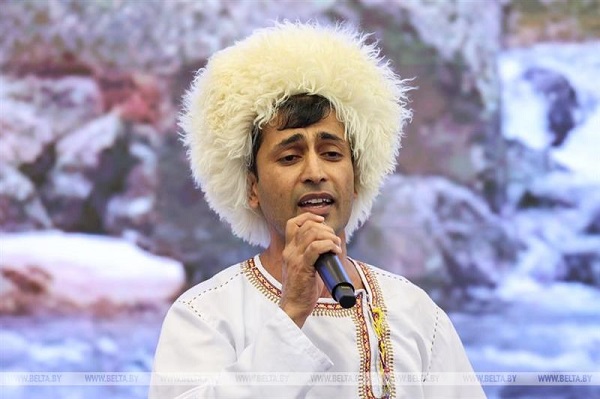
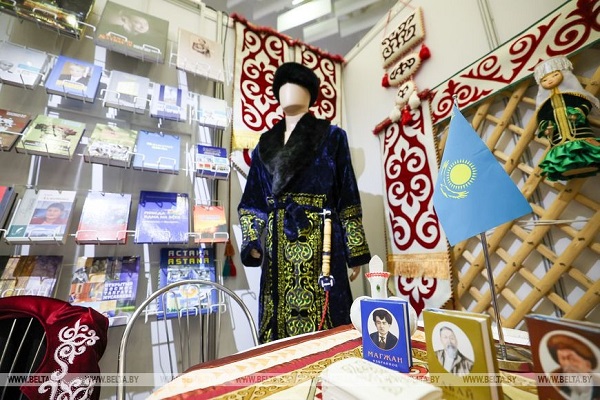
The 33rd Minsk International Book Fair featured special cultural presentations by Azerbaijan, Kazakhstan, and Turkmenistan, as reported by the BELTA news agency.
Denis Ezersky, Belarus’s Deputy Minister of Information, noted that these presentations are designed to foster a deeper understanding of the diverse cultures and traditions within the region. Guests at the event were treated to national dances, traditional music, and literary readings from the three nations.

Representing Azerbaijan, Kamilla Babayeva, a first-year student at the Institute of Inclusive Education, performed poetry by celebrated 19th and 20th-century authors Samad Vurgun and Mirza Shafi Vazeh.
Eziz Agajanov, a student at BSUIR, performed a song in the Turkmen language followed by the famous Belarusian composition “Belovezhskaya Pushcha.” During the presentation, poems were also recited: “The Future of Turkmenistan” by Magtymguly Fragi, the classic of Turkmen literature, and “In the Windless Night, the Brightest Moon” by the great Kazakh poet and thinker Abai Kunanbayev.
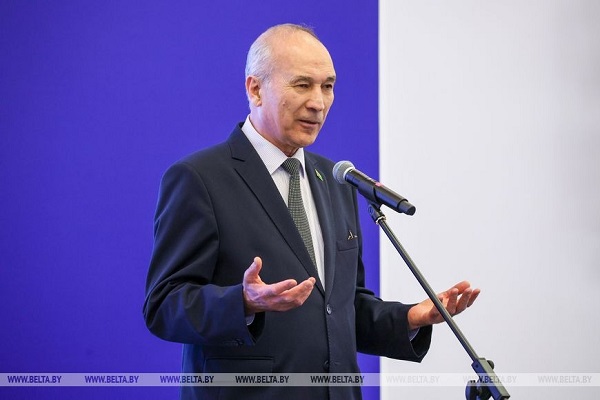
“We all enter the world of education through books. From our earliest days in school, teachers use books to provide us with information, deep history, and a connection to the present,” said Nazarguly Shakulyev, Ambassador of Turkmenistan to Belarus. He emphasized the lasting impact of physical books on the soul and memory, noting that while electronic devices are prevalent, the tactile experience of reading remains irreplaceable for many.
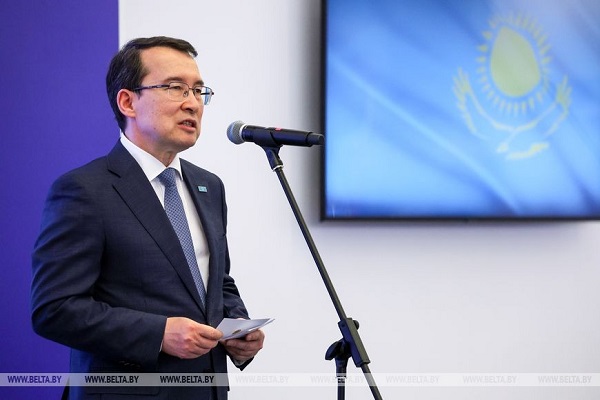
Timur Zhaksylykov, the Ambassador of Kazakhstan to Belarus, highlighted the role of the CIS in maintaining and developing long-standing friendly ties on an equal and mutually beneficial basis.
“The cooperation between Belarus and Kazakhstan is rich in content, particularly in the literary sphere,” Ambassador Zhaksylykov noted. He pointed to historical figures such as the 19th-century Belarusian educator and writer Adolf Yanushkevich, who lived in Kazakhstan and left behind invaluable ethnographic accounts of Kazakh life. He also recalled that the works of legendary Kazakh poet Zhambyl Zhabayev were translated into Belarusian as early as 1939, earning praise from Belarusian national poets Yakub Kolas and Yanka Kupala.
Fuad Safar oglu Ibragimov, Director of the Azerbaijani Cultural Center at BSPU, shared a poignant historical connection, noting that many Belarusians remained in Azerbaijan after World War II. During the war, approximately 6,000 children were evacuated to Azerbaijan. Despite the hardships of the era, local families took these children into their homes and raised them as their own. ///nCa, 19 March 2026 (based on BELTA coverage)