


nCa Commentary
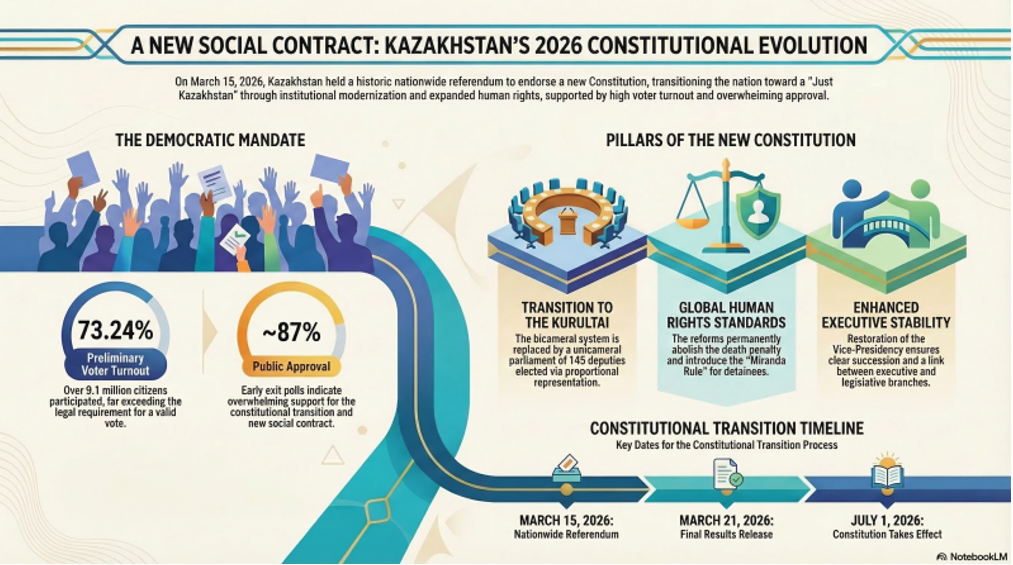
On 15 March 2026, Kazakhstan reached a historic milestone as citizens participated in a nationwide referendum to endorse a new Constitution. This transformative event, characterized by a preliminary voter turnout of 73.24%, signifies a powerful mandate for change and a new social contract between the state and its people.
With 9,126,850 citizens casting ballots, the referendum easily exceeded the 50% legal requirement for validity. Early exit polls suggest an overwhelming wave of support, with 86.7% to 87.4% of voters favoring the reforms.
Institutional Modernization: The Kurultai
At the heart of this constitutional renewal is a streamlined legislative framework. The previous bicameral system is replaced by the Kurultai, a unicameral parliament consisting of 145 deputies.
These representatives will be elected through proportional representation, a move intended to enhance political accountability and ensure that the legislative process is more responsive to the public. This change is designed to improve the efficiency of governance as the nation moves toward a “Just Kazakhstan”.
Stability and Leadership: The Vice-Presidency
To ensure political continuity and a clear path for succession, the new Constitution restores the office of the Vice-President. Appointed by the President with the approval of the Kurultai, the Vice-President will serve as a key liaison between the executive and legislative branches.
Critically, this official will now be first in line for succession should the President be unable to perform their duties, providing a vital anchor for national stability.
Expanding the Civic Voice: The People’s Council
The “social contract” is further strengthened by the creation of the People’s Council (Halyk Kenesi). This new consultative body acts as a platform for broad-based dialogue, representing various social groups and regions. Beyond its advisory role, the Council is empowered to initiate legislation and call for referendums, granting citizens a direct and permanent mechanism to influence national policy.
A Modern Shield for Human Rights
The new Constitution introduces several landmark legal standards that align Kazakhstan with global humanitarian ideals:
- The “Miranda Rule”: For the first time, Article 18 explicitly requires that all detainees be informed of their rights at the moment of arrest.
- Abolition of the Death Penalty: Article 17 formally and permanently prohibits the death penalty, cementing the nation’s commitment to the right to life.
- Digital Sovereignty: Recognizing the importance of the modern era, privacy and personal data protections are now explicitly extended to the digital realm.
- Strengthened Constitutional Court: The reform provides citizens with the direct right to appeal to the Constitutional Court if they believe their rights have been violated by regulatory acts.
The complete text of the new Constitution can be found here:
https://www.gov.kz/memleket/entities/ksrk/press/news/details/1159830?lang=ru
Preserving Values and Transparency
The draft reflects a commitment to cultural continuity and public trust. It defines marriage specifically as a “voluntary union between a man and a woman,” mirroring traditional social foundations.
Additionally, to foster a transparent civic environment, the Constitution now requires NGO transparency, mandating that non-commercial organizations make information regarding foreign funding open and accessible.
Looking Forward
While the President maintains necessary powers to appoint key officials and coordinate the branches of government, the single seven-year term remains a permanent feature to prevent the over-concentration of power.
Following the release of final results expected by 21 March 2026, the new Constitution is scheduled to officially take effect on 1 July 2026. This referendum marks the dawn of a resilient governance model that prioritizes the Rule of Law and the active participation of a peaceful civil society. /// nCa, 16 March 2026