


Yazgul Tirkishova, Chief Curator of the “Ancient Merv” State Historical and Cultural Reserve
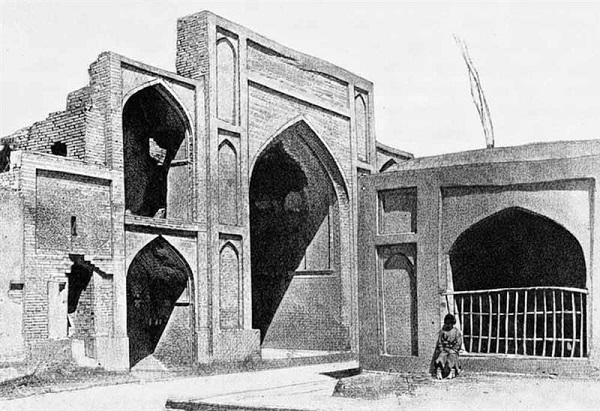
The mausoleum of Yusuf Hamadani — an Islamic theologian, Sufi sheikh, and one of the preeminent scholars of Islamic theology — stands in Merv as a complex historical and architectural crossroads. It is a place where the imperial ambitions of the Seljuk dynasty, the flourishing of Eastern mysticism, and the flawless mathematical logic of medieval architecture converge. To fully grasp the significance of this monument, one must view it not as an isolated structure, but as the conceptual core of Merv’s vast 12th-century cultural landscape.
During that era, the city — famously known as Maru-shahu jahan (“Merv, Queen of the World”) — was not merely an administrative hub, but a true intellectual capital of the Islamic world. It was a metropolis where, within the powerful walls of Sultan-kala, the greatest minds of the time gathered. In Merv’s libraries, which contemporaries hailed as “treasuries of wisdom,” luminaries such as Omar Khayyam conducted their research. Meanwhile, in madrasas and public squares, debates took place that would shape the development of law and philosophy for centuries to come. It was into this vibrant environment, where Seljuk state-building rested upon a robust ideological foundation, that Yusuf ibn Ayyub al-Hamadani — known to the Turkmen people for centuries as Khoja Yusup Baba — arrived.
His biography represents a journey from rigorous academia to profound internal spiritual practice, a transition characteristic of the era’s “Great Synthesis” of Islamic knowledge. Born in 1048 in Hamadan, he underwent a demanding education at Baghdad’s Nizamiyyah—the Caliphate’s premier educational institution. There, under the guidance of the eminent jurist Abu Ishaq al-Shirazi, he became a brilliant theologian. However, Yusuf Hamadani made a fundamental choice, renouncing a prestigious career as an official theologian in favor of a life of asceticism and mentorship.
Moving to Merv, he founded a khanqah (a Sufi hospice/lodge) that became the cradle of the Khwajagan tradition. This branch of Sufism was distinguished by its sobriety, social engagement, and rejection of ostentatious ritualism. Hamadani did not retreat into isolation; he remained at the heart of urban life, advising rulers—including the Great Sultan Sanjar—while simultaneously working with the common people. Through his direct disciples, such as Ahmed Yasawi and Abdul-Khaliq Gijduvani, his spiritual legacy shaped the unique form of Islam that became the foundation of cultural identity across all of Central Asia. The mausoleum, erected over his grave after 1140, served as the physical anchor of this spiritual authority, transforming his resting place into a sanctuary that draws pilgrims from every corner of the Muslim world.
The architectural design of the mausoleum is a triumph of regional engineering. The building demonstrates a supreme mastery of material and space, characteristic of what specialists call the “Seljuk Golden Age.” At the core of the composition lies a cubic volume that, through a system of corner arched squinches (sails), transforms into a polyhedron and ultimately into the perfect sphere of a dome. To the medieval mind, this transition from a square—symbolizing the earth and stability—to a circle—representing the heavens and divine infinity—was a visual embodiment of the path to enlightenment.
The master builders of that era operated not only with aesthetic categories but with complex geometric calculations. The weight of the heavy brick dome had to be distributed evenly across the corner supports, requiring profound knowledge of the strength of materials. It is likely that the original dome was double-layered. The inner shell created a space for prayer and meditation proportioned to the human scale, boasting magnificent acoustics, while the high and majestic outer shell served as a visual landmark in the flat panorama of the oasis. Between them remained an air gap that functioned as a natural thermal regulator, shielding the interior from the scorching heat of the Karakum Desert.
The brickwork deserves special attention. In 12th-century Merv, a unique artistic school emerged where fired brick ceased to be a mere structural element and became a medium for the most delicate plastic arts. The hazarbaf technique (“thousand interlacings”) allowed for a sophisticated interplay of light and shadow on the facades. Bricks were laid at varying angles to form geometric patterns that appeared to come alive depending on the position of the sun. The facades were further embellished with inserts of carved terracotta and ganch (alabaster), featuring intertwined floral motifs and austere Kufic epigraphy.
The inscriptions on the mausoleum walls served as more than just a source of information; they functioned as a rhythmic ornament. The calligraphy here is like frozen music, where the vertical lines of the letters create a sense of upward aspiration, harmonizing with the overall architectural momentum of the building. Adjoining the main structure was a deep iwan—a vaulted portal that served as a grand “gateway.” It not only shielded the entrance from the sun but also provided a necessary psychological transition from the bustling noise of the city to the profound silence of the tomb.
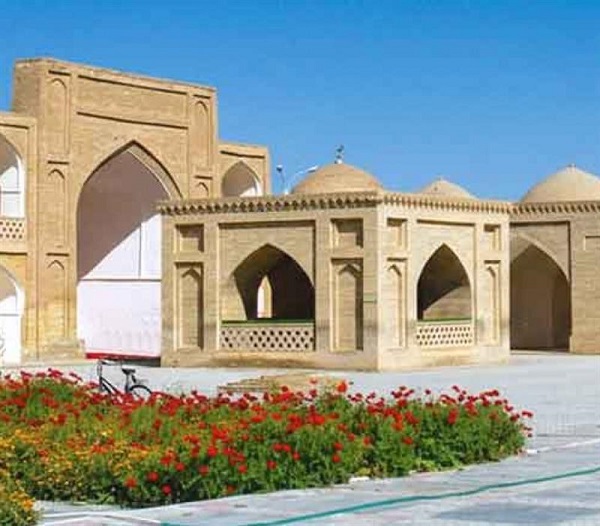
The history of the monument is inextricably linked to the catastrophe of 1221, when the Mongol forces of Genghis Khan decimated Merv. The scale of this tragedy is difficult to overstate: the city was leveled almost to its foundations, the irrigation systems were abandoned, and hundreds of thousands of residents perished or were taken into captivity. However, the mausoleum of Yusuf Hamadani, unlike many other structures in Sultan-kala, endured. This can be attributed not only to the durability of the Seljuk masonry but also to the special status of the site. Even during periods of the oasis’s deepest decline, the memory of Sheikh Hamadani was alive, and people continued to visit the ruins of his hospice.
In subsequent centuries, under the Timurids and later, the complex was repeatedly restored and expanded with new structures: mosques, khanqahs, and guesthouses. These layers created a multifunctional ensemble around the original core, which we see today.
Hamadani’s mausoleum is a key link in the evolutionary chain of Eastern architecture. It stands between the austere, almost fortress-like architecture of early Muslim buildings and the refined, tile-glazed azure aesthetics of 14th–15th century Samarkand and Bukhara. In this building, decorativeness is still subordinate to structural logic: one sees the “honest” work of the material, where every brick bears a load while simultaneously serving as an ornament.
For the Turkmen people, the mausoleum of Khoja Yusup Baba is not merely an archaeological monument but a tangible center of spiritual gravity—the beating heart of the oasis. In the popular consciousness, he has long transcended his role as a historical figure, becoming a Pir—a celestial patron whose authority is absolute. People come here not for historical facts, but for the sacred: for healing, for guidance, or for a blessing on a new endeavor.
Pilgrims travel hundreds of kilometers to perform ziyarat (pilgrimage). In the shade of ancient walls and mulberry trees, the boundary between the 12th and 21st centuries dissolves. Here, prayers are offered and sadaka (charity meals) are held, and this continuous flow of believers proves that a tradition which survived the Mongol devastation and the changing of eras remains the bedrock of national identity. As long as prayers echo against the mausoleum walls, the spirit of Ancient Merv continues to live.
Today, the mausoleum of Yusuf Hamadani continues to lead a dual life. For the scientific community, it is a priceless artifact that allows for the reconstruction of construction technologies and artistic tastes of the Seljuk era—a time when Merv was the center of the world. For believers, it is a living sacred site where spiritual continuity has never been broken, even during the darkest of times.
The uniqueness of this monument lies in the fact that it has proven that the ideas and meanings embedded in geometry and fired clay nearly nine centuries ago are capable of outlasting empires, wars, and climate shifts. The mausoleum remains a testament to the supreme level of intellectual and artistic culture achieved in Central Asia during the 12th century, and it continues to inspire researchers with its austere harmony and profound inner substance. ///Originally published in the “Neutral Turkmenistan” newspaper, 11 March 2026.