


Dr. Begench Karaev
One of the priority areas for the successful implementation of Turkmenistan’s foreign policy strategy under the leadership of President Serdar Berdimuhamedov is the consistent strengthening of global economic, transport, and energy ties, which are an integral component of the 2030 Agenda for Sustainable Development. In this area, Turkmenistan is actively promoting foreign policy initiatives aimed at establishing a constructive platform for dialogue to coordinate the consolidation of joint efforts among UN member states.
In his address at the plenary session of the 80th session of the United Nations General Assembly (New York, September 23, 2025), the President of Turkmenistan emphasized in this regard: “One of our country’s priorities remains active participation in the implementation of the Sustainable Development Goals and in strengthening cooperation in key areas such as transport and energy. As a center for multilateral dialogue on this issue, Turkmenistan will continue to promote the formation of a fair, balanced, and inclusive international development system.”
In the context of this thesis, the President of Turkmenistan announced the launch of an initiative at the current session of the General Assembly to proclaim a UN Decade of Sustainable Transport for the period 2026–2035, presenting a corresponding draft resolution. The President of Turkmenistan expressed confidence that “this step will consolidate the efforts of the international community to develop transport corridors, enhance their sustainability, and ensure accessibility for all countries.”
This initiative by Turkmenistan also aligns with the key provisions of the Avaza Political Declaration, adopted following the Third United Nations Conference on Landlocked Developing Countries, which took place in Avaza from 5 to 8 August 2025. Participants at this major high-level international forum of the UN emphasized “the importance of proclaiming a United Nations Decade of Sustainable Transport for a ten-year period beginning on 1 January 2026, particularly for landlocked developing countries and transit countries, and look forward to the implementation plan for the Decade.”
In this regard, paragraph 4 of this strategic document emphasized “the special needs and challenges that landlocked developing countries face due to the lack of direct territorial access to the sea, the presence of obstacles to transport and communication, the great distance from major markets, cumbersome transit procedures and the lack of adequate, safe, affordable and accessible infrastructure.”
The need to strengthen international solidarity to facilitate their structural transformation, industrialization, economic diversification, and full integration into the regional and global economies was recognized as the basis for full-scale cooperation. In this context, transit, transport, and connectivity became an integrated component of one of the five mutually reinforcing key areas for the implementation of the Avaza Programme of Action for Landlocked Developing Countries for the Decade 2024–2034.
Givingparticular emphasis on achieving the 2030 Agenda for Sustainable Development and strengthening global economic, transport, and energy links, Turkmenistan continues to actively promote initiatives aimed at creating a fair, balanced, and inclusive international development system. Further development of the Ashgabat Process on Transport, creating an effective platform for coordinating international and regional transport initiatives, aims to ensure the synchronization ,of projects and accelerate the creation of a sustainable global transport architecture.
National Leader of the Turkmen people, Chairman of the Halk Maslahaty, Arkadag Gurbanguly Berdimuhamedov, in a recent interview with the renowned Al Arabiya television channel, emphasized: “We are fully aware of our country’s geopolitical and geoeconomic position. It allows us to serve as a bridge connecting Europe and Asia, and through the Caspian Sea, access to the Black and Mediterranean Seas, and the Middle East.”
Arkadag noted : “It is this strategic position that determines Turkmenistan’s most balanced and considered approach to international cooperation and, in general, our foreign policy concept, the foundation of which is permanent neutrality.”
An integral part of this geostrategic concept is a whole complex of constructive and creative goals within the framework of maintaining stability, preventing conflicts, stimulating economic and trade relations, and ensuring the successful integration of the regions of Central Asia and the Caspian basin into global economic and political processes.
In this context, another component of the ongoing Turkmen-American dialogue deserves attention, as highlighted by experienced journalist Rizwan Khan, host of the Al Arabiya television channel with an audience of millions.
The National Leader of the Turkmen people, responding to a question about routes for delivering the country’s richest hydrocarbon reserves to the global market, noted: “Currently, our country is implementing one of the largest international projects—the Turkmenistan–Afghanistan–Pakistan–India (TAPI) gas pipeline. Construction of the first phase of TAPI, known as the Arkadagyň Ak Yol, continues in Afghanistan. This project, which enjoys international support, including from the United States, has enormous potential for meeting the growing energy needs of South Asian countries and also opens up promising prospects for access to developing markets in the Asia-Pacific region and the Middle East. The TAPI project is also of paramount importance for political stability and economic prosperity, and offers investment appeal. I would like to emphasize that the TAPI project is open to all interested companies. We hope that our American partners will also appreciate the prospects for participating in it.”
This thesis highlights the coherence of Turkmenistan’s energy and transport strategies, as it addresses the development of international gas transportation infrastructure, ultimately integrating it with not only regional but also global hydrocarbon supply networks. Furthermore, it addresses the need to ensure pipeline security within the context of the conceptual framework of integrity and indivisibility of security, which is fundamental to the implementation of Turkmenistan’s foreign policy strategy.
The National Leader of the Turkmen people’s philosophical teaching, “Dialogue is a Guarantee of Peace,” is fundamental in consolidating efforts across all the aforementioned areas of international cooperation. The core idea of this philosophy is mutual trust between the parties and a shared interest in the negotiation process based on the “win-win” formula.
As is well known, this is a category of negotiation that aims to achieve a mutually beneficial outcome, in which the interests of all parties are satisfied and there are no losers. Unlike compromise (where everyone gives in), this approach seeks higher-order solutions, based on cooperation and the “enough for everyone” paradigm.
From this perspective, it’s worth noting that one of the attractive elements of the diplomacy of the esteemed National Leader of the Turkmen people is openness and trust in the relaxed atmosphere of personal interaction. In particular, favorable conditions for this are also being created in the “sports format.” It should be noted that this format, in terms of scope and effectiveness, far surpasses the well-known, and largely politically motivated, formulas of “ping-pong diplomacy” or “casual meetings.”
Examples of this include major international sporting events initiated by Turkmenistan, including the 2017 Asian Games, the 2018 World Weightlifting Championships, the 2023 Kurash World Championships , and the 2025 World Sambo Championships in Ashgabat. While demonstrating the enormous sporting potential of the capital of a neutral state, they have also become a unique platform for diplomatic meetings and negotiations, including at the highest level.
Arkadag sets a personal example in this area. During his visit to the Principality of Monaco in the fall of 2025, he identified the development of the international sports movement as a promising area for partnership. As emphasized, Turkmenistan places great emphasis on sports. Major tournaments are regularly held in our country, and a number of modern complexes and facilities have been built for various sports. It is also noteworthy that Ashgabat was officially declared the “City of New Sports Opportunities of the Commonwealth” by the decision of the CIS Heads of Government Council on May 24, 2024. This status underscores the Turkmen capital’s role as a major international sports center, capable of hosting large-scale competitions, developing infrastructure, and promoting a healthy lifestyle.
, Honorable Hero Arkadag noted that, thanks to the efforts of Prince Albert II, a supporter of the sports movement and the development of targeted international cooperation, Monaco has won the honorary title of World Capital of Sport in 2025. In this regard, it was proposed to utilize mechanisms for building capacity and practical developments between our countries to consolidate efforts in this important area.
As is known, the official visit of the National Leader of the Turkmen people Gurbanguly Berdimuhamedov to France in May 2025 included, in addition to political talks with Emmanuel Macron at the Élysée Palace, a visit to the hippodrome. The visit was aimed at strengthening bilateral cooperation, including cultural ties and a presentation of the Akhal-Teke horse breed. More than a decade earlier, in October 2012, the esteemed Leader of the Nation visited the French Republic as an honorary guest at the Arc de Triomphe, the prestigious equestrian race. The busy schedule of his visit to Paris included brief working meetings with French government officials, including the Minister of Agriculture, Fisheries, and Forestry, the Minister of Budget, as well as a senator and the chairman of the France-Central Asia interparliamentary friendship group. Current aspects of developing foreign policy contacts were also discussed during a meeting with high-ranking French diplomats.
The visit of the National Leader of the Turkmen People to the United States in mid-February 2026 demonstrated successful interaction through “golf diplomacy” as a format that allows for in-depth discussions of promising issues and negotiations in a trusting atmosphere, without rushing into conclusions. It is worth noting that this elite sport is being introduced into global politics both as a comprehensive element of sports diplomacy and as a factor in deepening infrastructural cooperation. Being extremely popular in the United States and Europe, golf is becoming one of the tools for informal communication during global summits in the “G” format—the leaders of the G20 or a smaller group of countries.
With the participation of the esteemed Hero Arkadag, the capital’s Golf Club was opened in October 2017. The creation of such a facility in Turkmenistan marked a new era in the development of the domestic sports and tourism industries.
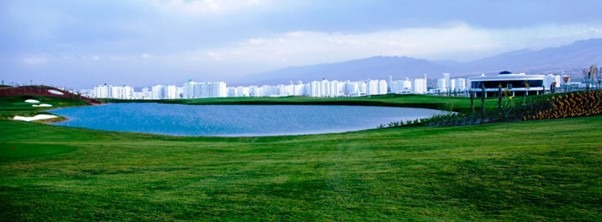
World golf legend and outstanding figure in the field of sports diplomacy, Jack Nicklaus , who has visited our country on numerous occasions, stated during his speech at the opening ceremony of the first golf club in Turkmenistan that: “Turkmenistan has every opportunity to become a world leader in golf!” Jack Nicklaus emphasized that he was “happy to accept the responsibility entrusted to him for the creation of Turkmenistan’s first golf course, as he is convinced that this sport, which can be practiced throughout life at any age, will become popular in the country.” He also emphasized the social and cultural significance of golf, which fosters a spirit of partnership and healthy competition.
As part of the recent visit of the Leader of the Nation to the United States, extended negotiations were held with the management of the Nicklaus company Companies . The topic of discussion was the implementation of projects for the construction of modern golf courses in the city of Arkadag and the Avaza National Tourist Zone .
The diplomatic potential of golf and its elite clubs extends far beyond purely sporting entertainment. In particular, the latest Turkmen-American dialogue on the Atlantic coast of the US state of Florida demonstrates that the “Golf Format” can become part of successful economic and technological cooperation, including investment and infrastructure construction. Specifically, the program of the National Leader of Turkmenistan’s visit to the US focused on developing investment dialogue and deepening partnerships with leading American companies in urban development, sports, agriculture, and horse breeding.
As reported, the economic focus of the visit also included a meeting with Eric Stewart, Executive Director of the Turkmenistan-USA Business Council. The parties confirmed the long-term nature of their partnership with American business giants such as Boeing, General Motors, General Electric, John Deere, CASE and others. During a separate meeting with the president of the John Deere in Central Asia and the CIS, Chaba Leiko focused on further modernization of the technical fleet of the agro-industrial complex of Turkmenistan and the training of qualified personnel for the industry.
The humanitarian and sports agenda was presented by a visit to the equestrian complex “La Victoria.” The National Leader of the Turkmen People studied the American experience of horse breeding and preparation for international show jumping tournaments, proposing to intensify professional exchanges between horse breeders of the two countries. During his stay in the United States, Gurbanguly Berdimuhamedov also met with several prominent politicians and businessmen, including Steve Wynn, Isaac Perlmutter, and William Koch.
As the esteemed national leader of the Turkmen people noted in his interview with Al Arabiya TV, “We clearly see the real opportunities that are now opening up and remain committed to constructive dialogue across all areas. This approach is driven by a mutual understanding of the priorities of the Turkmen -American partnership. We highly value the current level and state of bilateral political cooperation.”
The philosophy of golf is rooted in the idea of a leisurely, yet purposeful and persistent exploration of geographical spaces, the contours of which are intricately reflected in the patterns of the course and the terrain of the golf course. The trajectory of the white ball in the air determines the winding distance of the subsequent walking route, as if demonstrating the measured steps of the ancient trade caravans of the Great Silk Road.
The Respected National Leader notes that Turkmen have historically played a golf-like game called “chilik,” which develops agility, accuracy, and quick reactions, as well as attentiveness, energy, and determination, and imparts physical strength. These folk games, which became increasingly sophisticated and complex over time, gave rise to various sports competitions that have become widespread worldwide. Widely practiced worldwide, golf and the Turkmen game “chilik” have a positive impact on human health. Along with physical conditioning, they help prevent many diseases and strengthen athletic skills. Reputable medical experts confirm the positive impact of golf on increasing life expectancy.
What do golf and a desert caravan have in common? The fact is that the inclusive nature of Turkmenistan’s transport diplomacy envisions effective international partnerships to create comprehensive infrastructure along all major routes, including the historic routes of the Great Silk Road. Within this conceptual vision, Turkmenistan integrates domestic infrastructure into broad international corridors along the East-West and North-South routes.
A compelling example of this is the decision made by the President of Turkmenistan during the government meeting on February 20, 2026, to undertake a large-scale reconstruction of the Ashgabat-Dashoguz Trans-Karakum Highway. As noted, the reconstruction of the Ashgabat-Dashoguz highway, as well as the construction of new bridges along the entire route, meets the goals of modernizing the country’s road construction sector, successfully implementing transit freight and passenger transportation , and elevating international cooperation in this area to a qualitatively new level.
Thus, the symbolic outlines of the winged horse as the main element of Turkmenistan’s national motto for 2026, as well as the patterns of golf courses and golf courses, and the schematic outlines of a vast transportation infrastructure—all of these, taken together, reflect the essence of neutral diplomacy, which facilitates the movement of true partners toward each other.
Dr. Begench Karaev deals with the problems of philosophy of law and politics. He is the author of a number of textbooks and monographs, including “Political analysis and strategic planning”, “Political analysis: problems of theory and methodology: (Experience in the study of modern Central Asian society)” and “Traditional and modern in the political life of Central Asian society (experience of political analysis)”. /// nCa, 24 February 2026